 Lynden
 Birch Bay Sits Right at the Edge of the Weather
Birch Bay is one of the more exposed pockets of Whatcom County when it comes to what the exterior of a house actually has to survive. Homes here sit close enough to the water that salt-laden air is a daily fact of life, not an occasional event. Add in the driving rain that comes off the Strait during fall and winter storms, plus a moss and algae season that runs longer than it does even a few miles inland, and you end up with a building envelope that's under more sustained stress than most siding products were ever designed for.
We work throughout Whatcom County out of Lynden, and Birch Bay is one of the areas where we're the most particular about material choice and installation detail — not because the homes are unusual, but because the environment doesn't forgive shortcuts. A siding job that would hold up fine twenty minutes inland can start showing problems within a few years out here if it's the wrong product or it's installed loose.
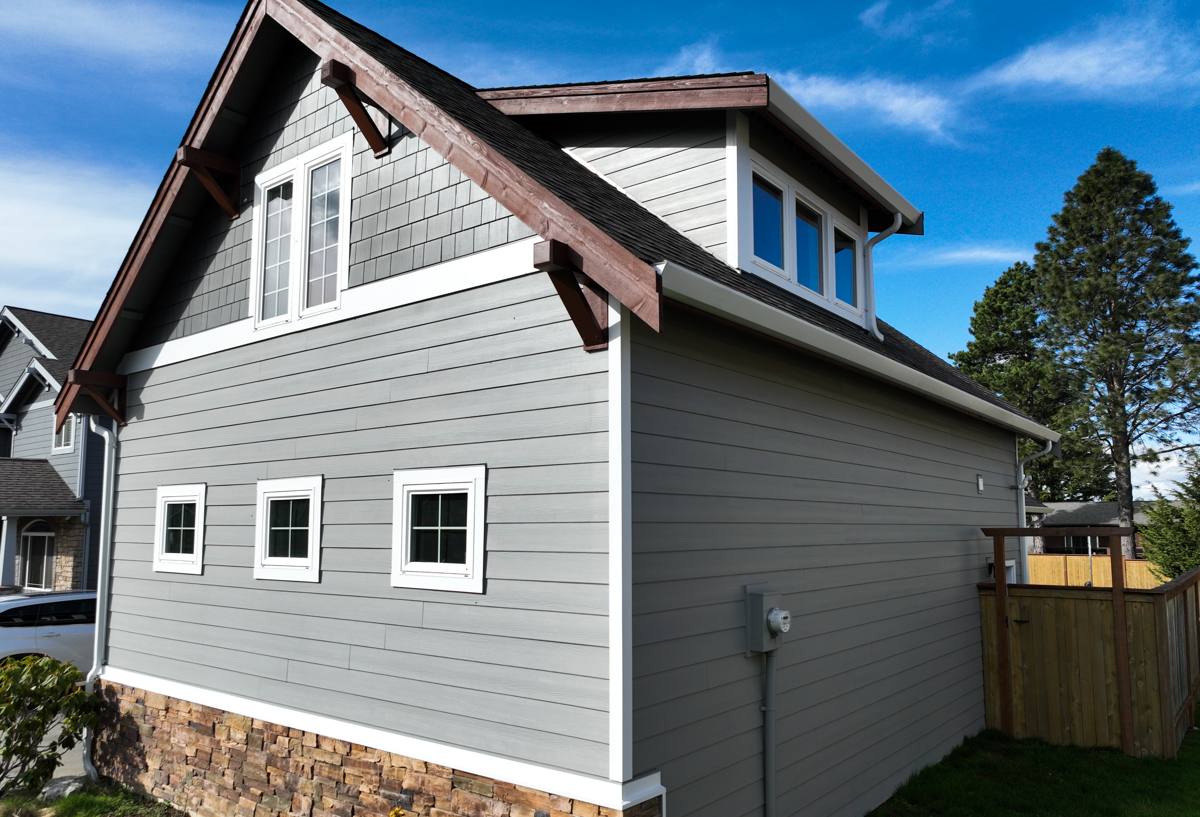
What Salt Air and Coastal Moisture Actually Do to a House
It helps to be specific about the mechanisms, because "salt air is tough on siding" is true but vague. A few things are happening at once on a Birch Bay exterior:
Corrosion of fasteners and metal trim
Airborne salt accelerates corrosion on anything metal — nail heads, flashing, trim, hardware. Once fasteners start to rust and weep, they stain the siding around them and eventually lose their grip. This is one reason fastener spec and flashing detail matter more here than in a typical inland job.
Constant moisture cycling
Coastal fog, driving rain, and high humidity keep exterior surfaces damp for longer stretches than drier inland neighborhoods see. Materials that absorb moisture and swell, or that rely on a paint film to keep water out, are working overtime in this cycle of wet-dry-wet.
Extended moss and algae season
Shaded, damp, north-facing walls in Birch Bay can stay wet enough to support moss and algae growth for most of the year. That's a cosmetic issue at first, but organic growth that's left to sit also holds moisture against the siding surface, which compounds any underlying moisture problem.
Wind-driven rain
Storms coming off the water don't just fall — they push. Wind-driven rain finds gaps in flashing, laps, and trim details that would stay dry in a calmer setting. This is a detailing problem as much as a material problem, and it's where installation quality ends up mattering as much as the product itself.
Why We Install Only James Hardie Fiber Cement
We've made a deliberate decision to install James Hardie fiber cement siding exclusively — not vinyl, not LP SmartSide, not cedar or primed spruce, not other fiber cement brands. That's a stricter standard than most contractors hold, and in a coastal environment like Birch Bay, the reasoning is straightforward.
Fiber cement is non-combustible and dimensionally stable — it doesn't expand, contract, warp, or absorb water the way wood-based products do, which matters directly in a climate that cycles between soaked and dry all winter. James Hardie's ColorPlus finish is baked on at the factory under controlled conditions, which gives it better adhesion and UV resistance than field-applied paint has to offer, and it comes with a warranty that covers the finish separately from the substrate. Hardie also engineers regional product lines (HZ5 for harsher, wetter climates) specifically for the kind of exposure Pacific Northwest coastal homes see.
None of this means other products are unusable everywhere — plenty of siding materials perform fine in moderate, sheltered settings. But we don't install to the lowest common denominator. We install to what holds up in Birch Bay's worst months, and that's the product line we've standardized on across every home we do.
| Factor | Why It Matters in Birch Bay |
|---|---|
| Moisture absorption | Fiber cement resists water intrusion far better than wood-based sidings, reducing swelling and rot risk in a wet coastal cycle |
| Fastener corrosion | Correct stainless or coated fasteners and proper flashing detail matter more here — salt air accelerates rust on the wrong hardware |
| Finish durability | Factory-applied ColorPlus finish holds color and adhesion longer than field-painted surfaces exposed to salt air and UV |
| Moss/algae exposure | Shaded, damp walls need siding that doesn't hold moisture against organic growth — surface prep and drainage detail count |
| Wind-driven rain | Lap, trim, and flashing details need to be tighter than a standard inland install to keep water out under storm pressure |
Siding Installation and Replacement for Birch Bay Homes
Whether we're replacing failing siding or working on new construction, the process starts with an honest look at what's actually happening behind the existing exterior — not just what it looks like from the curb. In a coastal setting, we're checking for:
- Moisture intrusion behind the current siding, especially at seams, corners, and window/door penetrations
- Condition of the water-resistive barrier and flashing underneath
- Fastener corrosion or staining that signals a hardware problem, not just a cosmetic one
- Areas with heavy moss or algae buildup that indicate poor drainage or persistent shade/moisture
- Trim and fascia condition, since these are often the first places coastal weather causes damage
From there, installation follows James Hardie's published specifications for fastener type, spacing, clearances, and flashing — details that get glossed over more often than they should, especially on a home this exposed to wind-driven rain. Correct installation is what actually delivers the performance the product is rated for; a good material installed loosely will still leak.
Roofing, Windows, and Decks — The Rest of the Envelope
Siding doesn't work in isolation. On a Birch Bay home, the roof, windows, and any deck or outdoor structure are all fighting the same salt air and moisture exposure, and problems in one area tend to show up as damage in another — a leaking window can rot the wall cavity behind good siding just as easily as bad siding can.
We handle roofing, window replacement, and deck construction and repair alongside siding, which means we're looking at the whole exterior as one connected system rather than treating each trade as a separate job with separate assumptions. That matters most at the transitions — where roof meets wall, where windows meet siding, where a deck ledger attaches to the house — because those are the spots coastal weather finds first.
Decks in a Salt-Air Environment
Decks facing the water take a particularly hard beating: UV, salt spray, and standing moisture on horizontal surfaces age materials faster than vertical siding ever sees. Fastener choice, ledger flashing, and board spacing for drainage all matter more here, and we build with that exposure in mind rather than treating a Birch Bay deck the same as one built twenty miles inland.
Why a Local Crew Matters Here
Birch Bay isn't generic coastal Pacific Northwest — it has its own microclimate quirks depending on how exposed a given lot is to wind off the water versus tucked back with more tree cover. A crew that works this specific stretch of Whatcom County regularly gets a feel for which walls need extra flashing attention, which lots hold moss year-round, and which details actually fail first out here versus what looks fine on paper.
We're based in Lynden and work Whatcom County day in and day out, which means we're not learning the local conditions on your project. It also means if a warranty question or a follow-up issue comes up down the road, we're a short drive away, not a crew that passed through once.
What Drives the Cost of a Siding Project Here
Every home is different, but a few factors consistently move the price on a Birch Bay siding job:
| Cost Factor | Why It Varies |
|---|---|
| Extent of moisture damage found | Rot repair, sheathing replacement, or reframing behind old siding adds scope beyond a straight re-side |
| Home size and complexity | Cut-up facades with lots of corners, gables, and trim take more labor than a simple rectangular footprint |
| Siding profile and accessories | Lap width, trim style, and accent details (shakes, board-and-batten sections) affect material and labor cost |
| Access and site conditions | Steep lots, limited staging area, or work near the water can affect equipment and scheduling |
| Scope beyond siding | Bundling roofing, window, or deck work with a siding project can be more efficient than separate jobs |
We won't quote a number without seeing the house — anyone who does is guessing — but these are the factors that move estimates up or down from project to project.
Keeping Coastal Siding Performing Long-Term
Fiber cement is low-maintenance compared to wood-based products, but "low-maintenance" isn't "no-maintenance," especially this close to the water. A short annual checklist goes a long way:
- Rinse salt residue and grime off the siding surface once or twice a year, especially on water-facing walls
- Check caulking at trim joints, window and door penetrations, and corners for cracking or gaps
- Watch shaded, north-facing sections for moss or algae buildup and address it before it spreads
- Inspect gutters and downspouts regularly — clogged gutters send water where it shouldn't go, straight down a wall
- Look at fastener heads and trim for early rust staining, which is easier and cheaper to address early than late
Let's Look at Your Home
If you're in Birch Bay and dealing with siding that's showing its age — staining, soft spots, peeling paint, or moss that keeps coming back — we're happy to come take a look and give you a straight assessment of what's actually going on and what it would take to fix it right. There's no pressure and no cost to get an estimate; use the form below to get started.