 Lynden
 Siding Built for Laurel's Corner of Whatcom County
Laurel sits in the quieter, rural stretch of Whatcom County just outside Lynden — the kind of area where homes sit on bigger lots, often with more open exposure to wind and weather than you'd get in a denser subdivision closer to town. That openness is part of what makes Laurel a good place to live. It's also part of what makes exterior materials work harder here than a homeowner might expect.
We're a Lynden-based contractor, and Laurel is inside our regular service radius, not an afterthought. We know the drive, we know the general lay of the land between Lynden and the county's northern reaches, and we know what this climate does to a house over ten, twenty, thirty years. That local familiarity matters more in siding work than most homeowners realize, because so much of what determines whether an exterior lasts comes down to details that have nothing to do with the product box: how the crew flashes a window, how they gap a butt joint, how they think about drainage behind the cladding.
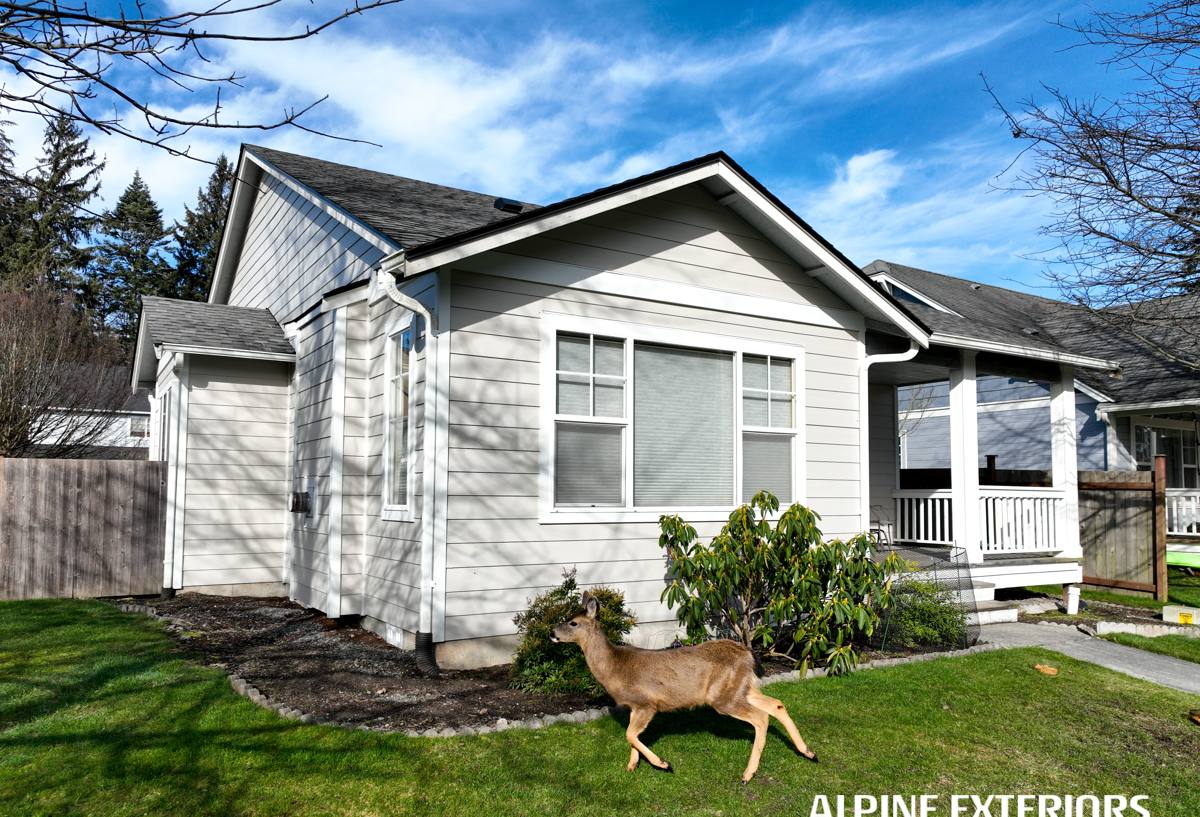
What the Climate Actually Does to a Laurel Home
Whatcom County's exterior conditions aren't dramatic in any single event — there's no hurricane season, no wildfire-driven ember storms most years. The damage here is slower and steadier, which is exactly why it catches homeowners off guard. A house doesn't fail all at once; it degrades a little every winter until the cumulative effect shows up as a costly repair.
Driving Rain and Saturation Cycles
Marine-pattern weather off the Salish Sea and Puget Sound region brings long stretches of steady, wind-driven rain rather than short downpours. That matters for siding because it's not just about how much water hits the wall — it's about how long the wall stays wet and how often it gets a chance to dry out between storms. Materials that absorb moisture and hold it are the ones that eventually swell, delaminate, or rot from the inside out.
Salt Air and Coastal Influence
Whatcom County's proximity to the Salish Sea means a measurable amount of salt-laden air moves inland on prevailing winds, even in communities that aren't waterfront. Salt exposure accelerates corrosion on fasteners and trim, and it can be harder on certain paint and coating systems than homeowners expect from an inland-feeling property.
The Long Moss Season
Shade, moisture, and mild temperatures are a perfect combination for moss and algae growth on north-facing walls, under eaves, and anywhere airflow is limited. Beyond the cosmetic issue, moss holds moisture against the surface it's growing on — which, over years, is a slow but real threat to any material that isn't dimensionally stable when wet.
Temperature Swings and UV
Our summers bring real UV exposure even without extreme heat, and the swing between damp winters and dry summers puts repeated expansion-and-contraction stress on siding, trim, and paint film. Materials and finishes that aren't engineered for that cycle tend to show it first at seams, laps, and fastener points.
Why We Install Only James Hardie Fiber Cement
We made a deliberate decision to install one siding system across every job we take on: James Hardie fiber cement. That's not a brand preference — it's a response to exactly the conditions described above. We don't install LP SmartSide, vinyl, Cemplank, Allura, primed spruce, or cedar, and we're upfront about why.
Each of those products has legitimate uses and reasonable manufacturers behind it. Our objection isn't that any of them is a bad product on paper — it's that, installed on homes in this specific climate, over the long run, they carry trade-offs we're not willing to put our name behind.
- Wood-based engineered siding (like LP SmartSide) uses treated wood strand substrates. The treatment is real, but wood-based products still depend heavily on caulking, flashing, and paint maintenance staying perfect for decades in a climate that never really lets a wall dry out for long. A missed caulk joint or a paint failure gives moisture a path into a material that can swell and deteriorate once compromised.
- Vinyl siding is affordable and low-maintenance in the sense that it doesn't need painting, but it's a thin, flexible plastic product that can crack in cold snaps, warp near heat sources, and fade under UV over time. It also doesn't offer the same fire resistance or resale perception as fiber cement.
- Other fiber cement brands (Cemplank, Allura) use similar core chemistry to Hardie but don't have the same regional manufacturing history, factory-finish track record, or transferable warranty structure in this market. We've standardized on the brand with the deepest local track record and the strongest support behind it.
- Primed spruce and raw cedar are beautiful, traditional materials, but they're field-painted or stained wood, which means the finish is only as good as the maintenance schedule behind it — and in a climate with this much sustained moisture and moss pressure, that maintenance schedule is unforgiving.
James Hardie fiber cement is non-combustible, dimensionally stable when wet, and available in HZ5 formulations engineered for exactly this kind of climate zone. The factory-applied ColorPlus finish is baked on under controlled conditions rather than brushed on-site, which is a meaningful difference in a region where field-applied paint has a lot working against it. Backed by a strong transferable warranty, it's the system we're comfortable standing behind on a Laurel property for the long haul.
How We Approach a Laurel Siding Project
Every property is different, but the process we follow stays consistent because it's built around getting the fundamentals right, not around cutting corners to move faster.
1. On-Site Assessment
We walk the exterior and look at more than just the visible siding condition. We check for signs of moisture intrusion, evaluate existing flashing and trim, look at how the roofline and gutters manage water around the walls, and note any north-facing or shaded areas that are dealing with heavier moss or algae growth.
2. Water Management First
Siding is only as good as what's behind it. We pay close attention to weather-resistive barriers, flashing at windows and doors, and proper drainage planes — the parts of the job that aren't visible once the siding goes up but that determine whether the wall stays dry for the next thirty years.
3. Correct Fastening and Clearances
Hardie's installation instructions are specific about fastener spacing, gapping, and ground clearance for good reason — get them wrong and you introduce the exact moisture pathways the product is designed to resist. We install to manufacturer spec because that's also what keeps the warranty intact.
4. Finish and Detail Work
Trim, caulking at transitions, and touch-up on any field-cut edges are where a lot of installs get sloppy. We treat these as part of the job, not an afterthought, because they're often the first place a marginal install shows its age.
Beyond Siding: The Full Exterior Envelope
Siding doesn't work in isolation — it's one piece of the exterior system that keeps a house dry, and it's most effective when the roof, windows, and other envelope elements are doing their part too. We handle roofing, window replacement, and deck work alongside siding, which means we're looking at the whole picture rather than one component in a vacuum.
| Exterior Component | What Whatcom County Weather Does to It | Why It's Worth Addressing Together |
|---|---|---|
| Roofing | Sustained rain and moss pressure on shaded slopes | A compromised roof edge or valley sends water directly into siding and trim below it |
| Windows | Wind-driven rain testing seals and flashing | Poor window flashing is one of the most common causes of hidden wall damage behind new siding |
| Decks | Freeze-thaw cycling and constant moisture exposure | Ledger board attachment and flashing at the house wall directly affects the siding around it |
| Siding | Moisture cycling, salt air, UV, and moss | The visible layer, but only as durable as what's behind and around it |
When one contractor is coordinating all of it, there's no finger-pointing later about whose scope a leak fell into. That's a real advantage for homeowners in a climate where water intrusion is the underlying threat behind almost every exterior failure.
Why a Local Crew Matters in Laurel
A national roll-up or an out-of-area crew can install siding. What they usually can't offer is the accumulated knowledge of how a specific region's weather behaves — which walls in this area tend to hold moisture longest, what the moss pressure looks like on a shaded north elevation near a tree line, how a Whatcom County winter actually treats a fresh install through its first few storm seasons. We're not learning that on your house; we've already learned it on others nearby.
There's also a practical accountability piece. A local, Lynden-based company is the company you call in year three if something needs a look, not a name on a truck that moved on to the next region months ago.
Cost Factors Homeowners in Laurel Should Understand
Every project prices out differently, but a few factors consistently move the number more than homeowners expect:
| Factor | Why It Affects Cost |
|---|---|
| Extent of existing damage or rot | Hidden sheathing repair adds labor and material before new siding can even go on |
| Home size and wall complexity | More corners, dormers, and trim detail mean more labor hours per square foot |
| Siding profile and accessory selection | Lap width, trim style, and accent choices (shakes, board and batten) vary in material and labor cost |
| Access and site conditions | Steep grades, limited access, or multi-story walls require more scaffolding and time |
| Scope bundled with siding | Combining siding with roofing, window, or deck work can improve overall efficiency and sequencing |
A Homeowner's Maintenance Checklist for This Climate
Whatever siding is currently on a Laurel home, these are worth checking on a regular basis:
- Inspect north- and shade-facing walls annually for moss or algae buildup
- Check caulking at window and door trim for cracking or gaps, especially after a hard winter
- Look for staining or soft spots near ground level and around downspout discharge points
- Confirm gutters are directing water away from siding, not overflowing onto it
- Trim back vegetation and tree cover that's keeping any wall section shaded and damp longer than the rest of the house
- Watch fastener heads and trim edges for early corrosion or paint failure
Catching small issues early is almost always cheaper than waiting for them to become a wall repair.
Get a Straightforward Look at Your Laurel Property
If you're weighing a siding replacement, or you're not sure whether what you're seeing on your walls is cosmetic or something more, we're glad to come take a look. There's no pressure and no obligation — just an honest assessment from a crew that works this area regularly and installs one system because we believe it's the right long-term answer for homes here. Use the form below to request a free estimate.