 Lynden
 Exterior Work Built for Kendall's Corner of Whatcom County
Kendall sits in a part of Whatcom County that gets more weather than people expect who haven't lived here. It's close enough to the water and the foothills that homes take on a mix of problems: salt-tinged air moving in off the Strait and the Sound, driving rain that comes in sideways during the fall and winter storm cycles, and a moss season that can run nine months out of the year if a roof or a north wall never gets direct sun. We've worked on homes throughout the Lynden area, and Kendall properties tend to show a specific pattern of wear that's worth understanding before you decide what to repair, replace, or leave alone.
This page covers what we actually see on Kendall homes, how our siding, roofing, window, and deck work fits the local conditions, and why we standardized on one siding system instead of offering the usual menu of options.
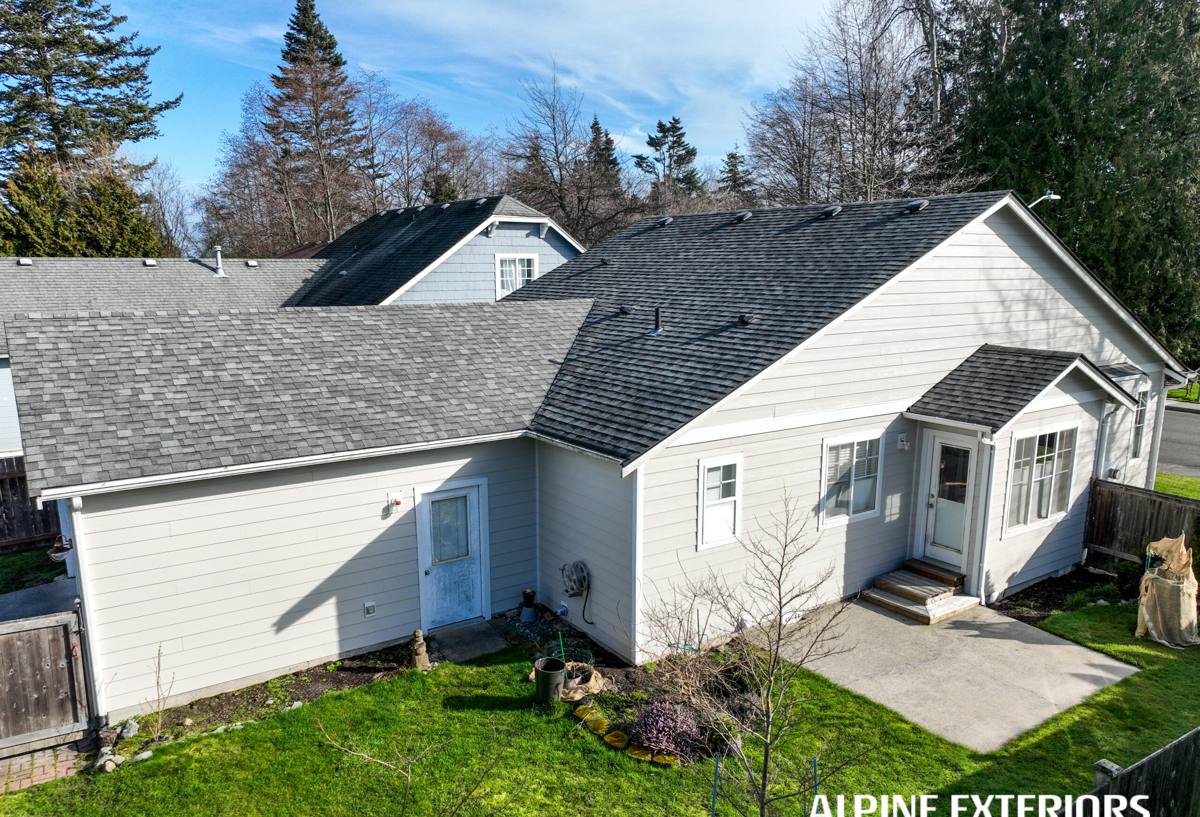
What the Climate Does to a Kendall Home
Salt Air and Slow Corrosion
You don't have to be waterfront to feel the effects of salt air in this part of Washington. Moisture carrying dissolved salt travels inland on wind, and over years it accelerates corrosion on fasteners, flashing, and any exposed metal trim. Siding materials that rely on paint film alone for protection are the first to show it — chalking, fading, and eventually cracking at seams where moisture can get behind the surface. Fastener corrosion is a quieter problem: a nail or screw that rusts inside the wall assembly can eventually let a siding panel work loose, which is often the first sign something's wrong long after the damage has started.
Driving Rain and Wall Assemblies
Whatcom County storms don't just rain down, they rain sideways. Wind-driven rain pushes water horizontally against exterior walls, testing every seam, joint, and penetration in the siding system. A wall assembly that isn't detailed correctly — proper water-resistive barrier, correct lap and overlap, sealed penetrations around windows and vents — will eventually let moisture past the cladding. Once that happens, the damage is usually happening inside the wall cavity before it's visible outside, which is why installation quality matters as much as the material itself.
Moss, Shade, and North-Facing Walls
Kendall has plenty of tree cover and homes tucked against tree lines, which is part of the area's appeal but also part of the maintenance load. North-facing walls and roof planes that don't get much direct sun stay damp longer after every rain, and that's exactly the environment moss and algae need to take hold. On roofing, moss growth under shingles can lift them and create channels for water intrusion. On siding, sustained dampness behind moss or algae growth breaks down paint film faster and can feed rot in materials that aren't moisture-resistant by design.
Siding: Why We Only Install James Hardie
We install James Hardie fiber cement siding exclusively. We don't offer vinyl, LP SmartSide, primed wood, or cedar as options, and that's a deliberate call based on what holds up in this climate over decades, not just the first few years.
Vinyl siding is affordable and low-maintenance in mild climates, but it's a petroleum-based product that can warp in heat, become brittle in cold, and rarely lays flat against a wall the way fiber cement does — gaps behind vinyl panels are exactly where wind-driven rain likes to find a way in. Wood-based products like LP SmartSide use engineered wood strand technology that's genuinely improved over older wood siding, but it's still a wood product at its core, and wood reacts to sustained moisture exposure in ways fiber cement doesn't. Primed spruce and cedar are beautiful and traditional, but they demand a maintenance schedule — recoating, caulking, watching for rot at end grain and seams — that a lot of homeowners don't sign up to keep.
James Hardie fiber cement is a mix of cement, sand, and cellulose fiber. It doesn't warp, it doesn't burn, and it holds paint and factory finish far longer than wood or vinyl because it isn't dimensionally reactive to moisture the way wood is. Hardie's ColorPlus finish is baked on at the factory under controlled conditions, which gives more consistent, longer-lasting color than field-applied paint — a real advantage in a climate where a house gets rained on more months than not.
HZ5 and Climate Engineering
Hardie engineers its product lines by climate zone. The HZ5 line is built for regions with freeze-thaw cycling and sustained moisture exposure — which describes Whatcom County well. That's not a marketing detail; it affects the product's moisture management and durability performance specifically for weather like Kendall gets.
| Material | Moisture Behavior | Maintenance Load | Fire Rating |
|---|---|---|---|
| James Hardie Fiber Cement | Dimensionally stable, resists warping | Low — factory finish holds for years | Non-combustible |
| Vinyl Siding | Can gap or warp with temperature swings | Low, but limited repair options | Combustible, can melt/deform |
| LP SmartSide / Engineered Wood | Better than raw wood, still moisture-sensitive at cut edges | Moderate — edge sealing critical | Combustible |
| Primed Spruce / Cedar | Reactive to moisture; prone to cupping, rot at end grain | High — recoat and caulk cycle | Combustible |
Roofing for a Moss-Prone, Rain-Heavy Area
Roofing in Kendall has to deal with the same driving rain and shade-driven moss growth as the siding does. We look at ventilation, underlayment quality, and flashing detail around every penetration — chimneys, vents, skylights — because that's where roof leaks actually start, far more often than in the open field of shingles. On homes with significant tree cover, we'll talk through moss prevention and roofing material choices that resist growth better in low-sun conditions, since a roof replacement is the wrong time to ignore a problem that will just come back in two years.
Windows: Sealing Out Wind-Driven Rain
Window replacement in this area is as much about the installation as the window itself. A high-quality window installed with poor flashing and sealant work will leak in a Whatcom County windstorm regardless of its energy rating. We flash and seal window openings to shed water outward, integrate properly with the wall's water-resistive barrier, and use materials suited to the temperature swings we get here. For Kendall homes especially, we also talk with homeowners about where trees and shade affect a window's exposure to prolonged dampness versus wind-driven rain, since the failure points aren't identical.
Decks: Built to Handle Standing Moisture
A deck in Kendall spends a lot of the year wet, and shaded decks under tree canopy dry out slower than ones in the open. That changes what matters in construction: proper spacing between boards for drainage and airflow, ledger board flashing that actually sheds water away from the house rather than trapping it, and fastener choices that won't corrode over time in a damp, salt-tinged environment. We build and repair decks with that reality in mind rather than defaulting to whatever's cheapest at the lumber yard.
Why a Local Crew Matters Here
Weather patterns in Whatcom County aren't uniform even within a few miles. A crew that mainly works drier climates east of the mountains, or one that treats every job the same regardless of tree cover, sun exposure, and proximity to water, will miss details that matter on a Kendall property specifically — how much shade a wall gets, which direction the prevailing storms hit from, whether moss has already gotten a foothold on the north side. We work this area regularly enough to know what to look for before we ever open a wall or pull a shingle, and that shows up in fewer surprises during the job and fewer callbacks after it.
What to Check Before You Hire
- Ask whether the crew is familiar with the specific microclimate of your property — shade, wind exposure, and proximity to water all matter
- Confirm what siding, roofing, and flashing materials are proposed and why, not just a price
- Ask how window and door openings will be flashed and sealed, not just what brand of window is being installed
- Check for licensing, bonding, and insurance, and ask for proof rather than taking it on faith
- Ask what the manufacturer's warranty actually covers versus what's covered by workmanship warranty
- Get a clear, written scope of work before any contract is signed
Planning a Project on a Kendall Home
Whether you're dealing with siding that's showing its age, a roof that's holding moss no matter how often you clean it, windows that let in drafts and water during storms, or a deck that's starting to feel soft underfoot, the starting point is the same: an honest look at what's actually happening to the structure, not just what's visible from the driveway. We'll walk the property, explain what we find, and lay out options without pushing a sale you don't need.
If you'd like a straightforward, no-pressure estimate on siding, roofing, windows, or decks for your Kendall home, use the form below and we'll get in touch to schedule a time to take a look.