 Lynden
 Exterior Work Built for Acme's Corner of Whatcom County
Acme is a quieter stretch of Whatcom County, and homes out here take a different kind of beating than a house tucked into a subdivision. Tree cover means more shade and more moisture sitting on siding longer after a storm passes. Rural lots mean wider exposure to wind-driven rain with fewer neighboring structures to break it up. And like most of Whatcom County, the humidity that rolls in off the Pacific doesn't stay at the coast — it settles into every low-lying yard and north-facing wall in the county, Acme included.
We're a Lynden-based siding, roofing, window, and deck contractor, and Acme is inside our regular service area, not a stretch assignment. That matters more than it sounds like it should. A crew that works this part of the county every week knows which wall orientations grow moss first, which trim details fail early under constant damp, and which fixes are quick versus which are corner-cuts that come back to bite a homeowner in five years.
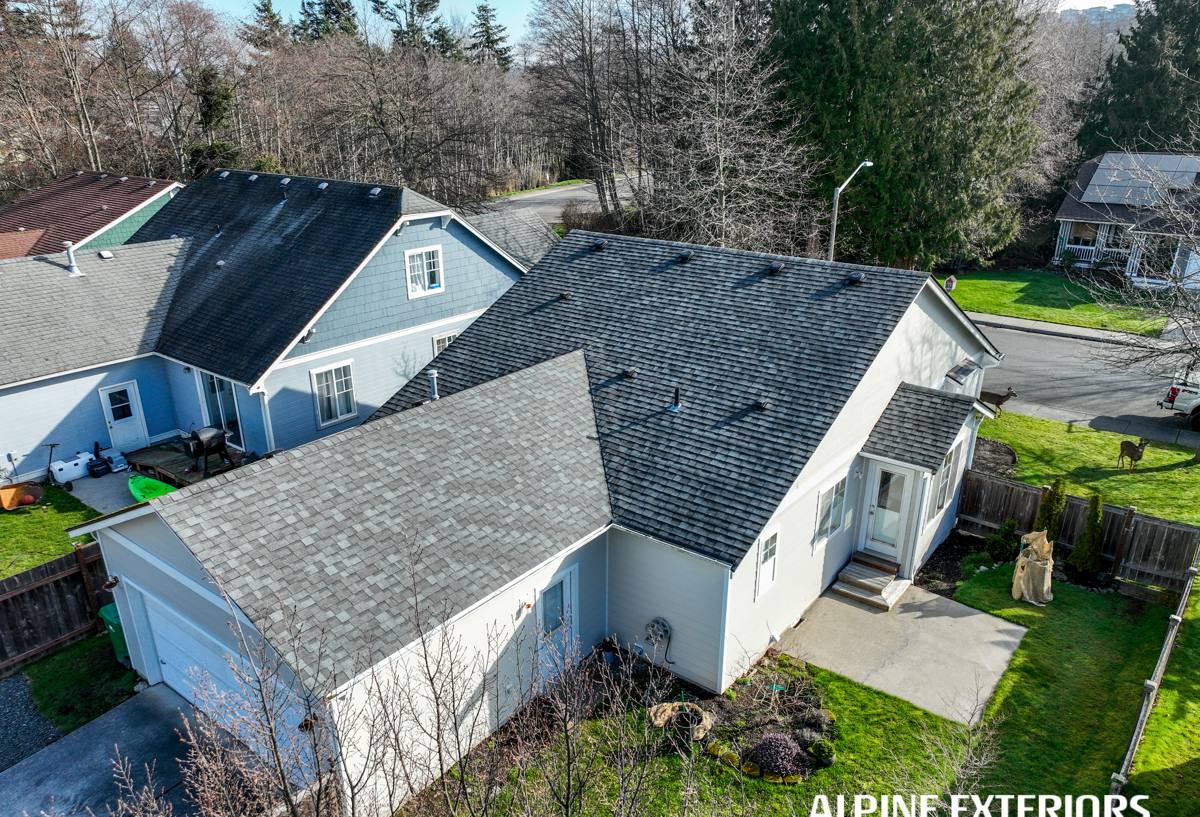
What the Local Climate Actually Does to a House
The regional climate here isn't dramatic — it's relentless. Salt-laden air moving inland, driving rain that doesn't just fall but gets pushed sideways into wall assemblies, and a moss season that can stretch from fall through spring. None of that shows up as one big failure. It shows up as a slow accumulation of small problems that add up to a siding or roof replacement arriving years earlier than it should have.
Moisture Is the Root of Almost Everything
Wood-based siding products absorb moisture at cut edges, fastener holes, and butt joints. Once moisture gets behind the surface layer, it doesn't just sit there — it swells the substrate, and that swelling is what cracks paint, lifts caulk lines, and eventually rots the material from the inside out. In a climate where the siding rarely gets a long, uninterrupted dry stretch to fully release that moisture, the cycle repeats faster than it would in a drier region.
Moss and Organic Growth
Shaded, damp surfaces are exactly what moss and algae need to take hold. On roofing, moss lifts shingle edges and holds water against the roof deck. On siding, especially anything with a porous or wood-grain surface, organic growth holds moisture right against the material and accelerates decay. Cleaning it off helps, but it's a maintenance treadmill unless the underlying material resists the growth in the first place.
Wind-Driven Rain and Exposure
Rural and semi-rural properties often have more open exposure than in-town lots — fewer windbreaks, more direct hit from storms moving through. That means seams, flashing, and joints have to be detailed correctly the first time, because there's less margin for a sloppy install to go unnoticed before it leaks.
Why We Only Install James Hardie Fiber Cement
We get asked fairly often why we don't offer vinyl, LP SmartSide, cedar, or other fiber cement brands like Cemplank or Allura. It's a fair question, and the honest answer is that we made a standard for ourselves based on what holds up in this specific climate, not on what's cheapest to install or easiest to sell.
The Trade-Offs We Won't Sign Off On
- Wood-based siding (LP SmartSide, primed spruce, cedar): These are engineered or natural wood products, and wood absorbs moisture. In a climate with this much sustained damp and moss pressure, cut edges and fastener points are chronic weak spots unless maintenance is kept up religiously.
- Vinyl siding: It's low-maintenance and inexpensive, but it's a thin plastic panel that can warp in heat, crack in cold, and simply doesn't hold color or rigidity the way a fiber cement panel does over a 20-30 year span.
- Other fiber cement brands (Cemplank, Allura): These are legitimate fiber cement products, and we're not here to trash them. Our decision comes down to James Hardie's regional engineering, factory finish process, and the depth of their installer network and warranty backing in this part of the country.
What Hardie Gets Right for This Climate
James Hardie fiber cement is non-combustible, dimensionally stable, and engineered in climate-specific product lines — the HZ5 line used in this region is formulated for the freeze-thaw and moisture cycles typical of the Pacific Northwest. The ColorPlus factory finish is baked on under controlled conditions, which means better fade and moisture resistance than field-applied paint, and touch-up product is available to match it for years after install. It doesn't feed moss the way a wood-grain organic surface can, and it won't rot from the inside the way wood-based products can if a seam ever fails.
Siding, Roofing, Windows, and Decks — One Crew, One Standard
Most homes don't fail in one place. A roof that's shedding water poorly puts extra load on the siding below it. Old windows with failed seals let moisture into wall cavities from the inside. A deck attached to the house without proper flashing can rot the ledger board and the siding around it. We handle all four because they're connected systems, not separate line items.
Siding
James Hardie lap siding, panel siding, and trim, installed to the manufacturer's specifications for this climate zone — correct fastening, proper clearances, and flashing details at every penetration.
Roofing
Roof systems that are detailed for heavy, sustained rain and moss exposure, with attention to underlayment, flashing, and ventilation — a roof that breathes properly sheds moisture faster and resists moss longer.
Windows
Replacement windows installed with correct flashing integration into the siding system, since a window that's sealed wrong is one of the most common sources of hidden wall rot.
Decks
Decks built and flashed correctly where they meet the house, so the connection point doesn't become the weak link in the whole exterior.
Comparing Siding Options for an Acme Home
| Material | Moisture Behavior | Maintenance | Typical Lifespan | Fire Rating |
|---|---|---|---|---|
| James Hardie Fiber Cement | Engineered for moisture cycling; doesn't rot | Low — occasional wash | 30+ years | Non-combustible |
| Vinyl | Doesn't absorb, but can warp/crack | Low | 15-25 years | Combustible |
| LP SmartSide / Engineered Wood | Absorbs at edges/fasteners if not maintained | Moderate — recaulk, repaint cycle | 15-25 years | Combustible |
| Cedar | Absorbs moisture, prone to organic growth | High — regular sealing/staining | 20-30 years with upkeep | Combustible |
Lifespan ranges are general and depend heavily on installation quality, sun/shade exposure, and how consistently a homeowner keeps up with maintenance. A poorly installed Hardie job can underperform a well-installed alternative — installation quality matters as much as the material itself.
What Correct Installation Actually Involves
Fiber cement siding is only as good as the install behind it. The manufacturer's instructions cover fastener spacing, clearance from grade and roof lines, joint treatment, and flashing at every window, door, and penetration. Skipping these details is the single biggest reason any siding product — Hardie included — fails early. When we quote a job, the install detail is the actual product; the panels themselves are a commodity anyone can order.
Signs an Older Installation Was Done Wrong
- Siding installed tight to the ground or roof line with no clearance gap
- Caulk used as a substitute for proper flashing at trim and window returns
- Face-nailing at the wrong spacing or into the wrong substrate
- No visible kick-out flashing where roof lines meet siding walls
- Butt joints with no back-flashing behind them
Hiring a Contractor in Whatcom County: What to Actually Check
Whatcom County has plenty of contractors who'll quote a siding job. Not all of them are set up to install fiber cement to spec, and not all of them will still be around to honor a warranty claim in ten years.
- Washington contractor license number, active and in good standing
- Manufacturer training or certification specific to fiber cement installation
- Proof of liability insurance and workers' comp coverage
- A written scope that names clearance, flashing, and fastening details — not just "install siding"
- A local track record you can ask about, not just a franchise name on a truck
Planning Timeline and What to Expect
Exterior projects in this region are weather-dependent. Dry-window scheduling matters for siding and roofing work especially, since panels and underlayment need to go on and get sealed before the next rain system moves through. A local crew that works this area regularly has a better read on realistic scheduling windows than an out-of-area company bidding jobs across three counties.
If you're weighing siding, roofing, window, or deck work on an Acme property, we're glad to take a look and give you a straight, no-pressure estimate — what your home actually needs, what it doesn't, and what it would cost to do right.