 Lynden
 A Cross-Border Neighborhood We Know Well
Aldergrove, BC sits just minutes from Lynden, Washington, connected by one of the few border crossings in this stretch of the Pacific Northwest. Homes on the Canadian side of that line face the same weather patterns as homes on ours — the same wet winters, the same marine air pushing inland off the Salish Sea, the same long gray stretch from November through April. We've built our business around Whatcom County and the towns that border it, and Aldergrove has always been a natural part of that service area. A short drive across the line doesn't change how a house should be built to survive here.
Working across the border does mean paying attention to details that purely local contractors sometimes overlook — material availability, scheduling around crossing times, and making sure paperwork and warranties are handled cleanly regardless of which side of the line a homeowner lives on. That's part of the job, and we treat it as routine.
What This Climate Does to a House
Aldergrove and Lynden both sit in the lower Fraser Valley and Nooksack watershed, an area where moist air moves in off the water and gets funneled inland by the surrounding terrain. That air carries salt-laden moisture, and combined with driving rain that can come sideways during winter storms, exterior surfaces here take a beating that drier regions never see. Add a moss season that can run eight months or longer on north-facing walls and shaded rooflines, and you have a climate that actively works to break down whatever is nailed to the outside of a house.
The Damage Pattern We See Most
On siding, the failures we're called out for follow a pattern: swelling and delamination at butt joints and corners where water gets behind the material, paint failure on south and west exposures from UV and moisture cycling, and moss or algae staining on shaded elevations that never fully dry out between rains. None of this is unique to any one product — it's what happens to any exterior material that isn't engineered for this specific combination of rain volume, humidity, and biological growth.
Why We Only Install James Hardie Fiber Cement
We made a decision years ago to stop installing anything other than James Hardie fiber cement siding, and we stand behind that decision on every job, including the ones we do in Aldergrove. It's not that other products don't have a place in the market — it's that we don't think they hold up well enough in this specific climate to put our name on the installation.
What We Won't Install, and Why
- Vinyl siding expands and contracts significantly with temperature swings, can crack in cold snaps, and offers little defense against wind-driven rain finding its way behind panels over time.
- LP SmartSide and other engineered wood products use wood strand cores that, once moisture gets past a compromised seam or fastener point, can swell and deteriorate faster than fiber cement in a climate this wet.
- Cemplank, Allura, and other fiber cement alternatives may look similar to Hardie on a spec sheet, but we've standardized on one manufacturer, one factory finish system, and one warranty structure so we can guarantee consistent performance and hold ourselves accountable to a single standard.
- Primed spruce and cedar require an ongoing maintenance commitment — refinishing, caulking, and moisture monitoring — that most homeowners underestimate until the wood is already compromised.
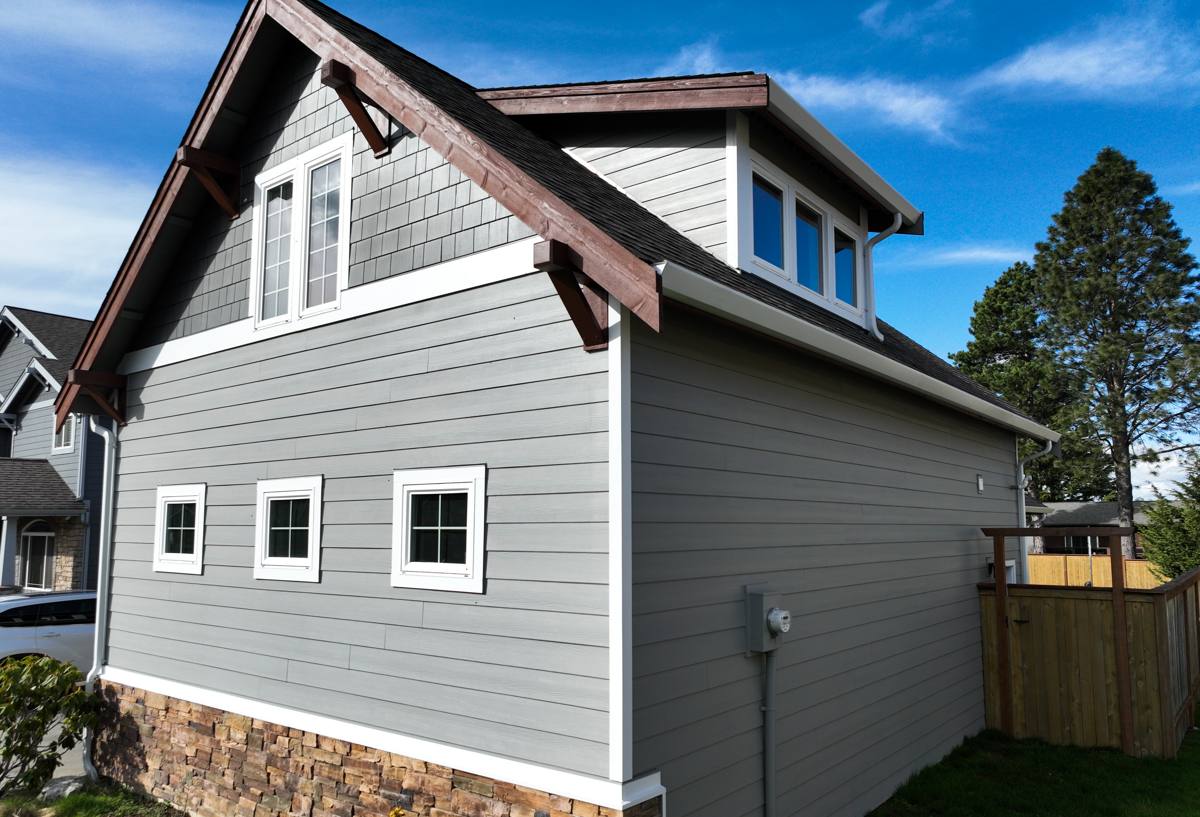
James Hardie fiber cement is non-combustible, dimensionally stable, and factory-finished with ColorPlus technology, which means the color coat is baked on before the boards ever reach the jobsite rather than painted on-site. It doesn't feed moss the way wood-based products can, it doesn't warp with humidity swings, and Hardie's HZ10 product line is specifically engineered for climates like ours — cold, wet winters with heavy moisture exposure. That's the product we put on homes in Aldergrove, and it's the only one we install anywhere.
Full Exterior Envelope: Roofing, Windows, and Decks
Siding is only one part of keeping water out of a house. We also handle roofing, window replacement, and deck construction, because these systems all interact — a roof that sheds water poorly will overload gutters and flashing that then dump water onto siding, and a deck built without proper ledger flashing will rot the wall behind it regardless of what siding is on the house.
How the Systems Work Together
When we look at a home in Aldergrove, we're checking roof condition and moss buildup, gutter capacity for the rain volumes this region sees, window flashing and seal integrity, and any deck ledger connections where a structure meets the house. Addressing siding without checking these connected systems is how homeowners end up with a beautiful new wall that still leaks two years later because the real water source was never fixed.
What Correct Installation Actually Involves
Fiber cement siding performs exactly as well as its installation. Hardie's own warranty documentation is specific about fastener spacing, clearances, and flashing details, and skipping those steps is the single biggest reason any siding product fails early in a wet climate.
Non-Negotiables on Every Job
- A drainage plane behind the siding — typically a weather-resistive barrier plus furring or a rain screen gap — so any water that gets past the cladding has somewhere to go.
- Proper clearance between siding and grade, decks, and roof lines to prevent constant wicking of moisture into the bottom edge of boards.
- Correctly flashed and caulked penetrations at every window, vent, and utility line.
- Fastener placement and spacing that matches Hardie's published installation instructions, not shortcuts to save labor time.
This level of care is what separates a Hardie installation that lasts decades from one that runs into problems in five years — and it's also what determines whether the manufacturer's warranty actually holds if something does go wrong.
Cost Factors to Expect
Every home is different, but the variables that move a project's price are consistent. The table below covers the main factors we walk homeowners through during an estimate.
| Factor | Why It Matters |
|---|---|
| Home size and wall complexity | More corners, gables, and dormers mean more cutting, flashing, and labor time |
| Existing siding removal | Tear-off and disposal of old material adds time versus installing over a properly prepped surface |
| Siding profile chosen | Lap, shingle, and panel styles vary in material and installation cost |
| Underlying moisture damage | Rotted sheathing found once old siding comes off needs repair before new siding goes on |
| Trim and accessory work | Fascia, soffit, and trim replacement alongside siding affects total scope |
We give straightforward, itemized estimates so homeowners can see exactly what's driving the number, rather than a single lump sum that's hard to evaluate.
Choosing a Contractor for Cross-Border Work
Hiring across the border adds a few practical questions worth asking any contractor, whether it's us or someone else you're considering.
Questions Worth Asking
- Are they familiar with the specific weather exposure of your lot — sun, wind, and shade patterns matter as much as the general region.
- Do they install one siding system consistently, or do they switch products based on what's cheapest for a given job?
- Can they explain their flashing and drainage plane approach in plain terms, not just brand names?
- Do they carry proper insurance and offer a warranty that covers both materials and workmanship?
- Will they put the project timeline and scope in writing before work starts?
A crew that's done this work repeatedly in this exact climate — Lynden, Aldergrove, and the surrounding Fraser Valley and Whatcom County towns — will have answers ready without hesitation.
Maintaining Your Siding Once It's Installed
Fiber cement needs far less upkeep than wood or vinyl, but "low maintenance" doesn't mean "no maintenance." A short annual routine keeps siding performing the way it's designed to.
- Rinse siding once or twice a year to remove pollen, dust, and early moss growth, especially on shaded north-facing walls.
- Check caulking around windows, doors, and trim annually and re-caulk any cracked or separated joints.
- Keep gutters clear so overflow doesn't run down the face of the siding repeatedly.
- Trim back landscaping and tree branches that keep a wall section damp and shaded.
- Watch for any soft spots, staining, or paint failure and address them early rather than waiting.
If you own a home in Aldergrove and want an honest look at how your siding, roof, windows, or deck are holding up against this climate, we're happy to walk the property with you. Estimates are free, there's no pressure, and you'll get a straight answer about what actually needs attention — just fill out the form below to get started.