 Lynden
 A Local Crew That Already Knows This Weather
Abbotsford sits close enough to Lynden that our crews are often working on one side of the border in the morning and the other by afternoon. That matters more than it sounds like it should. The exterior of a home in the Fraser Valley has to survive the same long, wet winters, the same moss-friendly shade pockets, and the same wind-driven rain that we deal with every day on our own jobs a few miles south. We are not a big regional company sending a crew that has never worked this climate before. We are a Lynden-based team that treats Abbotsford as part of our home territory, not an out-of-town job.
That local familiarity shows up in small but real ways: knowing which sides of a house take the worst weather exposure, knowing how the moisture in this valley behaves differently than it does further inland, and knowing what actually fails first on a house exterior around here versus what just looks bad.
What This Climate Does to a House Over Time
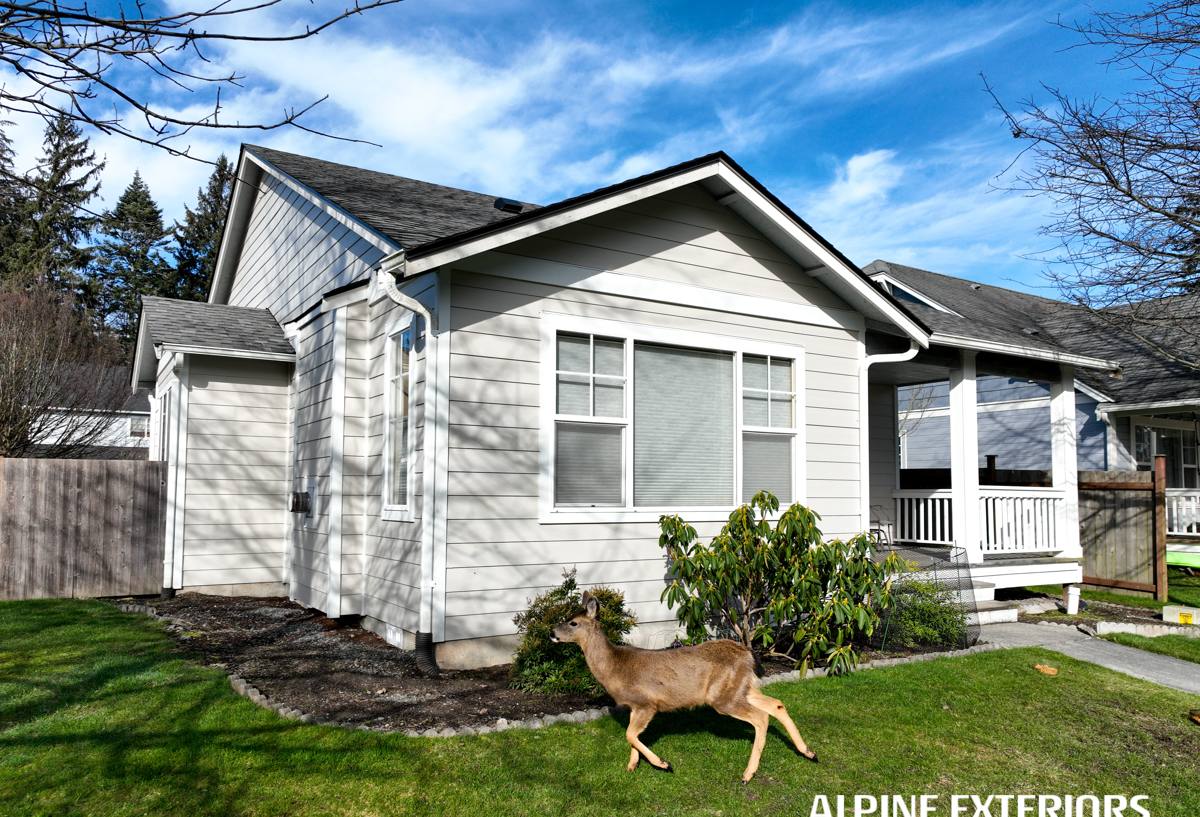
Homes throughout the Whatcom County and Fraser Valley area face a specific combination of stresses: persistent damp air moving in off the Salish Sea and surrounding waterways, driving rain that gets pushed sideways into wall assemblies during winter storms, and a moss and algae season that can stretch for most of the year on shaded or north-facing exteriors. None of these are dramatic, one-time events. They are slow, repeated cycles that work on a building envelope year after year.
Where the Damage Actually Starts
It is rarely the open, sun-exposed wall that fails first. It is usually the north side, the side shaded by mature trees, the area behind shrubs planted too close to the foundation, or the lower courses of siding that stay damp longer after every rain. Salt-laden air compounds this by accelerating corrosion on fasteners, flashing, and any metal components that were not properly rated for coastal exposure. Over time this shows up as soft spots, bubbling paint, swelling at seams, and the kind of moss growth that holds moisture against the wall instead of letting it shed.
Why Moss Is More Than Cosmetic
A lot of homeowners treat moss as a cleaning problem. It is really a moisture-retention problem. Moss holds water against whatever it is growing on, keeps that surface wetter for longer, and creates a steady microclimate that is hard on paint, caulking, and the substrate underneath. On products that are not dimensionally stable in moisture, that constant damp cycle is often what starts the clock on swelling, delamination, or rot — long before the moss itself is even visible from the street.
Why We Standardized on James Hardie Fiber Cement
We install James Hardie siding exclusively. We do not install vinyl, LP SmartSide, Cemplank, Allura, primed spruce, or cedar, and that is a deliberate standard, not an oversight. Fiber cement from James Hardie is non-combustible, dimensionally stable in the kind of moisture cycling this region sees, and finished at the factory with ColorPlus technology rather than relying entirely on field-applied paint that has to hold up against driving rain from day one.
What We Chose Not to Install, and Why
| Material | Where it falls short in this climate |
|---|---|
| Vinyl siding | Can warp or distort with heat and cold cycling, and seams give moisture a path behind the cladding over time |
| LP SmartSide (engineered wood) | Wood-based substrate is more sensitive to sustained dampness at cut edges and seams than fiber cement |
| Cedar | Handsome, but demands ongoing sealing and refinishing to resist the moss and moisture cycle here |
| Primed spruce / raw wood panel | Field priming is only as good as the crew and the weather window it was installed in |
| Cemplank / Allura (other fiber cement brands) | We stayed with one manufacturer's engineered product line and warranty structure rather than mixing brands |
None of these are bad products in every situation. Vinyl is inexpensive and low-maintenance in mild climates. Cedar is genuinely beautiful. But we install exteriors that have to perform through Fraser Valley winters for decades, and we would rather stand behind one system we trust completely than offer several we would have reservations about.
The HZ5 Product Line
James Hardie engineers its siding in climate-specific formulations called HZ zones. The HZ5 line is built for colder, wetter regions like ours, with a formulation designed around freeze-thaw cycling and sustained moisture exposure rather than a generic, one-size-fits-all product. That is a meaningful difference from a manufacturer that sells the same board nationwide.
Siding Is Only Part of the Envelope
A house exterior fails as a system, not as isolated parts. That is why we treat siding, roofing, windows, and decks as connected work rather than separate trades that happen to share a job site.
Roofing
A roof that is shedding water improperly, or losing granules and moss-choked valleys, sends extra moisture down the wall plane exactly where siding is least able to dry out. We look at roof condition on every siding estimate for that reason.
Windows
Old or failing window flashing is one of the most common hidden moisture entry points we find when we open up a wall during a siding replacement. Addressing windows at the same time as siding avoids paying for access twice.
Decks
Ledger boards and deck attachment points are a frequent source of water intrusion into the wall assembly, especially on older homes where the flashing detail was never done to current standards. We check this as part of any full exterior scope.
What a Siding Project Looks Like With Us
- Free, no-pressure on-site estimate and visual inspection of siding, trim, flashing, and any obvious moisture damage
- Written scope covering tear-off, any needed sheathing or moisture barrier repair, and the specific James Hardie products proposed
- Installation to James Hardie's published fastening, clearance, and flashing specifications — not shortcuts that void the warranty
- Final walkthrough and warranty paperwork registered in the homeowner's name
Questions Worth Asking Any Contractor Before You Hire
- Are you installing to the manufacturer's written specification, or a modified version of it?
- Who is responsible if the installation itself has a problem, versus a manufacturer material defect?
- Do you carry current liability insurance and workers' compensation coverage?
- Will you put the full scope of work, materials, and clearances in writing before starting?
- How do you handle moisture or rot discovered once the old siding comes off?
Cross-Border Logistics, Handled Simply
Serving Abbotsford from a Lynden base means a bit of extra coordination — material delivery timing, scheduling around border crossing hours, and making sure paperwork and payment are straightforward for a Canadian homeowner working with a US-based crew. We handle that coordination as a normal part of doing business in this area rather than treating it as unusual. If you have specific questions about permitting or process on the BC side of a project, we would rather answer them plainly during the estimate than make promises we cannot back up.
Cost Factors Homeowners Should Understand
| Factor | Why it moves the price |
|---|---|
| Existing wall condition | Rot or sheathing damage found at tear-off adds repair scope beyond the original estimate |
| Home size and complexity | More corners, gables, and trim detail means more labor per square foot of coverage |
| Product line and color | ColorPlus factory finishes and certain Hardie profiles carry different material costs |
| Access and site conditions | Tight lots, second-story work, or landscaping that must be protected all affect labor time |
| Combined scope | Bundling siding with roofing, window, or deck work can reduce total mobilization and access costs |
We do not quote firm numbers without seeing the house. Broad ranges vary too much house to house to be useful, and we would rather give an honest, specific number after a walkthrough than a broad figure that does not hold up once the tear-off starts.
Why Local Matters More Than It Seems
Any crew can install siding on a dry, mild day. The real test is how the work holds up through a wet Fraser Valley winter, and that comes down to details a crew only gets right when they have done it repeatedly in this exact climate: flashing laps oriented the right direction for our prevailing storm patterns, fastener spacing that accounts for real moisture cycling rather than a manufacturer's minimum, and clearances at grade and decking that actually keep water moving away from the wall instead of trapping it. That is the standard we hold ourselves to on every Abbotsford project, the same as we do at home in Lynden.
If you are weighing a siding, roofing, window, or deck project on a home in Abbotsford, we are glad to come take a look. The estimate is free, there is no pressure to move forward, and you will get a straight answer about what your house actually needs.