 Lynden
 Siding That Has to Work in This Climate, Not Just Look Good on Day One
Abbotsford, BC sits just a few minutes north of Lynden across the border, and the two towns share almost the same weather story: marine air pushed in off the Pacific, long wet winters, and a growing season that never fully lets the ground dry out. That combination is hard on exterior building materials in specific, predictable ways. Homeowners in this stretch of the Fraser Valley and Whatcom County deal with salt-tinged air, driving rain that comes in sideways during winter storms, and a moss season that can run eight months or longer on north-facing walls and anything shaded by trees or fences.
Siding that isn't engineered for this environment shows it fast — not necessarily with dramatic failure, but with the slow stuff: swelling seams, chalky or peeling paint, soft spots at the bottom courses, and a green-black film that keeps coming back no matter how many times it's pressure washed off. This page is about what actually holds up on Abbotsford-area homes, what a correct fiber cement install looks like, and why we standardized on one product line instead of offering a menu of options.
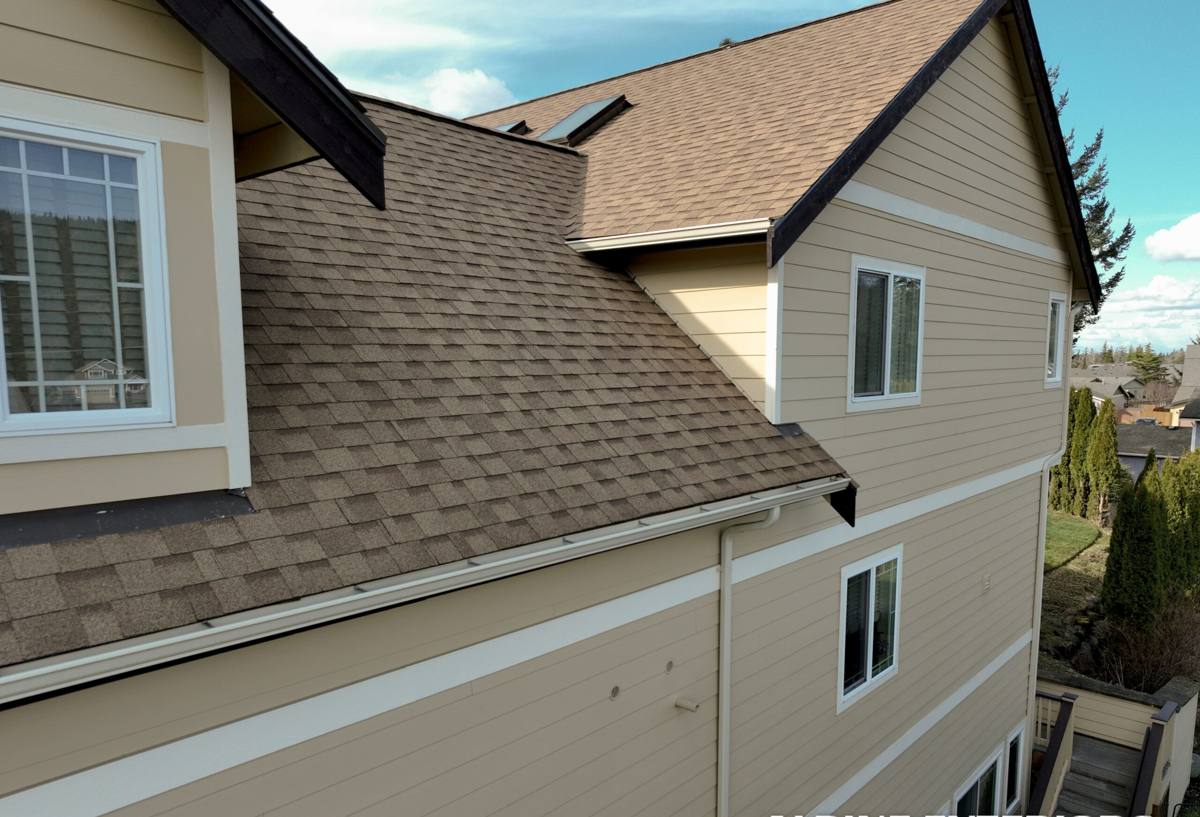
What Salt Air, Driving Rain, and Moss Actually Do to Siding
Salt Air
You don't have to be on the waterfront to feel salt air's effects here — coastal moisture carries inland on wind patterns common to this part of the Pacific Northwest. Salt-laden air accelerates corrosion on fasteners, flashing, and any exposed metal trim, and it breaks down cheaper paint films faster than a dry inland climate would. Siding materials that rely on a factory coating to keep moisture out need that coating to actually resist salt exposure, not just rain.
Driving Rain
Wind-driven rain doesn't just fall on a wall — it gets pushed into every seam, lap joint, and fastener hole that isn't properly detailed. Over years, a house with poor flashing or the wrong caulk in the wrong places will show water intrusion at window heads, butt joints, and inside corners long before the siding "looks" like it's failing. This is a detailing problem as much as a materials problem, and it's where a lot of installations go wrong even when the siding product itself is a good one.
The Long Moss Season
Moss and algae need moisture, shade, and time — and Abbotsford-area properties, with mature trees, fencing, and long damp stretches from fall through spring, provide all three. Moss doesn't just sit on top of siding; given enough time it holds moisture against the surface, which is what actually damages wood-based products underneath. Any siding material that can't shed moisture and resist organic growth on its factory finish is fighting an uphill battle here.
What a Correct Fiber Cement Installation Involves
Fiber cement siding is only as good as the assembly behind it. On every job we treat the siding as one layer of a full water-management system, not a standalone finish.
Drainage Behind the Siding
A proper rainscreen or drainage gap lets any water that gets past the siding drain out and lets the wall assembly dry. This matters more in a climate with as much sustained rain as this one — a wall that can't dry between storms stays wet longer, and wet sheathing is where rot starts.
Flashing at Every Penetration
Windows, doors, deck ledgers, hose bibs, light fixtures — every penetration through the siding is a potential entry point for driving rain. Correct head, sill, and kick-out flashing, installed in the right order relative to the water-resistive barrier, is what actually keeps water out. Caulk is a backup, not the primary defense.
Fastening and Clearances
Fiber cement has specific fastener spacing, embedment depth, and clearance requirements from grade, roofing, and horizontal surfaces. Nailing it like a generic panel product, or tight to grade where splashback and standing moisture collect, shortens its life regardless of how good the material is.
Joint Treatment
Butt joints and seams need to be treated to shed water, not just butted and caulked. Where trim and siding meet, the gap and sealant choice both matter for long-term performance in a climate this wet.
Why We Install Only James Hardie Fiber Cement
We don't offer a lineup of siding brands to choose from. We install James Hardie, full stop, and we think that's worth explaining rather than just stating.
Hardie's fiber cement is engineered specifically for regional climate zones — its HZ5 line is built for the wetter, more moderate coastal climates that cover this exact area, with a formulation and factory finish designed to resist moisture absorption and hold color longer under sustained damp conditions. The ColorPlus factory finish is baked on under controlled conditions, which gives it better long-term color retention and adhesion than field-applied paint, and that matters directly for the salt-air fading and moss staining we see on homes here. Fiber cement itself is non-combustible, doesn't attract insects, and doesn't swell or rot the way wood-based sidings can when they take on moisture.
We looked at the alternatives homeowners ask about — vinyl, LP SmartSide engineered wood, cedar, other fiber cement brands like Allura or Cemplank — and each one asks a homeowner to accept a trade-off we're not willing to install and then walk away from. Vinyl can warp and fade, and it doesn't offer the impact resistance or paintable, wood-like appearance many homeowners want. Engineered wood products use wood fiber with a resin binder, which means moisture management at cut edges and joints is unforgiving — get it wrong once and water intrusion can compromise the panel from the inside out. Cedar and primed spruce look great initially but require an ongoing maintenance commitment — restaining, recaulking, and repainting on a cycle — that most homeowners underestimate until they're several years in. Other fiber cement brands may perform reasonably, but Hardie's specific climate engineering, factory finish process, and transferable warranty structure are what we've chosen to stand behind on every home we side.
| Material | Moisture/Rain Resistance | Moss & Algae Resistance | Ongoing Maintenance | Typical Local Lifespan |
|---|---|---|---|---|
| James Hardie Fiber Cement (HZ5) | Strong; won't swell or rot from water absorption | Factory finish resists staining better than field paint | Occasional wash; no repainting cycle | 30+ years with correct install |
| Vinyl | Sheds water but can warp/buckle with heat and age | Grows moss and algae like any smooth surface; fades over time | Low, but limited repair/color options | 15-25 years |
| Engineered Wood (LP SmartSide) | Moisture-sensitive at cut edges and joints | Vulnerable if coating is compromised | Requires diligent caulk/paint upkeep | Highly install-dependent |
| Cedar / Primed Spruce | Absorbs moisture without ongoing sealing | Prone to moss, mildew, and graying | High — restain/repaint on a recurring cycle | Varies widely with maintenance |
Our Process for Abbotsford-Area and Lynden Homes
- Walk-through and assessment: We look at existing siding condition, trim, flashing, and any moisture or moss patterns specific to your lot's shade and drainage.
- Water-management plan: Before any siding goes up, we plan the drainage gap, flashing details, and window/door integration for your specific wall assembly.
- Tear-off and sheathing check: We inspect sheathing condition once old siding is off — this is often the first real look at whether prior moisture issues caused hidden damage.
- Install to Hardie's specifications: Correct fastener spacing, clearances from grade and roofing, and joint treatment, not shortcuts.
- Final detailing: Trim, caulking at appropriate joints only, and a final water-management check before we call the job done.
Why a Crew That Already Works This Area Matters
Abbotsford, BC and Lynden share a border, but they don't automatically share a contractor pool — a lot of siding crews stick to one side or the other and don't build the local knowledge that comes from working both. A crew that already works this specific stretch has seen how moss patterns behave on the shaded lots common here, knows which wall orientations take the worst of the driving rain off winter storms, and has already made the flashing and drainage decisions that work for this climate rather than guessing from a manual written for a drier region. That local repetition is what turns "installed per manufacturer spec" into "installed correctly for this specific house."
Cross-border logistics are also worth being upfront about: permitting, code requirements, and inspection processes differ between the U.S. and Canada, and a homeowner in Abbotsford should always confirm requirements with their own local building authority before work begins. We're straightforward about that boundary rather than glossing over it.
Maintenance Checklist Once Your Siding Is Installed
- Rinse siding annually with a garden hose (not a pressure washer aimed directly at seams or joints) to keep moss and pollen from building up.
- Check caulking at trim and penetration points every year or two — caulk is a maintenance item even on low-maintenance siding.
- Trim back vegetation and tree limbs that keep walls shaded and damp longer than they need to be.
- Look at ground-level clearance after landscaping changes — mulch or soil piled against siding traps moisture.
- Walk the exterior after major windstorms to check for loose trim or displaced flashing.
What Affects the Cost of a Fiber Cement Siding Job Here
Every home is different, but a few factors consistently move the price on jobs in this area more than others:
- Tear-off complexity: Removing failing wood or engineered siding often reveals sheathing repairs that weren't visible before the job started.
- Wall complexity: Dormers, multiple gables, and lots of trim add labor time regardless of material.
- Plank profile and finish choice: Lap width, texture, and ColorPlus color selection affect material cost.
- Access: Tight lot lines, fencing, or landscaping that limits staging and scaffolding can add time.
- Existing moisture damage: Homes that have had chronic moss or water issues sometimes need sheathing or framing repair before new siding goes on.
Warranty and Long-Term Value
James Hardie backs its fiber cement products with a strong, transferable limited warranty — a real consideration if you plan to sell the home down the road, since the warranty transfers to the next owner rather than resetting or voiding at sale. Combined with correct installation, that's the difference between siding you replace again in fifteen years and siding that's still doing its job decades from now, holding up against the salt air, driving rain, and moss that define this climate. We stand behind our installation work in addition to the manufacturer's product warranty, because a warranty is only as good as the install underneath it.
If you're weighing a siding replacement or new build in Abbotsford, BC or anywhere around Lynden, we're happy to walk your property, look at what your walls are actually dealing with, and give you a straightforward, no-pressure estimate — use the form below to get started.