 Lynden
 Why Aldergrove Homes Go Through Siding Faster Than the Spec Sheet Promises
Aldergrove sits just north of the Whatcom County line, and while the international border shows up on a map, the weather doesn't stop to check paperwork. Homes here deal with the same wet, marine-influenced climate that wears on siding throughout the Fraser Valley and the northern reaches of Puget Sound country: long stretches of driving rain, salt-laced air moving in off nearby saltwater, and a moss season that can stretch from fall well into spring. None of that is exotic weather, but it is relentless, and siding that isn't built and installed for it shows the wear years before it should.
The practical effect on a house is cumulative. Rain doesn't just fall straight down here — wind pushes it sideways into wall assemblies, which is why lap joints, butt seams, and corner trim take more abuse than they would in a drier climate. Salt-bearing air accelerates corrosion on fasteners and metal flashing that isn't rated for it. And moss and algae don't just sit on the surface — on siding with weak factory finishes or poor drainage detailing, they hold moisture against the substrate long enough to start real damage underneath.
What This Means for an Older Sidewall
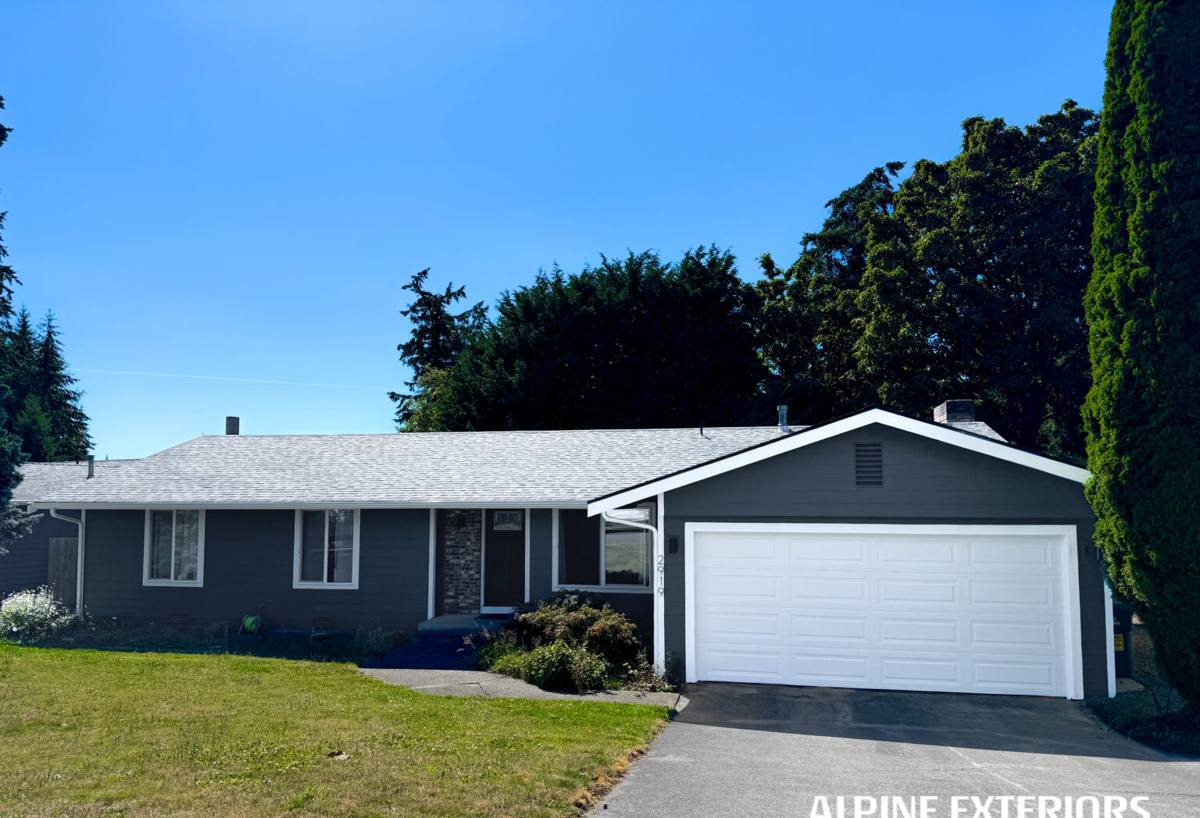
If your home still has its original siding — especially older wood, hardboard, or a first-generation vinyl or fiber cement product — this is usually where problems start: soft spots near ground contact, cupped or bowed boards, chronic moss staining on north- and west-facing walls, and paint or finish that won't hold anymore no matter how often it's redone. None of that is cosmetic. It's a sign the wall assembly is absorbing more moisture than it's shedding.
What a Correct Siding Replacement Actually Involves
"Replacement" gets used loosely in this trade. Some crews strip the old siding and nail up new boards over whatever they find. A correct replacement treats the old siding coming off as a chance to fix the parts of the wall you can't see once new siding goes back on — because those hidden layers are what actually keep water out, not the visible cladding.
Tear-Off and Sheathing Inspection
Once the old siding is off, the sheathing underneath gets inspected board by board. Soft, delaminated, or water-stained sheathing gets replaced before anything new goes up — covering damaged sheathing with new siding just hides a problem that keeps getting worse behind the wall.
Weather-Resistive Barrier and Flashing
A new weather-resistive barrier goes on correctly lapped, shingle-style, so water is always directed outward and down. Flashing at windows, doors, and every horizontal trim break gets installed to shed water away from the substrate, not just tucked in for appearance. In a climate that pushes rain sideways into walls, this layer matters more than the siding itself.
Fastening and Clearances
Fiber cement siding has specific fastening patterns and clearance requirements — ground clearance, roof-line clearance, gaps at butt joints for expansion — that are easy to shortcut and hard to notice until moisture problems show up years later. Getting this right is what separates a job that lasts thirty-plus years from one that needs attention again in ten.
Signs an Aldergrove Home Needs Replacement, Not Another Repair
Repair makes sense when the damage is isolated and the rest of the siding is sound. Replacement makes sense once the problems are systemic. A straightforward way to tell the difference:
- Soft or spongy siding when pressed, especially near the bottom courses or under windows
- Persistent moss or algae growth that returns within a season of cleaning
- Paint or finish that no longer holds for more than a couple of years
- Visible cupping, warping, or separation at seams and corners
- Rising energy bills with no other explanation, suggesting moisture-compromised insulation
- Repairs on more than two or three separate walls in the last few years
One or two of these usually means a targeted repair. Several at once, especially combined with age, usually means the wall assembly as a whole is past the point where patching makes financial sense.
Why We Install Only James Hardie Fiber Cement
We get asked regularly why we don't offer vinyl, LP SmartSide, or cedar as options. It's not that those products have no merit — each has a legitimate place in the market. It's that in a climate like this one, with sustained moisture exposure and a long moss season, the trade-offs stopped making sense for us as a standard we're willing to put our name behind.
| Material | How It Handles This Climate | Where It Falls Short |
|---|---|---|
| Vinyl | Won't rot; low upfront cost | Can warp or crack in temperature swings; seams and panels loosen over time, letting moisture behind the wall |
| LP SmartSide (engineered wood) | Lighter, easier to install than fiber cement | Wood-based core is vulnerable if any seam, cut edge, or fastener point isn't perfectly sealed and maintained |
| Cedar | Natural appearance many homeowners want | Needs ongoing refinishing to resist moisture and moss; combustible; upkeep cost adds up over the ownership period |
| James Hardie fiber cement | Non-combustible, dimensionally stable, factory-cured finish resists moss and fade | Heavier material, more installation-sensitive — must be installed to Hardie's spec to perform as designed |
Hardie's fiber cement is cement, sand, and cellulose fiber — it doesn't feed moss the way wood-based products can, it doesn't expand and contract with temperature the way vinyl does, and the ColorPlus factory finish is baked on under controlled conditions rather than field-applied, which is a real advantage against long wet seasons and UV exposure. The trade-off is that it demands correct installation — proper clearances, fastening, and joint treatment — to deliver on that durability, which is exactly why we treat installation quality as non-negotiable rather than optional.
Working Across the Border: What's Actually Different
Aldergrove homeowners occasionally ask whether working with a Washington-based crew on a BC property is complicated. In practice it mostly means being upfront about a few things rather than pretending the border doesn't exist.
Permits and Code
British Columbia's building code and the Township of Langley's permitting process are not the same as Whatcom County's. We coordinate with homeowners on what local permitting is required for their specific project rather than assuming Washington rules carry over — a siding replacement doesn't always trigger a permit, but it's worth confirming before work starts, not after.
Materials and Scheduling
Because James Hardie product is sourced and staged out of our normal supply chain, we plan material delivery and crossing logistics as part of the schedule up front, so a border crossing doesn't turn into a delay mid-project. Homeowners don't need to manage any of that — it's built into how we quote and schedule Aldergrove jobs.
Our Process, Start to Finish
- Site visit and assessment — we walk the exterior, check for moisture damage, and measure for an accurate material take-off
- Product and color selection — choosing the right Hardie plank, panel, or shingle profile and ColorPlus finish for the home
- Written estimate — a clear scope covering tear-off, repair allowances, materials, and labor, so there are no surprises mid-job
- Permit coordination — confirming what's required locally before any work begins
- Tear-off and substrate repair — removing old siding and addressing any damaged sheathing found underneath
- Weather barrier, flashing, and installation — installed to manufacturer spec, not shortcut spec
- Final walk-through — reviewing the finished work with the homeowner before we consider the job done
Cost Factors for an Aldergrove Siding Replacement
Every quote depends on the specific house, but the variables that actually move the price are consistent from project to project:
| Factor | Why It Matters |
|---|---|
| Home size and wall complexity | More corners, gables, and trim details mean more labor and cut waste |
| Condition of the existing wall | Rotted or delaminated sheathing found during tear-off adds repair scope |
| Siding profile chosen | Lap siding, shingle-style panels, and board-and-batten carry different material and labor costs |
| Trim and accessory work | Corner boards, window trim, and fascia work are often bundled with a full replacement |
| Access and site conditions | Multi-story walls, tight lot lines, or landscaping close to the house affect scaffolding and staging |
Full siding replacements are a significant investment — most homeowners are looking at a project that runs into the higher end of exterior remodeling costs once tear-off, repair, and trim are included. A written estimate based on an actual walk-through is the only way to get a number that reflects your house rather than a generic average.
Why Hiring a Crew That Already Works Aldergrove Matters
A crew that hasn't worked in this specific climate zone can install siding correctly by the book and still miss the details that matter here — the extra attention flashing needs on walls that take direct wind-driven rain, or the ventilation and drainage choices that keep moss from taking hold on shaded north walls. Experience with this exact combination of salt air, rainfall pattern, and moss pressure shows up in the small decisions made on-site, not just in the material spec sheet.
It also matters on the logistics side. A contractor who already understands the permitting differences between Whatcom County and the Township of Langley, who already has a working rhythm for crossing materials and crews, isn't learning that process on your project. That's fewer surprises and fewer delays for you.
Ready to Talk About Your Siding
If your Aldergrove home is showing the signs of a wall assembly that's past its useful life — persistent moss, soft spots, finish that won't hold — it's worth getting a straight assessment before deciding between repair and replacement. We're happy to walk the exterior, answer questions honestly, and put together a written estimate with no pressure attached. The form below is the easiest way to get started.