 Lynden
 Why Blaine's Marine Climate Is Hard on an Asphalt Shingle Roof
Blaine sits right on the water at the northern edge of Whatcom County, and that location shapes what a roof has to deal with year-round. A roof here isn't fighting the same conditions as one twenty miles inland — it's dealing with salt-laden air off the water, wind-driven rain that doesn't just fall straight down, and long stretches of shade and dampness that give moss every opportunity it needs. An asphalt shingle roof can handle all of this well, but only if it's built for these specific conditions rather than installed the same way it would be in a drier, sunnier climate.
Salt Air and Metal Components
Salt air doesn't damage the shingles themselves much, but it accelerates corrosion on the metal parts of a roofing system — flashing, fasteners, vents, and any exposed hardware. A roof close to Blaine's shoreline needs corrosion-resistant metal and fasteners chosen with that in mind, not just whatever's cheapest at the supply house. Skimp here and the shingles can outlast the metal that's supposed to be keeping water out around chimneys, walls, and vent pipes.
Driving Rain and Wind
Storms coming off the water tend to push rain sideways, not straight down. That means water finds its way under shingle edges, around fasteners, and into laps in the underlayment that would never get tested in a calmer climate. Every seam, nail pattern, and overlap has to be done correctly the first time, because wind-driven rain will find any shortcut in the installation.
Shade, Moisture, and Moss
Whatcom County's moss season runs long — mild, wet winters and cool, damp springs create ideal growing conditions, especially on north-facing slopes and roof sections shaded by trees or neighboring structures. Moss isn't just cosmetic. It holds moisture against the shingle surface, works its way under tabs as it grows, and can lift shingles enough to let water underneath. A roof in this area needs to be installed and maintained with moss in mind from day one, not treated as an afterthought once it's already established.
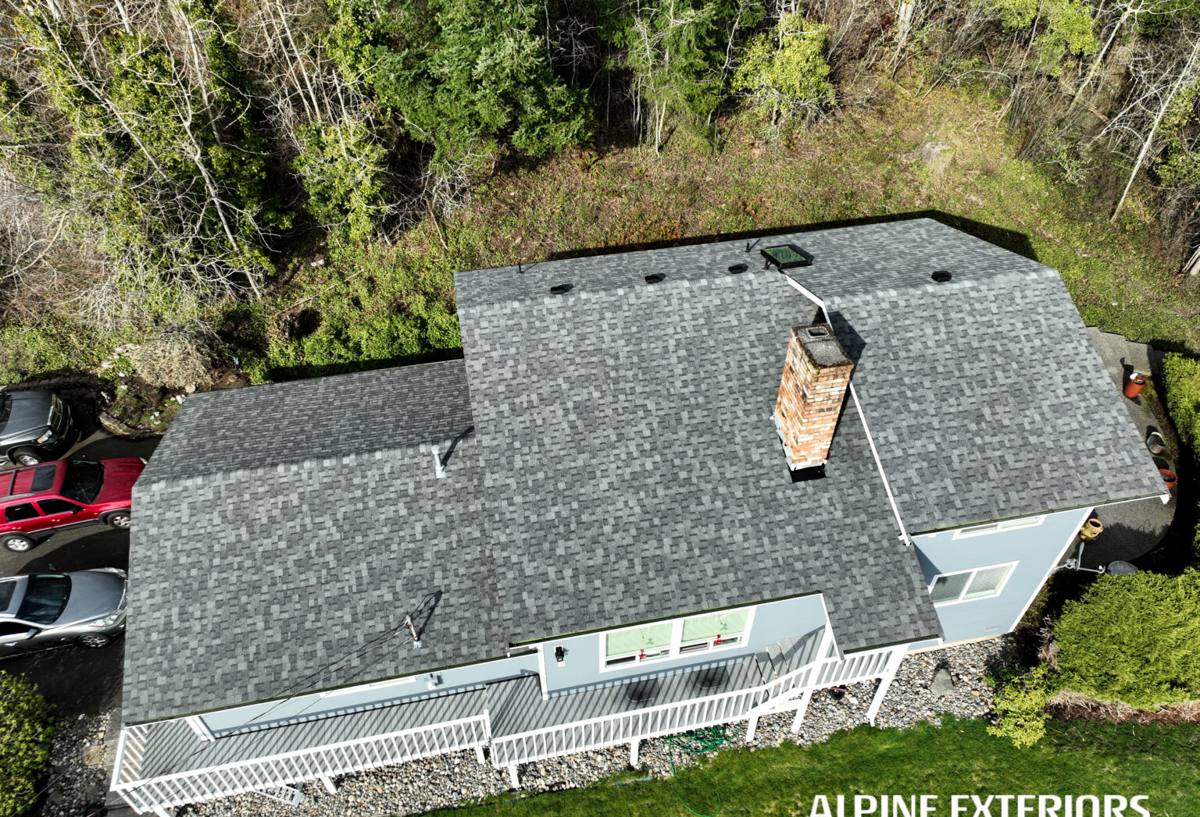
What a Correctly Installed Roof Needs Here
An asphalt shingle roof is a system, not just a layer of shingles. In a climate like Blaine's, every layer of that system earns its keep.
Underlayment and Ice-and-Water Protection
A quality synthetic underlayment across the full roof deck is the baseline, but the details matter more at eaves, valleys, and low-slope transitions — the spots most exposed to wind-driven rain and standing water. Self-adhering ice-and-water membrane belongs in those vulnerable areas even where snow load isn't the main concern, because the same product does double duty against wind-driven rain intrusion.
Flashing at Every Penetration
Chimneys, skylights, vent pipes, and any place a roof meets a wall need properly formed and sequenced flashing — not just sealant smeared over a gap. Sealant fails; correctly lapped metal flashing doesn't rely on caulk to do the real work. Given the salt air near the water, we use flashing and fasteners suited for corrosion resistance in this environment.
Fastening and Wind Rating
Nail placement, nail count, and shingle exposure all affect how well a roof holds up in wind. Manufacturer specs exist for a reason, and cutting corners here is the single most common cause of shingles blowing off or lifting in a coastal storm.
Ventilation
Balanced intake and exhaust ventilation keeps the attic dry and temperature-stable, which protects the roof deck from the underside and helps the shingles last their full rated life. Poor ventilation traps moisture, and trapped moisture is exactly what feeds moss, rot, and premature shingle failure — a real risk in a climate this wet.
Choosing the Right Shingle for This Climate
Not every asphalt shingle product is a good match for a coastal, moss-prone climate. The table below breaks down the main categories homeowners in this area choose between.
| Shingle Type | Moss/Algae Resistance | Wind Performance | Typical Lifespan |
|---|---|---|---|
| Standard 3-tab | Lower — no algae-resistant granules unless specified | Adequate when installed correctly, less margin in gusts | Shorter end of the asphalt shingle range |
| Architectural/laminate | Better mass and layering resist moss intrusion at the tab | Generally rated for higher wind speeds | Mid-to-long range |
| Algae-resistant (AR) laminate | Best — granules treated to resist moss and algae growth | Same as standard laminate line | Mid-to-long range, holds appearance longer |
For a shaded, damp property near Blaine, we generally steer homeowners toward an algae-resistant laminate shingle. It costs a bit more up front than plain 3-tab, but it holds its color and sheds moss growth far better over the life of the roof — which matters more here than in a drier climate where that upgrade is more optional.
Our Process for a Blaine Asphalt Shingle Roof
We run the same disciplined process on every roof, adjusted for what we find on your specific house and lot.
- On-site inspection. We look at slope, shading, existing ventilation, and any moss or moisture already present before quoting anything.
- Deck assessment during tear-off. Full tear-off lets us see the actual condition of the roof deck — soft or delaminated sheathing gets replaced, not covered over.
- Underlayment and flashing first. We install synthetic underlayment across the field and ice-and-water membrane at eaves, valleys, and penetrations before a single shingle goes down.
- Shingle installation to spec. Correct nail count, placement, and exposure for the wind conditions this area actually sees — not just the manufacturer's minimum for a calmer climate.
- Ventilation check and correction. If intake or exhaust airflow is inadequate, we address it as part of the job, not as a change order later.
- Cleanup and walkthrough. Magnetic sweep for stray fasteners, full site cleanup, and a walkthrough so you understand what was done and why.
Cost Factors for an Asphalt Shingle Roof in Blaine
Every roof is priced individually, but the same handful of factors drive most of the cost difference between jobs in this area.
| Factor | Why It Matters |
|---|---|
| Roof size and pitch | More surface area and steeper slopes both add labor and material |
| Tear-off complexity | Multiple existing layers or deck repair add time and disposal cost |
| Shingle grade chosen | 3-tab vs. architectural vs. algae-resistant laminate shifts material cost |
| Flashing and penetration count | Chimneys, skylights, and multiple roof planes add detail work |
| Ventilation upgrades needed | Adding or correcting intake/exhaust vents is sometimes required for a proper installation |
| Access and site conditions | Waterfront lots, steep driveways, or tight lots can affect staging and disposal logistics |
As a broad guideline, most full asphalt shingle roof replacements on homes in this area land somewhere in the moderate-to-upper range for residential roofing, with the specifics depending heavily on the factors above. We give a firm, itemized number after we've actually seen the roof — not a phone estimate.
Preventing Moss and Extending Roof Life
A well-installed roof still needs some basic upkeep in a climate like this one. None of it is complicated, but skipping it shortens the life of even a good roof.
- Keep gutters and valleys clear of debris so water and moss spores don't sit against the shingles
- Trim back overhanging branches to reduce shade and let the roof surface dry out between rains
- Consider zinc or copper strips near the ridge, which release trace metal that inhibits moss growth as rain washes over the roof
- Have visible moss removed gently — never pressure-washed, which strips protective granules and shortens shingle life
- Schedule a periodic roof inspection, especially after major windstorms common to this area
- Address small leaks or lifted shingles immediately rather than waiting for the next dry season
Signs Your Roof Needs Attention
A few warning signs come up repeatedly on roofs in this part of Whatcom County, and catching them early usually means a repair instead of a full replacement.
- Granules collecting in gutters or at downspout outlets
- Visible moss or dark streaking, especially on shaded or north-facing slopes
- Curling, cupping, or cracked shingle tabs
- Soft spots underfoot on the roof deck, or sagging between rafters
- Water stains on interior ceilings, particularly after wind-driven storms
Why a Crew That Already Works Blaine Matters
A roofing crew that hasn't worked this stretch of coastline before will often default to a generic installation approach — the kind that's fine in a drier, calmer climate but leaves gaps here. Knowing to prioritize corrosion-resistant flashing near the water, to treat moss prevention as part of the installation rather than an afterthought, and to fasten for the wind patterns this area actually sees isn't guesswork — it's familiarity built from doing this work locally, in Whatcom County conditions, on roofs facing the same salt air, rain, and shade that yours does. That local knowledge shows up in fewer callbacks and a roof that performs the way it's supposed to for its full lifespan.
If you're planning an asphalt shingle roof replacement or repair in Blaine, we're happy to come take a look and give you a straightforward, no-pressure estimate — just fill out the form below.