 Lynden
 Deck Replacement in Custer: Built for What Whatcom County Weather Actually Does
Custer sits close enough to the water and open enough to the wind that decks here take a beating most homeowners don't fully appreciate until the boards start cupping or the ledger board starts staining the siding above it. Salt-tinged air off the Strait, driving rain that comes in sideways during winter storms, and a moss season that can run from October clear through April all work against a deck's structure and surface at the same time. A deck that would last two decades in a dry inland climate can start failing in half that time out here if it wasn't built — or isn't being replaced — with that reality in mind.
We work on homes throughout Custer and the surrounding Lynden area regularly, so this isn't theoretical for us. It's the same set of failure points, over and over: fasteners that rust and streak, ledger connections that trap water against the house, decking that holds moss and goes slick, and framing that was never given a real chance to dry out between rains. Replacing a deck the right way here means designing around those problems from the first board, not just swapping old lumber for new and hoping for a better outcome.
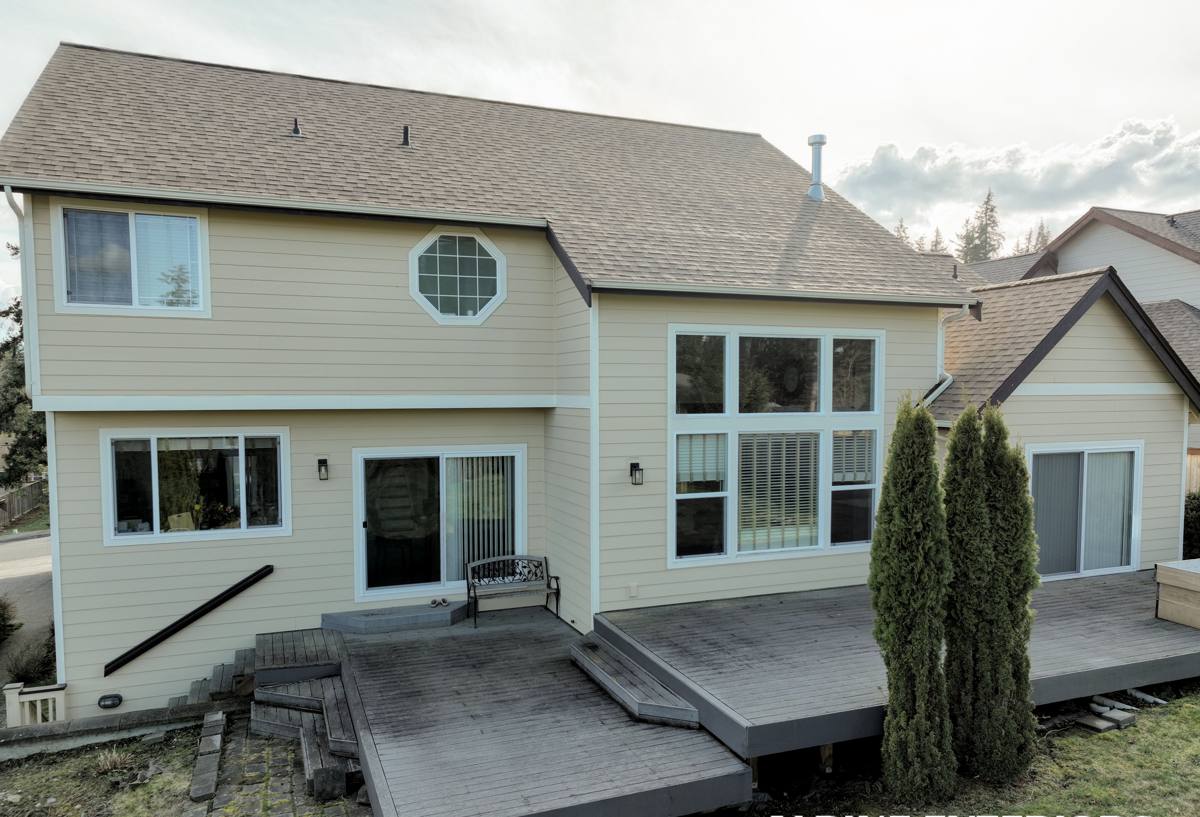
Why Decks Fail Faster in This Part of Whatcom County
Salt Air and Metal Fasteners
Custer's proximity to Puget Sound and the Strait of Georgia means the air carries more salt than homeowners moving from inland Washington usually expect. Salt-laden moisture accelerates corrosion on any fastener, bracket, or connector that isn't rated for it. Galvanized nails and screws that would be fine in a dry climate can start bleeding rust stains into deck boards within a few seasons here. Once a fastener starts corroding, it's also losing holding strength — which matters a lot on a structure people walk and stand on.
Driving Rain and Water Intrusion
Rain in this area doesn't always fall straight down. Wind-driven rain gets pushed sideways and up under railings, around post bases, and behind ledger boards where the deck attaches to the house. That's the single most common place we find hidden rot when we tear an old deck out — the ledger connection, hidden behind the decking and often behind flashing that was undersized or missing entirely.
Moss, Algae, and a Long Wet Season
Whatcom County's moss season is long, and a deck with poor drainage or tight board spacing gives moss and algae exactly the damp, shaded conditions they need to take hold. Beyond looking bad, moss holds moisture against the wood surface and makes boards genuinely slippery — a real safety issue on stairs and near entry doors.
What a Correct Deck Replacement Actually Involves
A deck replacement isn't just new boards on old framing. Done right, it's a full evaluation of everything from the ledger connection down to the footings, because the surface is only as good as what's underneath it.
- Full removal of old decking, railings, and any framing that shows rot, checking, or fastener corrosion
- Inspection of the ledger board and house connection — the number one hidden failure point in this climate
- Proper flashing at the ledger to direct water away from the house structure, not into it
- Verification of footing depth and condition, since undersized or shifted footings show up as bounce or unevenness later
- Corrosion-resistant fasteners and structural connectors rated for coastal/salt-air exposure
- Joist spacing and blocking appropriate for the decking material chosen, not just "what was there before"
- Drainage consideration underneath the deck so water and debris don't sit and hold moisture
- Railing and stair code compliance, which matters both for safety and for resale
Skipping any one of these to save time or cost is exactly how a deck ends up needing major work again in five to eight years instead of holding up for two or three decades.
Decking Material Options for a Custer Deck
There's no single "right" material for every deck — it depends on budget, how much upkeep the homeowner wants to take on, and how exposed the deck is to weather. We'll walk through the honest trade-offs rather than push whatever has the best margin.
| Material | Upfront Cost | Maintenance | How It Handles This Climate |
|---|---|---|---|
| Pressure-treated lumber | Lowest | Needs regular sealing/staining | Prone to moss and moisture uptake if not maintained; most affordable path to a solid deck |
| Cedar | Moderate | Periodic sealing to hold color and resist moisture | Naturally moisture-resistant and attractive, but still needs upkeep in a wet climate |
| Composite decking | Higher | Occasional cleaning, no sealing/staining | Handles moss, moisture, and salt air with far less maintenance burden over time |
| PVC decking | Highest | Minimal — cleaning only | Best long-term moisture and moss resistance, but least "natural wood" appearance |
We install all of the above depending on what a homeowner wants, but for Custer specifically — with the salt air and moss exposure this area sees — composite and PVC decking earn their higher upfront cost back in reduced maintenance and a longer service life before the next replacement conversation. Wood decking is a perfectly reasonable choice too, as long as the homeowner is realistic about the sealing and cleaning schedule it needs to hold up out here.
Railings, Fasteners, and the Details That Actually Matter
Most of what separates a deck that lasts from one that doesn't isn't visible from the yard. It's the fastener spec, the flashing detail, and the hardware choices made during framing.
Fastener and Hardware Selection
We use fasteners and structural connectors rated for coastal exposure rather than standard-grade galvanized hardware, specifically because of the salt air common to this part of Whatcom County. It costs a little more upfront and it's the difference between hardware that's still solid in fifteen years and hardware that's staining and weakening in five.
Railing Systems
Railings take direct weather exposure and get touched constantly, so we pay attention to how a given railing system sheds water and resists corrosion at the post connections — that's usually where a railing fails first, not in the balusters themselves.
Board Spacing and Drainage
Board spacing affects how well a deck sheds water and dries out between rains. Too tight, and boards trap moisture and grow moss; too wide, and debris collects underneath. Getting this right is part of designing for the specific climate, not a cosmetic choice.
Our Process for a Custer Deck Replacement
- On-site evaluation — we look at the existing deck, the ledger connection, and the framing condition, and talk through what the homeowner actually wants to use the space for
- Honest scope and material discussion — including the maintenance trade-offs above, so there are no surprises later
- Permitting — deck replacements in Whatcom County typically require a permit, and we handle that process as part of the job
- Demolition and disposal of the old structure, checking framing and ledger condition as it comes apart
- Rebuild — framing, ledger flashing, footings as needed, decking, and railings installed to code
- Final walkthrough — we go over the finished deck with the homeowner before calling the job done
Signs Your Custer Deck Needs Replacing, Not Just Repairing
Not every aging deck needs a full replacement — sometimes a repair to a few boards or a railing section is genuinely all that's needed. But there's a point where patching stops making sense.
- Soft or spongy spots in decking, which usually means rot underneath the surface
- Visible rot, staining, or gaps at the ledger board where the deck meets the house
- Fasteners that are rusted, bleeding stains, or backing out of the wood
- Persistent moss or algae that comes back quickly even after cleaning
- Noticeable bounce, sway, or movement when walking on the deck
- Railings or posts that feel loose or flex under normal pressure
If more than one or two of these show up, it's usually a sign the underlying structure — not just the surface — has been compromised. That's when replacement becomes the more honest recommendation than another round of patching.
Why a Local Lynden-Area Crew Matters for This Job
A crew that works Custer and the greater Lynden area regularly already knows what this climate does to decks over time, because we've seen it firsthand on other homes nearby. We're not guessing at whether coastal-rated fasteners are worth the extra cost, or whether standard board spacing needs adjusting for moss control — we've already seen what happens when those details get skipped. We're also familiar with Whatcom County permitting requirements for deck work, which keeps the project moving instead of stalling on paperwork. And because we're local, we're reachable after the job is done if a question comes up — not a crew that did one job in the area and moved on.
If your deck in Custer is showing its age, we're happy to take a look and give you a straight, no-pressure assessment of whether it needs repair or full replacement. Use the form below to request a free estimate — there's no obligation, just an honest read on where your deck actually stands.