 Lynden
 Why Deming's Corner of Whatcom County Is Tough on a Roof
Deming sits up the Nooksack River valley along the Mount Baker Highway, closer to the foothills than Lynden and most of the rest of Whatcom County. That location changes what a roof has to deal with. The same moist marine air that carries salt off the Salish Sea into the county still reaches this far inland, but by the time it moves up the valley it's usually stacked with heavier rain and funneled by the surrounding hills. Mix that with the second-growth forest that shades a lot of Deming properties, and you get a roofing climate that's harder on materials than a purely coastal spot or a purely dry inland spot would be on its own.
For metal roofing specifically, three things matter more here than in town:
Driving rain finds every weak seam
Wind-driven rain doesn't just run downhill off a roof — it gets pushed sideways and upward under laps, around penetrations, and into any fastener that wasn't sealed correctly the first time. On a well-built metal roof this is a non-issue because the panel laps and flashing details are designed for it. On a roof where corners got cut, driving rain is exactly what exposes the mistake, usually a season or two after the crew has moved on.
A long moss season under the canopy
Shaded roof sections that stay damp for days after a storm are where moss and algae take hold first. Moss itself doesn't destroy metal panels the way it can shorten the life of shingles, but it holds moisture against fasteners, seams, and flashing longer than the roof would otherwise see, and it clogs valleys and gutters fast. A long moss season means more of the year with something damp sitting on the roof.
Debris load from surrounding trees
Needles, cones, and small branches collect in valleys, around chimneys, and behind any roof-to-wall transition. On a lot with mature conifers close to the house, that debris load is constant, not seasonal, and it's one of the biggest reasons gutters and valley flashing on rural Whatcom County properties get neglected without anyone noticing until there's a leak.
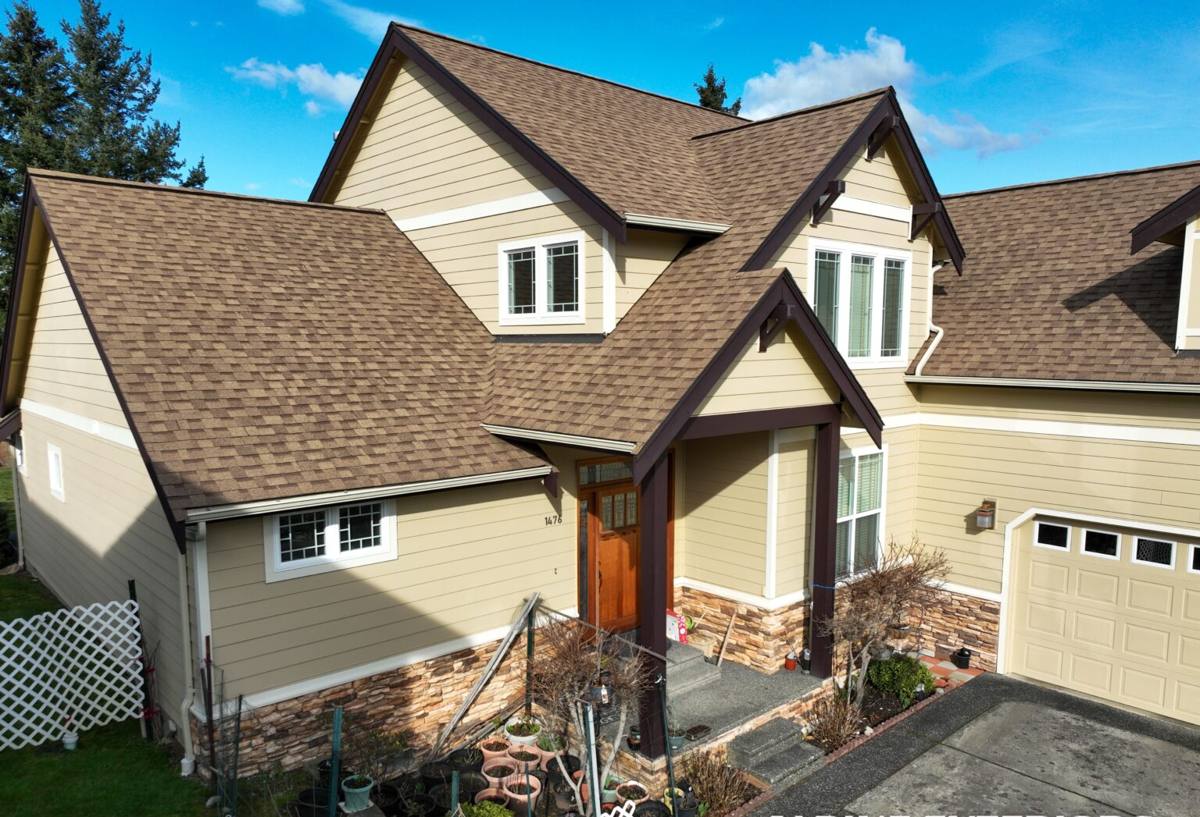
Common Problems We Find on Deming Roofs
Called out to look at an existing metal roof in this area, the same handful of issues show up again and again:
- Exposed fasteners that were the wrong type for the panel metal, rusting from the head down
- Valleys packed with needles and debris, holding water against the panel finish
- Flashing at chimneys, skylights, and roof-to-wall junctions that was never properly integrated with the underlayment
- Gutters sized for a normal rain year, overwhelmed by the volume this valley actually sees
- Condensation staining on the underside of the deck from a roof that was never vented correctly
None of these are metal roofing failures. They're installation or maintenance shortcuts that a wetter, shadier climate exposes faster than a dry one would.
Standing Seam vs. Exposed-Fastener Metal Roofing
Both systems are legitimate, and both get used around Whatcom County. The right choice depends on the roof's pitch, the tree cover on the lot, and how much long-term maintenance the homeowner wants to take on.
| Factor | Standing Seam | Exposed-Fastener |
|---|---|---|
| How it's fastened | Hidden clips under the seam, no exposed screws | Screws driven through the panel face with rubber washers |
| Moisture performance under trees | Better — no exposed fastener heads for debris and moisture to sit against | Adequate if washers are checked and replaced on schedule |
| Upfront cost | Higher | Lower |
| Long-term maintenance | Minimal — mainly keeping valleys and panels clear of debris | Washers age and need periodic replacement, especially under drip lines |
| Best fit | Heavily shaded lots, low-slope sections, homeowners who want the least upkeep | Simpler roof shapes, budget-conscious projects, outbuildings and shops |
We'll walk both options with you on-site rather than push one system across every roof. On a wooded Deming lot with a lot of shade, the maintenance savings of standing seam often make the extra cost worth it. On a simpler roof or a secondary structure, exposed-fastener panels installed correctly and checked periodically hold up fine.
What a Correctly Installed Metal Roof Actually Includes
The panels themselves are the easy part to get right. Almost every roofing failure we're called out to fix traces back to what's underneath or around the panels, not the panels themselves.
Underlayment and ice/water protection
A synthetic underlayment rated for the panel type goes down first, with self-adhered ice-and-water membrane at eaves, valleys, and any low-slope transition — the spots where driving rain and standing meltwater are most likely to get pushed backward under a lap.
Fastener and flashing compatibility
Mixing incompatible metals — the wrong fastener alloy against a panel, or the wrong flashing metal at a transition — sets up galvanic corrosion that shows up as staining and pitting within a few years, long before the panel itself would have failed on its own. Matching fastener and flashing materials to the panel isn't optional; it's the difference between a 40-plus-year roof and one that needs attention in year eight.
Valley and penetration detailing
Given how much debris this area sees, valleys get built wide enough to actually shed needles and branches instead of catching them, and every penetration — vent stack, skylight curb, chimney — gets flashed and sealed as its own detail, not just caulked over at the end.
Attic and roof ventilation
A metal roof over a poorly vented attic will show condensation problems that have nothing to do with the roofing material and everything to do with moist interior air having nowhere to go. Ridge and soffit venting sized correctly for the attic keeps that moisture moving instead of settling on the underside of the deck.
Our Process, Start to Finish
- On-site inspection — we look at the existing roof deck, ventilation, flashing points, and how much tree cover and drainage the specific lot deals with
- Written estimate — panel system, underlayment, flashing plan, and timeline laid out plainly, no vague allowances
- Tear-off and deck check — old roofing comes off and the deck gets inspected for rot or soft spots before anything new goes down, since covering a bad deck with a good roof just hides the problem
- Underlayment and flashing installation — ice-and-water membrane at vulnerable areas, then underlayment, then all flashing set and sealed before panels go on
- Panel installation — laid and fastened to manufacturer spec, with attention to expansion allowance so panels aren't fighting the seasonal temperature swings this valley sees
- Cleanup and walkthrough — job site cleared, magnetic sweep for stray fasteners, and a walkthrough so you know what maintenance the roof actually needs going forward
Maintenance a Metal Roof Still Needs Here
A correctly installed metal roof is low-maintenance, not no-maintenance. In a climate with this much rain and tree cover, a little attention twice a year prevents most of the problems we get called out for.
- Clear valleys and gutters of needles and debris at least twice a year, more often on a heavily wooded lot
- Check exposed-fastener washers for cracking or backing out every few years
- Rinse off moss and organic buildup before it packs into seams or valleys — don't let it sit all winter
- Inspect flashing at chimneys, skylights, and wall transitions annually for any sealant that's dried out or pulled away
- Trim back branches that overhang the roofline to cut down on debris load and reduce storm-damage risk
- Confirm attic ventilation isn't blocked by insulation or debris, especially after any attic work
Why a Crew That Already Works Deming Makes a Difference
A lot of Deming properties are on larger, wooded lots with longer driveways, well and septic systems, and tree cover that changes how a roof needs to be built and maintained compared to a standard in-town lot. A crew that's already worked out here knows to plan for that access, knows how much debris load a valley needs to handle, and isn't guessing at how the local weather pattern — heavier rain, longer wet shade, occasional snow load closer to the foothills — actually behaves on a roof over the course of a year.
That local experience also matters for permitting and code questions specific to Whatcom County, and for response time. When a storm knocks debris onto a roof or opens up a flashing joint, having a crew nearby that already knows the property and the area means a faster fix instead of a longer wait behind jobs scattered across the whole region.
Get a Straight Answer on Your Roof
If you're weighing a metal roof for a Deming property, or you've got an existing metal roof that's showing rust, moss buildup, or a leak you can't source, we'll come take a look and give you a straightforward assessment — no pressure, no inflated scope. Fill out the form below for a free estimate.