 Lynden
 Siding That Has to Work in Kendall's Climate, Not Just Look Good on Day One
Kendall sits in the part of Whatcom County where the weather doesn't do anything in half measures. Winters bring long stretches of saturated air and driving rain off the Nooksack valley, summers are short, and the shoulder seasons in between are damp enough that moss and algae get a running start on any surface that holds moisture. A siding product that performs fine in a drier climate can still fail here — not from one bad storm, but from years of cumulative dampness working into seams, fastener holes, and butt joints that were never properly sealed or flashed.
We install James Hardie fiber cement siding exclusively, and we've built our process around what actually holds up under Whatcom County conditions: repeated wet-dry cycling, wind-driven rain that gets pushed sideways into wall assemblies, and a moss season that runs longer here than in most of the state. This page is specifically about doing that job right on Kendall homes — not a generic rundown of what fiber cement is.
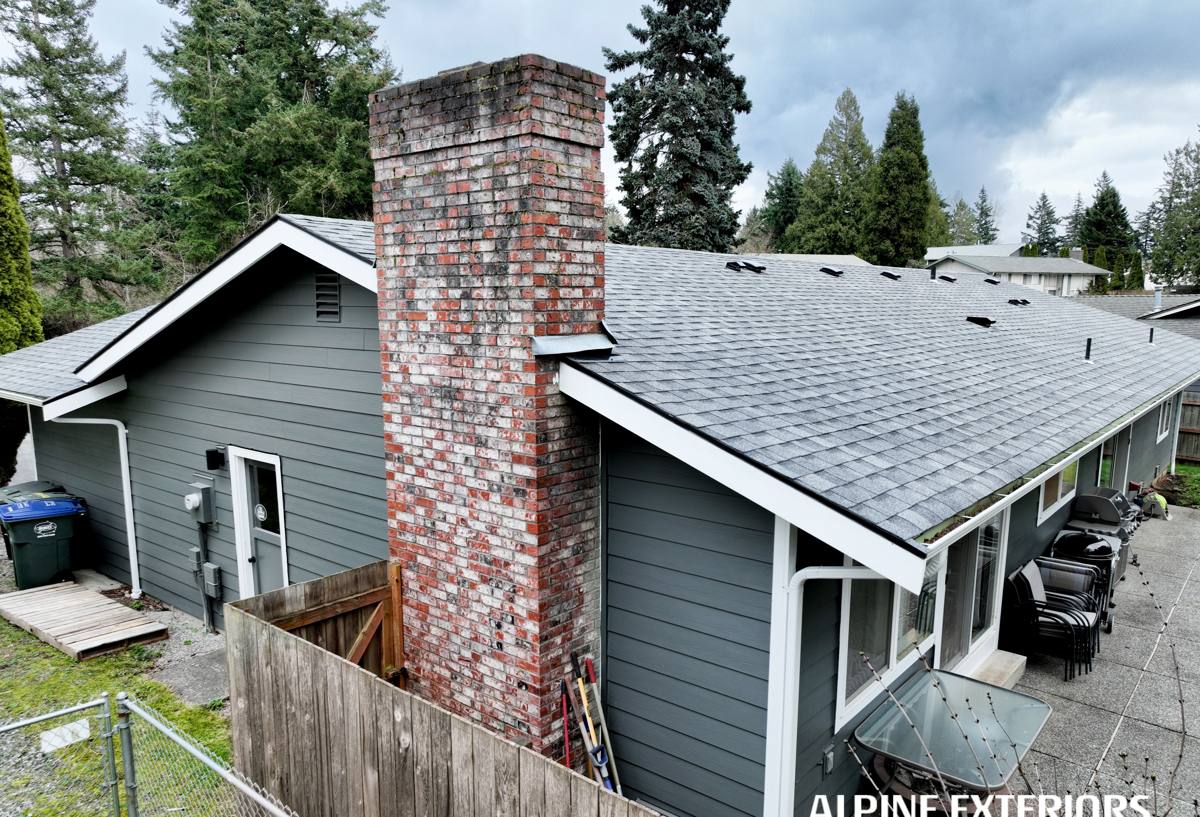
What Kendall's Weather Actually Does to a Wall
The failures we see on older homes in this area rarely come from the siding material itself — they come from moisture finding a way behind it. A few patterns show up again and again:
- Caulk-dependent seams that were sound when installed but opened up after a few freeze-thaw cycles, letting rain track behind the siding
- Missing or undersized flashing above windows and doors, where driving rain gets pushed upward and sideways instead of running straight down
- North- and west-facing walls that stay damp longer after storms, giving moss and algae more time to establish before the surface dries out
- Fastener patterns too tight or too loose for the plank, causing splitting or telegraphing over a few seasons of expansion and contraction
None of that is unique to any one siding brand — it's a function of how the job was installed. But it does mean that in a climate like Kendall's, installation quality matters more than it would in a drier part of the country. There's less margin for shortcuts.
Why We Install Only James Hardie
We get asked fairly often why we don't offer vinyl, LP SmartSide, or other fiber cement brands as cheaper alternatives. The honest answer is that we've standardized on one product line because it lets us guarantee the work we stand behind.
What Hardie Gets Right for This Climate
Hardie's fiber cement is non-combustible, doesn't swell or rot when it takes on moisture the way engineered wood products can, and holds paint and factory finish far longer than vinyl. The HZ5 product line is engineered specifically for climates with freeze-thaw cycling and sustained damp conditions, which describes Whatcom County winters well. The ColorPlus factory finish is baked on under controlled conditions, which gives more consistent, longer-lasting color than field-applied paint — a real advantage where moss and mildew growth are a fact of life and homeowners need a surface that cleans up rather than one that has to be repainted every few years.
Why We Don't Offer Alternatives
Vinyl siding can gap, warp, or crack over time and is dependent on trim details rather than a rigid, paintable substrate. Engineered wood products like LP SmartSide are more moisture-sensitive at cut edges and fastener penetrations, which is a real liability in a climate that stays wet for months at a stretch. Other fiber cement brands may perform reasonably well, but we've built our crew's training, our warranty backing, and our installation details around one system so there's no ambiguity about spec, fastening, or flashing requirements. That consistency is what lets us guarantee the installation, not just sell the material.
Comparing What's Actually on the Table
| Factor | James Hardie Fiber Cement | Vinyl | Engineered Wood (LP SmartSide) |
|---|---|---|---|
| Moisture tolerance | High — non-combustible, doesn't swell or rot | Moderate — won't rot but seams can let water behind panels | Moderate — treated, but vulnerable at cut edges and fastener holes |
| Finish longevity | ColorPlus factory finish, long service life before repaint | Color molded in but fades and chalks over time | Field-applied paint, needs more frequent recoating |
| Moss/algae resistance | Cleans up well, doesn't hold moisture in the substrate | Surface growth common in shaded, damp areas | Growth risk higher where finish is compromised |
| Fire performance | Non-combustible | Combustible | Combustible |
| Typical warranty | Long transferable manufacturer warranty when installed to spec | Varies, often prorated | Shorter, often voided by moisture damage |
None of this means the alternatives are junk products — vinyl and engineered wood both have legitimate uses. It's why, for the climate Kendall homes sit in and the standard we want to guarantee, Hardie is the only product we put on a house.
What a Correct Installation Involves
The material is only half the job. On a Kendall home, we pay particular attention to a handful of details that determine whether the siding is still performing correctly in fifteen years.
Moisture Management Behind the Cladding
Every installation starts with a weather-resistive barrier and correctly lapped, sealed flashing at every penetration — windows, doors, hose bibs, light fixtures. Given how much driving rain the area gets, we treat flashing details as non-negotiable, not an afterthought covered up by trim.
Fastening and Clearances
Hardie specifies exact fastener spacing, penetration depth, and minimum clearance from grade, roofing, and other flatwork. Getting clearance wrong is one of the most common causes of moisture wicking into the bottom edge of siding, and it's an easy thing for a crew unfamiliar with the product to get wrong.
Joints and Caulking
Butt joints get treated with the manufacturer-specified sealant and, where possible, backed with flashing rather than relying on caulk alone as the only moisture barrier. Caulk breaks down; flashing doesn't.
Our Process on a Kendall Job
- On-site assessment — we look at existing siding, sheathing condition, and problem areas (typically north/west walls and anywhere with visible moss or staining) before quoting anything.
- Tear-off and inspection — removing old siding lets us check the sheathing underneath for hidden rot or moisture damage before it gets covered up again.
- Weather barrier and flashing — installed and inspected before a single plank goes up.
- Hardie installation to spec — correct fastening, clearances, and joint treatment throughout.
- Final walkthrough — we go over the finished work with the homeowner and register the manufacturer warranty.
Why Hiring a Crew Familiar With This Area Matters
A crew that already works Whatcom County jobs isn't guessing at how much clearance to leave at grade or how aggressive the flashing needs to be at a window head — they've seen what happens when those details are skipped on a house exposed to this much rain and dampness for months at a time. That local repetition is what turns a spec sheet into judgment calls made correctly on-site, which matters more here than in a milder climate where installation mistakes take longer to show up.
Maintenance: What Kendall Homeowners Should Actually Expect
Correctly installed Hardie siding is genuinely low-maintenance, but "low" isn't "none." A realistic yearly routine:
- Rinse the siding (garden hose pressure, not a pressure washer) once a year, focusing on shaded north- and west-facing walls where moss gets a head start
- Check and re-caulk any gaps around windows, doors, and trim if you notice separation
- Keep gutters clear so overflow isn't running down the wall face
- Trim back vegetation and keep at least a few inches of clearance between siding and any mulch, soil, or plantings
- Watch for any soft spots or staining near the bottom courses, which usually points to a clearance or flashing issue worth having looked at
What Affects the Cost of a Kendall Siding Job
| Factor | Why It Matters |
|---|---|
| Existing wall condition | Rot or moisture damage found during tear-off adds sheathing repair before new siding goes up |
| Home size and complexity | Dormers, multiple gables, and cut-up wall lines take more labor per square foot than simple rectangular walls |
| Plank profile and finish choice | Lap width, texture, and ColorPlus color selection affect material cost |
| Trim and accessory scope | Full trim replacement versus reusing sound existing trim changes total scope |
| Access and site conditions | Slope, landscaping, and staging space affect labor time |
We give straightforward, itemized estimates rather than a single lump number, so homeowners can see exactly what's driving the price.
Signs Your Current Siding Is Due for Replacement
- Persistent moss or algae staining that comes back within weeks of cleaning
- Visible warping, buckling, or gaps at seams and corners
- Soft or spongy spots, especially near the bottom courses or under windows
- Paint that's peeling or bubbling rather than just fading
- Rising energy bills that track with drafts near exterior walls
If you're seeing any of these on a Kendall home, it's worth having someone look at what's happening behind the siding, not just the surface.
If you'd like a straightforward look at what your home actually needs, we're happy to walk the property with you and give a free, no-pressure estimate — no obligation, and no pitch for a product we wouldn't put on our own homes.