 Lynden
 Why Kendall Homes Put Extra Demand on Windows
Kendall sits in the stretch of Whatcom County between Lynden and the Mt. Baker foothills, and that location comes with a specific set of weather problems. Storms roll in off the water and get wrung out further as they climb toward the mountains, which means this area sees more driving rain — wind-driven, sideways rain that gets pushed into every gap a window has — than towns closer to the coast realize. Add a long, damp shoulder season where moss and algae get a foothold on north-facing walls and trim, and a faint but real salt component in the air that moves inland with coastal weather systems, and you've got a climate that is genuinely harder on window assemblies than most manufacturers' warranty language assumes.
None of this is dramatic on any single day. It's cumulative. A window that's a little loose at the corners, or caulked instead of properly flashed, won't fail this winter. It'll fail in year six or seven, quietly, as rot behind the trim or a slow rise in your heating bill that you can't quite explain. Energy-efficient windows done right in Kendall aren't just about a lower U-factor on a spec sheet — they're about an assembly that keeps water out for the life of the house.
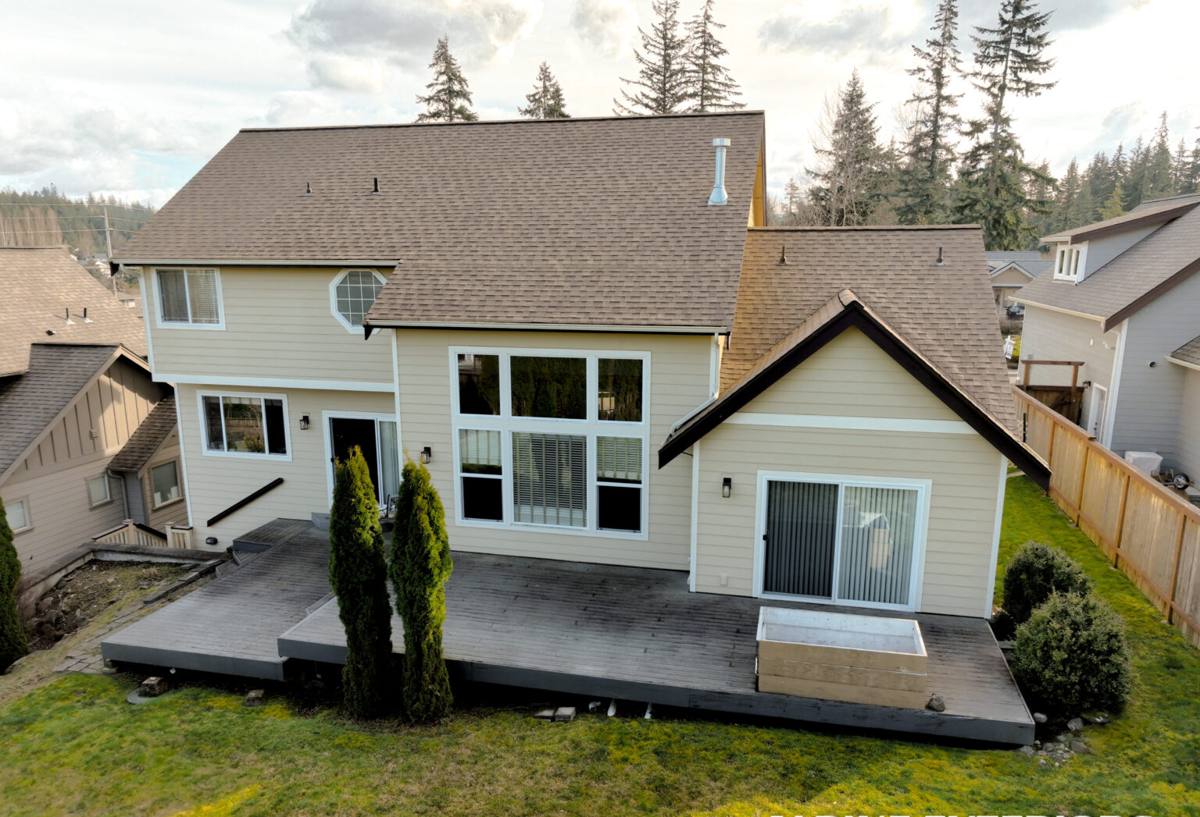
What "Energy-Efficient" Actually Means Out Here
Energy efficiency in a window comes from three things working together: the glass package, the frame material, and — more than most homeowners expect — the quality of the installation. A high-end window installed with a poor seal will underperform a mid-grade window installed correctly. We treat all three as equally important.
Glass Packages
Double-pane, low-E, argon-filled glass is the baseline we recommend for this climate. The low-E coating reflects radiant heat back into the room in winter and keeps solar heat out in summer, while the argon fill slows heat transfer through the airspace. In a house with a lot of west or south glass, we'll often talk through a low solar-heat-gain-coefficient option to cut down on summer overheating without losing winter warmth. Triple-pane glass is available and does reduce heat loss further, but for most Kendall homes it's a bigger jump in cost than the marginal efficiency gain justifies — we'll tell you honestly if your project is the exception.
Frame Materials
Frame material matters as much as glass in a wet climate, because the frame is what's exposed to standing moisture at the sill and what has to survive years of rain intrusion attempts at every joint. Vinyl, fiberglass, and wood-clad wood all show up in this market; each has real trade-offs, covered in the comparison below.
Signs Your Current Windows Are Working Against You
Most homeowners call us because something felt off, not because they scheduled a window replacement. Here's what we typically hear about, and what it usually means:
- Condensation between the panes — the seal has failed and the insulating gas is gone; this is a glass problem, not a cleaning problem, and it doesn't come back.
- Soft or discolored trim below a window — usually water finding its way past the flashing or sill pan, sometimes for years before it shows on the surface.
- Drafts you can feel with a hand near the frame — a failed weatherstrip or a frame that's racked slightly out of square.
- Moss or dark streaking concentrated around specific windows — a sign water is sheeting off that window in a pattern it shouldn't, often pointing to a flashing or head-trim issue.
- Rooms that are noticeably colder or hotter than the rest of the house — poor glass performance or a leaky seal, not just "an old house."
- Windows that are hard to open, close, or lock — frame movement from moisture absorption or a settling foundation, worth inspecting before it gets worse.
What a Correct Installation Actually Involves
This is where most of the long-term performance of a window is decided — and where corners get cut on rushed jobs. A window that's simply set into the rough opening and caulked around the outside will pass a walkthrough and fail in a few winters.
Flashing and Water Management
Every opening gets a sill pan to catch and direct any water that gets past the window itself, and flashing tape integrated with the house wrap in the correct shingle-lap order — bottom, sides, then top — so water is always directed outward and down, never trapped behind the siding. This is the single biggest factor in whether a window leaks in year one or lasts decades, and it's invisible once the trim goes back on, which is exactly why it's worth asking your contractor to walk you through it before they close the wall back up.
Air Sealing and Insulation
The gap between the window frame and the rough opening gets sealed with low-expansion foam or backer rod and sealant — never packed tight with standard spray foam, which can bow the frame and cause the sash to bind. Interior and exterior sealant beads both matter; skipping the interior side is a common shortcut that lets moist indoor air migrate into the wall cavity.
Level, Plumb, and Square
A window that's out of square will bind, won't seal evenly against the weatherstripping, and will stress the glass unit over time. We check and shim this on every unit, not just the ones that look off.
Our Process for Kendall Window Projects
- On-site assessment. We look at every window being discussed — not just the ones you've flagged — because moisture damage often shows up first on a window nobody's complained about yet.
- Honest scoping. We tell you which windows genuinely need replacement, which could be repaired, and which are fine. We don't upsell a full-house job when three windows are the actual problem.
- Product selection. We walk through frame and glass options against your budget and the specific exposure of each opening — a north wall taking the brunt of driving rain gets treated differently than a sheltered south window.
- Removal and inspection of the opening. Once the old window is out, we check the rough opening and sheathing for hidden rot before anything new goes in. This is often where we find problems the homeowner didn't know about.
- Installation with full flashing detail. Sill pan, shingle-lapped flashing, air sealing, shimming to level and plumb.
- Interior and exterior trim. Matched to the house, sealed at every joint.
- Final walkthrough. We test operation and locking hardware on every window before we call the job done.
Choosing a Frame Material for This Climate
| Frame Type | Moisture Behavior | Maintenance | Typical Lifespan |
|---|---|---|---|
| Vinyl | Won't rot or absorb water; performs consistently in wet climates | Low — occasional cleaning | 20–30+ years |
| Fiberglass | Excellent — expands/contracts with temperature at nearly the same rate as glass, reducing seal stress | Low | 30–40+ years |
| Wood-clad wood | Attractive interior wood with a protective exterior cladding, but any breach in the cladding exposes wood to rot | Higher — cladding seams and interior wood need periodic attention | 20–30 years with upkeep |
We install all three depending on the home and the homeowner's priorities. Where we get more cautious is with bare wood or lower-grade composite frames in direct rain exposure — not because the product is bad, but because it demands a maintenance commitment that doesn't fit every homeowner's schedule, and in this climate a missed year of upkeep can matter.
What Drives the Cost of a Window Project
| Factor | Why It Matters |
|---|---|
| Number of openings | Bigger scope, but per-unit cost usually drops with volume |
| Frame material | Vinyl is typically the most affordable; fiberglass and wood-clad run higher |
| Glass package | Standard low-E/argon vs. upgraded coatings or triple-pane |
| Condition of the rough opening | Hidden rot found during removal adds repair scope before the new window can go in |
| Trim and siding tie-in | Matching existing trim profiles or siding takes more labor than a straightforward swap |
| Access and window size | Second-story, oversized, or hard-to-access openings take more time to install correctly |
We give a written estimate after the on-site assessment, not a phone-quote guess, because the rough opening condition and access are things we genuinely can't judge without looking.
Why Working With a Crew That Already Knows Kendall Matters
Window installation isn't exotic work, but the details that make it hold up in Whatcom County's wet, moss-prone weather are learned from doing it here repeatedly — knowing which wall orientations take the worst of the driving rain, what flashing details actually keep water out through a full wet season, and where past crews in this area have cut corners that show up as callbacks years later. A crew that's used to installing in a milder or drier climate can put in a technically fine window that still isn't detailed for what this area throws at it season after season.
Living With the Climate After Installation
A correctly installed, quality window needs very little from you, but a few habits extend its life in this environment:
- Rinse pollen, moss spores, and grime off glass and frames a couple of times a year — buildup holds moisture against the frame longer than clean surfaces do.
- Check and clear weep holes at the bottom of the frame each fall, before the heavy rain season, so water has somewhere to drain.
- Keep gutters clear so overflow isn't running down the wall and pooling at window heads.
- Trim back vegetation or landscaping that keeps a window in constant shade and dampness — that's exactly where moss and mildew take hold first.
- Test locks and operation once a year; a sash that's suddenly hard to close can be an early sign of frame movement worth a look.
If your windows are drafty, fogged, or just older than they should be for how your energy bills feel, we're happy to come take a look. A free, no-pressure estimate gets you a straight answer on what actually needs replacing and what doesn't — fill out the form below and we'll set up a time to come out.