 Lynden
 Building a Deck That Actually Holds Up in Laurel
Laurel sits in the part of Whatcom County where marine air off the Salish Sea meets the open farmland around Lynden, and that combination is tougher on outdoor structures than most homeowners expect. A deck built without that climate in mind can look fine for a year or two and then start showing soft spots, black streaks, and loose fasteners well before it should. A deck built correctly for this area is a different story — it sheds water instead of holding it, resists moss instead of feeding it, and the hardware stays tight instead of weeping rust down the boards.
This page covers what deck building specifically for Laurel homes should involve: the climate factors that matter, the material trade-offs, how we frame and finish a deck to handle them, and what to expect from the process.
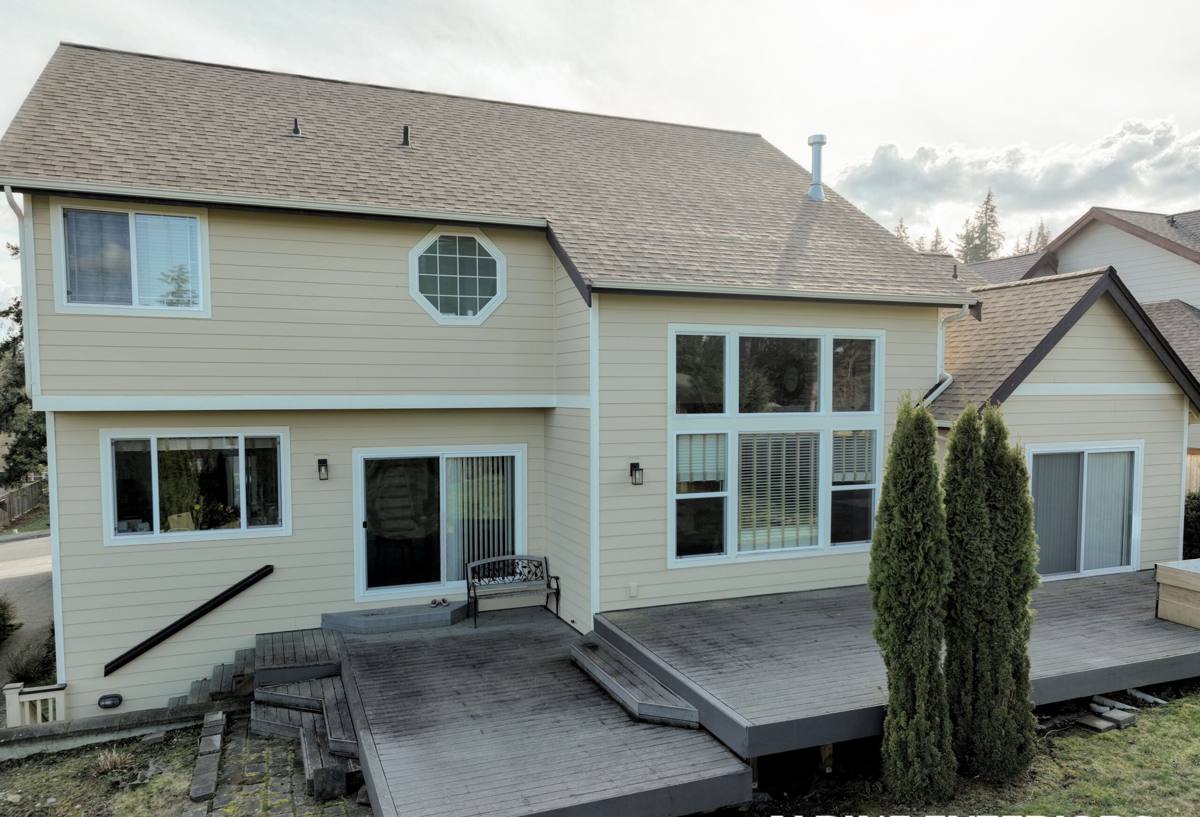
What Laurel's Climate Does to a Deck
Three things drive almost every deck problem we see in this area:
Salt-Laden Air
Air moving in off the Salish Sea carries a small but steady amount of salt with it. Over years, that salt content accelerates corrosion on exposed fasteners, hinges, and any metal hardware that isn't rated for exterior or coastal exposure. It's usually not dramatic — it's a slow creep of rust stains and weakened connections that shows up right when you'd least want it, at a stress point in the framing.
Driving Rain
Whatcom County doesn't just get rain — it gets rain that comes in sideways during winter storms, pushed by wind off open ground. That matters for a deck because driving rain finds every gap: under railing posts, behind ledger boards, in end-grain cuts that weren't sealed. Standing rain is easy to design around; driving rain requires actual flashing and drainage detail, not just a sloped surface.
A Long Moss Season
Between the rainfall totals and the extended shoulder seasons of fall and spring, this area gives moss and algae months of the damp, shaded conditions they need to establish. On a deck, moss doesn't just look bad — it holds moisture against the wood surface, which is exactly the condition that leads to rot and slippery footing.
None of these factors are unique to Laurel, but together they're a big part of why a deck built to a generic national spec often underperforms here, while one built with local conditions in mind holds up for decades.
Choosing Decking Material for This Climate
There's no single "best" decking material — there's a best material for your budget, your maintenance appetite, and how much sun or shade the deck will get. Here's how the common options stack up specifically against Laurel's wet, mossy climate:
| Material | Moisture Behavior | Moss/Algae Resistance | Maintenance |
|---|---|---|---|
| Pressure-treated wood | Good if properly sealed and re-sealed; end grain and cut edges need field treatment | Low — needs regular cleaning | Annual cleaning, re-staining every 2-3 years |
| Cedar | Naturally moisture-resistant, but the finish still needs upkeep | Moderate — natural oils help, but shaded areas still grow moss | Cleaning and oil/stain every 1-2 years |
| Composite (capped) | Excellent — doesn't absorb water or rot | Moderate to good depending on brand; surface still needs washing | Periodic washing, no staining or sealing |
| Composite (uncapped, older style) | Weaker — can absorb moisture at cut edges over time | Lower than capped composite | More frequent cleaning than capped versions |
We're straightforward with homeowners about the trade-offs. Real wood costs less up front and looks great, but it asks for real maintenance discipline in a climate that doesn't give you many dry weeks to do it in. Capped composite costs more initially and eliminates most of the moisture-related maintenance, which is why a lot of Laurel homeowners lean that direction for main living-level decks, while sometimes choosing wood for a smaller secondary structure where the upkeep is more manageable.
What a Correctly Built Deck Actually Involves
The visible surface boards are the smallest part of what determines whether a deck lasts. The parts that matter most are the ones you don't see once it's finished:
Ledger Board Flashing
Where the deck attaches to the house is the single most common failure point in this climate. It needs proper metal flashing integrated with the house's water-resistive barrier — not just caulk — so driving rain can't work its way behind the ledger and into the rim joist or the home's framing.
Joist Protection
Joist tape or an equivalent moisture barrier over the top of each joist keeps water from sitting in the screw holes and end grain where deck boards attach. This is inexpensive during construction and expensive to add later, which is why it's not something we skip to save time.
Footing Depth and Spacing
Footings need to be set below frost depth and sized for the actual load and soil conditions on the lot, not just a rule-of-thumb spacing. Whatcom County's building department has specific requirements here, and getting it right the first time avoids problems with an uneven, bouncy, or shifting deck down the road.
Fastener Selection
Given the salt content in the air here, we use fasteners and structural hardware rated for exterior/coastal exposure rather than standard interior-grade coated screws. It costs a little more in materials and saves a lot of grief in corrosion-related failures ten years out.
Board Spacing and Drainage
Correct gapping between boards, combined with a slight slope away from the house, lets water actually leave the deck surface instead of pooling. Pooled water is what accelerates both rot and moss growth, so this detail directly addresses two of the three climate factors above.
Our Process for a Laurel Deck Project
1. On-Site Assessment
We walk the site, look at sun/shade exposure, drainage patterns, and how the deck will tie into the house, and talk through what you actually want to use the space for.
2. Material and Design Discussion
We go over decking material options honestly, including cost ranges and what the maintenance commitment looks like for each, so you're choosing based on real trade-offs, not a sales pitch.
3. Permitting
Deck projects above a certain size or height typically require a permit through the county or city, depending on exactly where the property sits. We handle that process rather than leaving it to you.
4. Framing and Structural Work
This is where the flashing, footings, joist protection, and fastener choices described above get built in — the part of the job that determines the deck's lifespan.
5. Decking, Railing, and Finish
Surface installation, railing per current code requirements, and any staining or sealing needed before we walk the finished project with you.
Permits and Local Building Requirements
Most raised decks in Whatcom County need a building permit, and the requirements around footing depth, railing height, guard spacing, and stair geometry are set by the adopted building code, not by preference. Setback requirements can also come into play depending on how close the deck sits to a property line. We pull permits and handle inspections as part of the job so you don't have to navigate the county process yourself.
Deck Maintenance Checklist for This Climate
Whatever material you choose, a few habits go a long way toward getting the full lifespan out of a Laurel-area deck:
- Sweep debris off the surface regularly, especially in fall when leaves and needles trap moisture
- Wash the deck surface at least once a year to remove early moss and algae growth before it establishes
- Check that gaps between boards stay clear of debris so water can drain
- Inspect railing posts and ledger board areas annually for soft wood or rust staining
- Re-stain or re-seal wood decking on the schedule the product actually needs, not just when it looks bad
- Trim back overhanging vegetation that keeps sections of the deck shaded and damp
Why a Crew That Already Works Laurel Matters
A contractor who builds decks all over a wide, climate-varied territory tends to default to generic specs. A crew that regularly works Laurel and the surrounding Lynden area already knows which fastener grades hold up here, where the moss problems actually start on a given lot orientation, and what the local permitting process expects. That local pattern-recognition is the difference between a deck that needs attention every year and one that just quietly works for decades.
If you're planning a new deck or replacing one that's showing its age, we're glad to come take a look and put together a straightforward, no-pressure estimate — just fill out the form below.