 Lynden
 Siding Built for the Nooksack Area, Not Just "Whatcom County"
Nooksack sits close enough to the river valley and open farmland east of Lynden that it gets its own version of Whatcom County weather — heavier ground fog on cold mornings, damp air that lingers under tree cover, and long stretches of the year where siding simply doesn't get a chance to fully dry out. Add in the salt-laden air that rides inland off the Strait of Georgia and Bellingham Bay on a west wind, and you've got a combination that's tough on exterior materials: constant moisture exposure, driving rain that hits west and south walls hard, and a moss season that can run from October well into May.
We're a Lynden-based crew that works this area regularly, which matters more than it sounds like. Siding that's correctly specified and installed for a Bellingham subdivision or a drier part of the state doesn't automatically hold up the same way out here. This page is about what siding replacement actually looks like for a Nooksack-area home — the product, the install details, and the process — not a generic pitch.
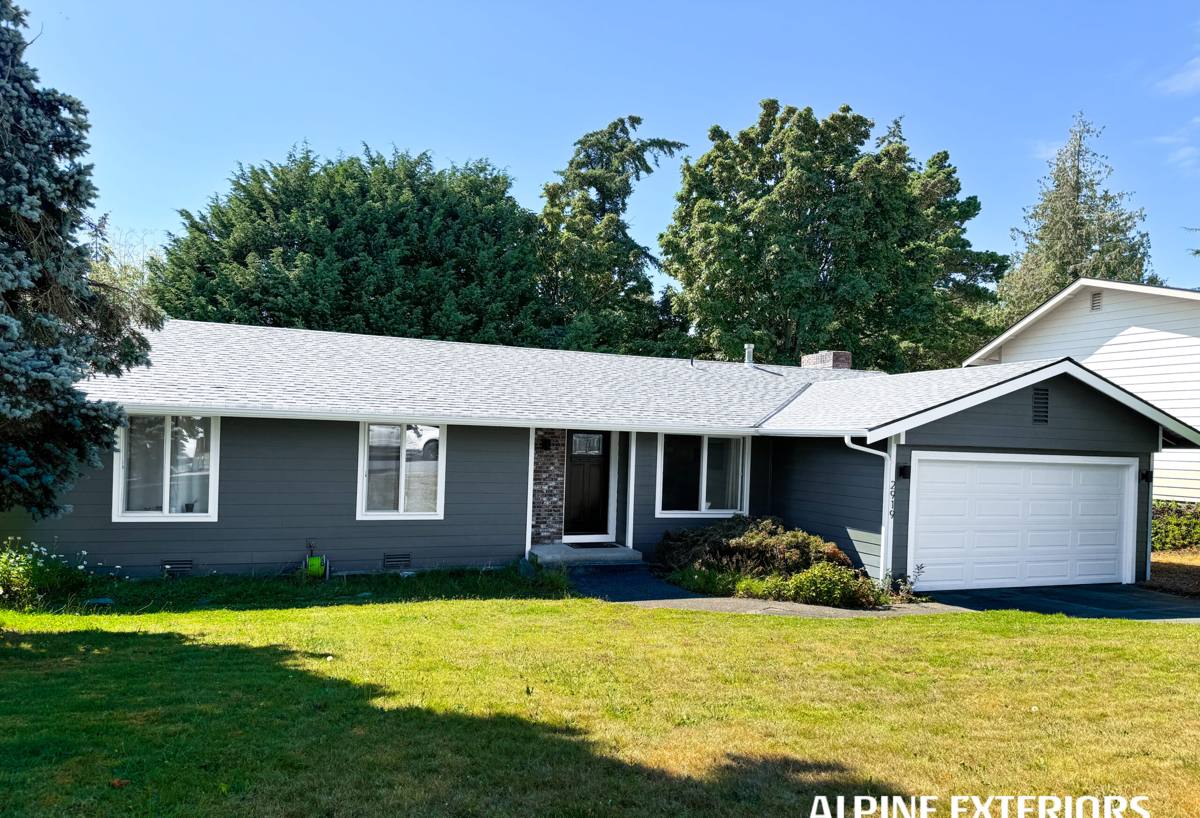
What This Climate Actually Does to Siding
Moisture That Doesn't Leave
Rural and semi-rural properties near Nooksack often have more tree cover, more shade, and closer proximity to water than in-town Lynden lots. That combination slows drying time on north- and east-facing walls dramatically. Wood-based siding products — cedar, primed spruce, engineered wood — depend on being able to dry out between rain events. When that drying window shrinks, you get swelling, paint failure, and eventually rot at seams, butt joints, and anywhere water can sit.
Moss, Mildew, and Organic Growth
Moss doesn't just grow on roofs out here. Given a shaded wall, a slow-draining gutter, or siding with any texture that holds moisture, you'll see green and black growth streaking down from trim, corners, and anywhere water sheets off slowly. This isn't cosmetic-only — sustained organic growth holds moisture against the siding surface, which accelerates whatever underlying problem the material already has.
Driving Rain and Wind-Driven Salt Air
Storms coming off the water don't just rain straight down — wind pushes moisture sideways into wall assemblies, trim joints, and anywhere flashing is undersized or missing. Salt air compounds this by corroding fasteners and accelerating the breakdown of finishes that aren't engineered to handle it.
Why We Only Install James Hardie Fiber Cement
We don't install vinyl, LP SmartSide, Cemplank, Allura, primed spruce, or cedar. That's a deliberate standard, not a sales position, and it comes directly from what holds up in conditions like Nooksack's.
- It's non-combustible. Fiber cement doesn't feed a fire the way wood-based products can — relevant given how many Nooksack-area properties border open field, brush, or timber.
- It doesn't rely on paint film integrity to survive. The core material itself is dimensionally stable and resists swelling from the moisture cycling that's constant in this climate.
- ColorPlus factory finish is baked on, not field-applied. That matters directly for moss and mildew resistance — a consistent, engineered finish sheds water and resists staining far better than a field-primed-and-painted wood product, and it doesn't need repainting on the same cycle.
- HZ5 product engineering. Hardie's HZ5 line is specifically formulated for the Pacific Northwest's wet, cold-cycling climate zone — this isn't a one-size-fits-all national product.
- Real transferable warranty backing. A manufacturer warranty is only worth something if the material and finish are engineered to actually last the claimed lifespan in your climate zone.
To be fair to the alternatives: vinyl is inexpensive and low-maintenance in mild, dry climates. LP SmartSide and cedar can look excellent and perform reasonably well with diligent maintenance in the right exposure. Cemplank and Allura are also fiber cement and not inherently bad products. Our standard isn't that these products fail everywhere — it's that we've decided not to install anything that puts a homeowner's maintenance burden or long-term performance at risk in this specific climate, and Hardie is what we've found holds that line consistently.
What a Correct Siding Replacement Involves Here
Replacing siding isn't just pulling old material off and nailing new boards on. In a moisture-heavy area like Nooksack, the work that happens underneath the siding matters as much as the siding itself.
Tear-Off and Sheathing Inspection
Once old siding comes off, we inspect the sheathing for soft spots, rot, or prior water intrusion — especially around window and door openings, at wall penetrations, and along the bottom plate where splashback and standing moisture do the most damage. Any compromised sheathing gets replaced before anything new goes up; covering damaged sheathing with new siding just hides the problem.
Weather-Resistive Barrier and Flashing
A correctly installed weather-resistive barrier (WRB) with properly lapped and taped seams is what actually keeps bulk water out of the wall assembly — the siding itself is the first line of defense, not the only one. Window and door flashing gets integrated into the WRB using proper shingle-lap sequencing so water sheds outward at every layer, never inward.
Rainscreen or Furring Where It's Needed
On shaded, north-facing, or heavily wooded lots — common around Nooksack — a rainscreen gap behind the siding gives the wall assembly a drainage and drying plane instead of trapping moisture directly against the sheathing. This is one of the details that separates a siding job that lasts from one that looks fine for a few years and then doesn't.
Fastening and Joint Treatment
Hardie board has specific fastening patterns, nail penetration requirements, and butt joint treatment specs. Skipping these — using the wrong fastener spacing, face-nailing where blind-nailing is called for, or leaving butt joints unsealed per spec — is how an otherwise good product underperforms. This is installer-sensitive work, and it's exactly where corner-cutting shows up years later as a callback, not a warranty claim.
Siding Replacement Readiness Checklist
- Note any soft, spongy, or discolored spots on current siding, especially near the bottom edge and window sills
- Check for moss or dark streaking on shaded walls — flag which walls get the least sun
- Look at gutters and downspouts for signs of overflow staining onto siding below
- Identify any trim, corner boards, or fascia that's already showing rot
- Think about tree cover and whether branches are holding moisture against any wall
- Have a rough idea of your home's age and whether the current siding was ever fully replaced (vs. re-sided over old material)
Cost Factors for a Nooksack-Area Job
Every home is different, but the variables that actually move the number are consistent. We give real numbers on-site after a walk-around — not a phone estimate — because these factors vary house to house.
| Factor | Why It Matters Here |
|---|---|
| Sheathing condition | Rural/wooded lots near the river often have more hidden moisture damage requiring sheathing replacement |
| Wall exposure (sun vs. shade) | Shaded, moss-prone walls may need rainscreen detailing that sunnier walls don't |
| Home size and wall complexity | Dormers, gables, and multiple stories add labor and material cutting |
| Trim and accessory scope | Corner boards, fascia, and soffit work are often bundled with siding replacement |
| Access | Long driveways, fencing, or landscaping common on larger Nooksack-area lots can affect staging and equipment access |
| Hardie plank vs. panel selection | Lap siding, board-and-batten, and panel systems have different material and labor costs |
Why a Local Crew Matters for This Job
Siding replacement out here isn't the same job as siding replacement in a dry inland climate, and it isn't identical to a tightly-packed in-town Lynden lot either. A crew that regularly works the Nooksack area already knows which walls typically need rainscreen detailing, where moss tends to establish first, and how much drying window to plan around when scheduling tear-off and install around weather. That's the difference between a crew reading a spec sheet and a crew that's actually seen how these details perform through a full wet season in this specific area.
We're based in Lynden, and Nooksack is part of our regular service area — not a stretch assignment. That means faster response for follow-up questions after the job, easier warranty service coordination, and a crew that isn't guessing at how Whatcom County's river-valley moisture behaves against a wall.
What to Expect From Our Process
- On-site walk-around. We look at your current siding, sheathing condition where visible, trim, and problem areas — not a drive-by estimate.
- Written scope and product plan. You'll know exactly which Hardie product line, profile, and color are proposed, and why, before any work starts.
- Tear-off and inspection. Old siding comes off, sheathing gets inspected and repaired as needed, and you're shown anything we find before it's covered up.
- WRB, flashing, and rainscreen install. The water-management layer goes in correctly before a single piece of new siding is hung.
- Hardie installation to spec. Fastening, joint treatment, and trim detail all follow manufacturer specification — not shortcuts.
- Final walkthrough. We go over the finished work with you directly.
If your Nooksack-area home is due for new siding — or you're seeing moss, staining, or soft spots that suggest it's due sooner than you'd like — we're happy to come take a look. The estimate is free, there's no pressure, and you'll get a straight answer about what your home actually needs.