 Lynden
 Siding Installation for Wiser Lake's Lake-and-Tree Microclimate
Wiser Lake sits a few miles outside Lynden in unincorporated Whatcom County, and homes here deal with a slightly different set of pressures than a house on an open lot in town. The lake itself keeps humidity high year-round. Mature tree cover around much of the shoreline means siding stays shaded and damp longer after a storm than it would in full sun. Add in the marine air that moves inland off the Strait of Georgia and Puget Sound on a regular basis, and you've got a combination of salt-tinged moisture, driving rain, and a moss season that can stretch from October into May. Siding installed here has to be chosen and installed with that specific mix in mind, not just picked off a sample board.
This page is about one thing: siding installation for Wiser Lake homes, done right, with a material that's actually built to hold up to this environment.
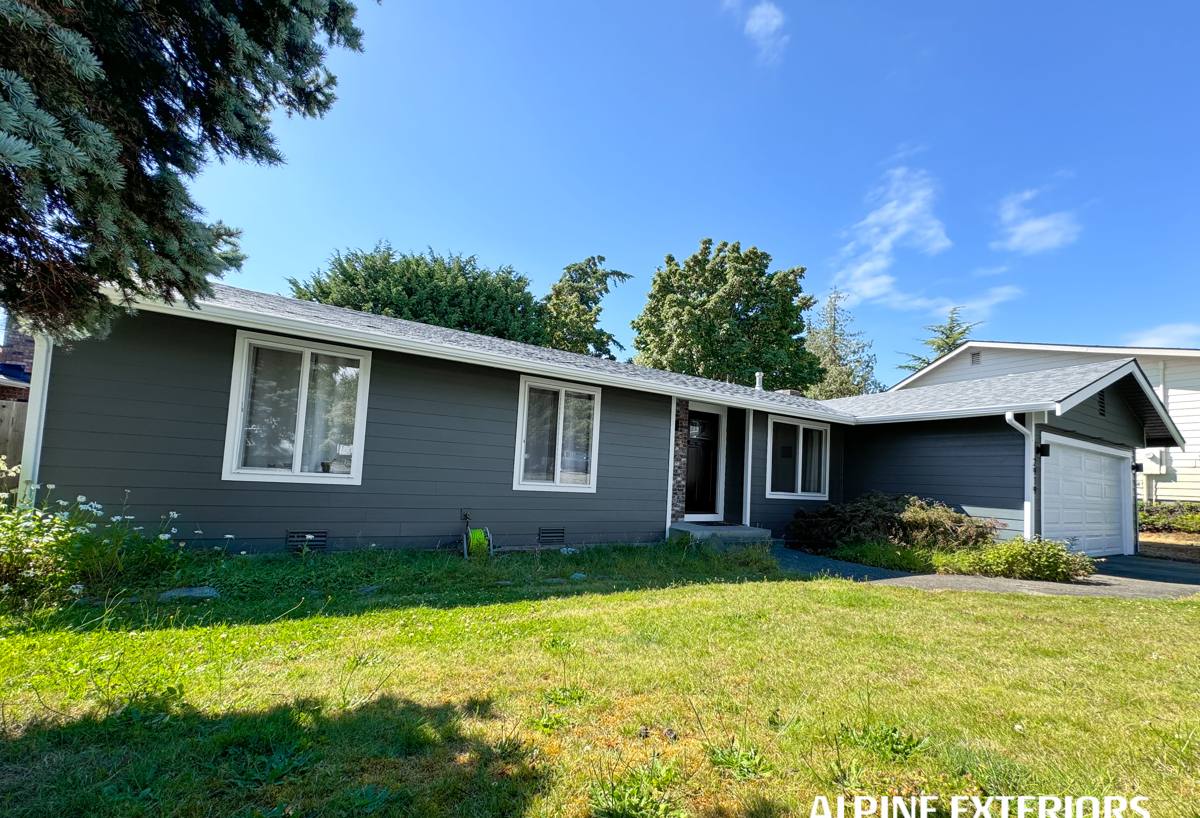
What Driving Rain and a Long Moss Season Do to the Wrong Siding
Whatcom County doesn't get hurricane-force wind-driven rain, but it gets something almost as hard on a wall assembly: long, low-intensity rain events pushed sideways by wind off the water, day after day, for months at a stretch. That kind of weather doesn't just wet the siding surface — it finds every gap, lap, and fastener penetration that wasn't detailed correctly and works moisture behind the cladding.
Combine that with shade from lakeside trees and you get extended dry-back times. Wood-based and wood-adjacent siding products need to dry out between wet cycles to avoid swelling, delaminating, or feeding rot at the bottom edges and butt joints. Around Wiser Lake, siding often doesn't get that chance before the next rain rolls through. That's exactly the environment where moss and algae take hold — not just cosmetically on the surface, but as an indicator that moisture is sitting on the siding longer than it should.
Why This Matters More Here Than in a Dry, Open Subdivision
A house on a treeless lot in a newer Lynden development sheds water and dries out fast between storms. A house near Wiser Lake, tucked under trees or close to the water, doesn't get that advantage. The material itself has to be more tolerant of sustained dampness, because the site conditions won't do the drying-out work for it.
Why We Install James Hardie Fiber Cement — and Nothing Else
We made a deliberate decision to install only James Hardie fiber cement siding. We don't install LP SmartSide, vinyl, Cemplank, Allura, primed spruce, or cedar. That's not a marketing position — it's a response to what we've seen hold up in this climate and what hasn't.
Wood-based and engineered-wood siding products can perform well when everything goes right: perfect installation, consistent maintenance, and no sustained moisture exposure. Wiser Lake's tree cover and rain pattern make "everything goes right, every year, for decades" a hard bar to clear. Vinyl handles moisture fine but moves a lot with temperature swings, can crack in cold snaps, and doesn't offer the same fire performance or resale positioning as fiber cement. Other fiber cement brands exist, but we standardized on James Hardie specifically because of its ColorPlus factory-applied finish, its HZ5 product engineering for the Pacific Northwest's wet-and-cold cycle, and a warranty structure that's genuinely transferable if the home sells.
Fiber cement doesn't feed mold or rot the way wood-based products can, it doesn't warp or expand the way vinyl does in temperature swings, and it's non-combustible — a real factor as wildfire smoke seasons have become a normal part of Pacific Northwest summers. For a Wiser Lake home sitting under tree cover with high ambient moisture, that combination of moisture tolerance, dimensional stability, and finish durability is what actually matters over a 30-plus year ownership horizon.
What a Correct Wiser Lake Siding Installation Involves
The material is only half the equation. A James Hardie installation done to spec, on a site like this, requires attention to details that get skipped on rushed jobs:
Water Management Behind the Siding
A proper weather-resistive barrier and rainscreen or drainage plane behind the siding gives any moisture that does get past the cladding a path to drain and dry out, instead of sitting against the sheathing. On a shaded, humid lot near the lake, this detail is not optional — it's the difference between siding that lasts and siding that traps water.
Flashing at Every Penetration
Windows, doors, hose bibs, light fixtures, and deck ledgers all need proper flashing and integration with the water-resistive barrier. Driving rain finds unflashed penetrations first, every time.
Correct Fastening and Clearances
James Hardie has specific nailing patterns, fastener types, and minimum clearances from grade, roofing, and decks. Getting these wrong doesn't show up immediately — it shows up as swelling, staining, or premature paint failure years later.
Joint and Caulk Detailing
Butt joints, trim intersections, and caulked seams are where a lot of amateur installs fail first. Hardie's engineered joiners and factory-primed edges, installed correctly, keep water out of these transitions.
Our Process, Start to Finish
- On-site assessment — we look at your home's exposure: tree shade, prevailing wind and rain direction, existing moisture or moss patterns, and the condition of the sheathing underneath the current siding.
- Scope and product selection — we walk through James Hardie's plank, panel, and shingle profiles and ColorPlus color options, and recommend what fits your home's style and the site's moisture load.
- Tear-off and sheathing check — old siding comes off and we inspect the sheathing for rot or damage before anything new goes up. Problems found here get addressed, not covered over.
- Water-resistive barrier and drainage plane installation — this is the layer that does the real work over the life of the siding, and it goes in before a single piece of Hardie board is hung.
- Flashing and trim — all penetrations, windows, and transitions get flashed to shed water outward and downward.
- Hardie installation to manufacturer spec — correct fastener spacing, clearances, and joint treatment throughout.
- Final walkthrough — we go over the finished job with you before calling it done.
Material Comparison for a Wiser Lake Property
| Factor | James Hardie Fiber Cement | Wood / Engineered Wood | Vinyl |
|---|---|---|---|
| Moisture tolerance in shaded, humid sites | High — engineered for wet climates | Moderate — needs consistent dry-back time | High, but traps moisture behind if installed poorly |
| Moss/algae resistance | Good with ColorPlus finish; surface doesn't feed growth | Lower — organic material can support growth | Surface resists growth but seams can trap debris |
| Fire performance | Non-combustible | Combustible | Melts/deforms under heat |
| Dimensional stability | High, minimal expansion/contraction | Moderate, can swell or cup | Expands/contracts noticeably with temperature |
| Typical warranty structure | Long-term, transferable | Varies by product and installer | Varies, often prorated |
Color and Finish Choices That Hold Up Near the Lake
James Hardie's ColorPlus finish is baked on in a controlled factory environment, which matters on a site where the siding stays damp longer than average — field-applied paint has more opportunity to fail at laps and cut edges when it doesn't get a full dry-out window before the next rain. We'll walk you through the current ColorPlus palette and help you weigh lighter versus darker tones; darker colors show less moss staining in photos over time but run slightly warmer in direct sun, while lighter tones can show shaded moisture streaking sooner if gutters and drainage aren't dialed in. Either way, the finish is engineered to resist the fading and cracking that field-painted wood siding is prone to in this climate.
Signs Your Current Siding Is Losing the Battle
- Moss or algae returning within weeks of cleaning, especially on north- or shade-facing walls
- Soft spots, bubbling, or visible swelling near butt joints and bottom courses
- Paint that's peeling or alligatoring rather than just fading
- Persistent damp or musty smell along interior walls that back onto exterior siding
- Visible gaps at trim, window, or corner boards that weren't there a few years ago
- Staining that runs downward from fasteners or seams after rain
Any one of these on its own isn't necessarily an emergency, but a few of them together on a Wiser Lake home usually means moisture has been getting behind the cladding for a while.
Why Hire a Crew That Already Works This Area
Siding installation isn't uniform across Whatcom County. A crew that mostly works dry, sun-exposed lots elsewhere in the county doesn't necessarily think about drainage planes and flashing the same way a crew that regularly works shaded, lake-adjacent properties does. Working around Lynden and Wiser Lake means we've seen how tree cover, lake humidity, and driving rain actually play out on a wall assembly over years, not just on installation day. That experience shows up in the details — where we put extra flashing, how we handle grade clearance near a lakeside lot, and which Hardie profile and color actually holds up under the specific shade and moisture pattern your property has.
Get a Straight Answer for Your Home
If your siding is showing moss, staining, or wear, or you're planning ahead for a replacement, we're happy to come take a look and give you a straightforward assessment — what shape your current siding is in, what a correct James Hardie installation would involve on your specific lot, and a real cost range. There's no pressure and no obligation. Use the form below to request a free estimate.