 Lynden
 Why Acme's Setting Puts Extra Stress on Siding
Acme sits in the quieter, hillier country outside Lynden, where the open farmland gives way to tree cover and rolling terrain. That change matters more than most homeowners realize. In Whatcom County overall, siding has to deal with a long, wet season, driving rain off and on for months at a time, and enough moisture in the air to keep moss and mildew active well past what homeowners in drier climates ever see. Out toward Acme, that same regional dampness gets compounded by shade. Tree-lined lots and slower-draining ground mean siding stays wet longer after a storm than it would on an open, sun-exposed lot closer to town.
That combination — persistent regional moisture plus local shade and slower drying — is exactly the kind of environment that separates siding that holds up for decades from siding that starts failing in five or ten years. It's not one dramatic storm that causes the damage. It's the slow, repeated cycle of wet-then-almost-dry, over and over, for months at a stretch.
What "Driving Rain and Moss Season" Actually Does
Driving rain doesn't just wet a wall — wind-driven moisture gets pushed sideways into laps, joints, and fastener holes, which is where most siding failures actually start. A long moss season adds a second problem: moss and algae hold water against the surface, block airflow, and keep siding damp even between storms. On a shaded Acme lot, north-facing walls and areas under mature trees can stay green and damp for weeks when a more open, sunnier wall would have dried out days earlier.
What Fiber Cement Siding Has to Get Right in This Climate
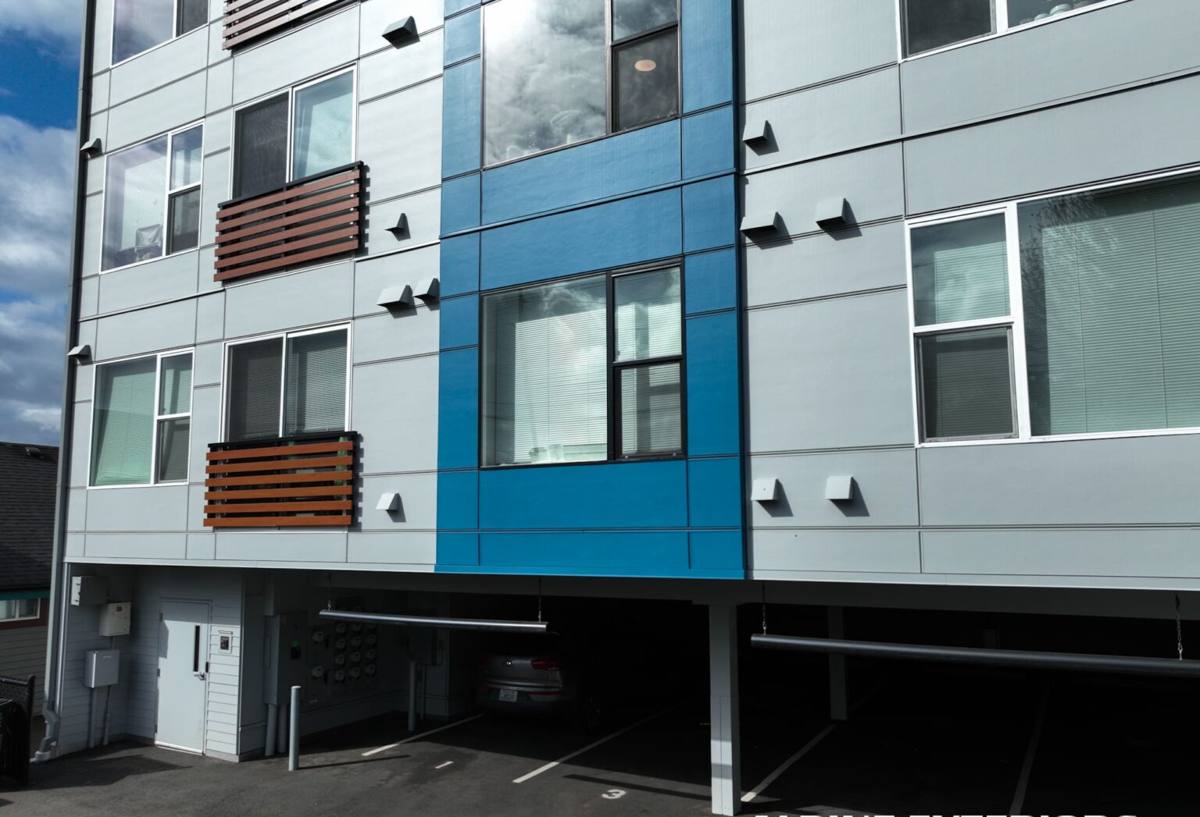
Fiber cement is a good match for Whatcom County's climate in general, but "fiber cement" isn't one single product — the fiber cement category includes real differences in formulation, factory finish, and how well a given line is engineered for a wet Pacific Northwest climate versus a dry one. We install James Hardie exclusively, specifically because their HZ5 product line is engineered for climates like this one — wet, moss-prone, with long stretches of moisture exposure rather than occasional heavy weather.
Why We Standardized on James Hardie
Fiber cement's core promise is that it's non-combustible, dimensionally stable, and doesn't rot, swell, or feed insects the way wood-based products can. James Hardie backs that with a factory-applied ColorPlus finish, which is baked on under controlled conditions rather than field-painted on site — that matters directly in a climate like ours, because a factory finish cures fully before it's ever exposed to Whatcom County rain, while field-applied paint has to cure in whatever weather shows up that week. Hardie also backs its products with a strong, transferable warranty, and because we install one manufacturer's system rather than mixing brands, there's a single point of accountability if something in that system doesn't perform as promised.
Where Installation Quality Makes or Breaks the Job
Fiber cement siding fails almost never because the material itself is bad — it fails because it was installed without accounting for local moisture behavior. In a shaded, damp setting like Acme, a few details matter more than they would on a drier lot:
- Correct clearance between the bottom edge of siding and the ground, decks, and roof lines, so splash-back and standing moisture don't sit against the cut edge
- Proper flashing and house-wrap integration at windows, doors, and any wall penetrations, so wind-driven rain can't track behind the siding
- A drainable weather-resistive barrier behind the siding, giving any moisture that does get past the surface a way to drain and dry rather than sit against the sheathing
- Factory-cut and factory-primed edges kept sealed at every field cut, since an exposed raw edge is the fastest way for a fiber cement board to take on water
- Fastener placement and spacing to manufacturer spec, since over-driven or misplaced fasteners create small gaps that become long-term leak points
None of this is unique to Acme — it's correct installation practice everywhere Hardie products go on. What changes here is the margin for error. On a shaded, slow-drying lot, a small installation mistake that might dry out and cause no harm in a sunny, open location instead stays wet for weeks, and that's when small mistakes turn into real damage.
Cost Factors That Are Specific to an Acme Job
Every siding estimate is specific to the house, but a few factors come up more often on Acme jobs than on siding jobs closer to central Lynden:
| Factor | Why It Comes Up in Acme | Typical Effect on the Job |
|---|---|---|
| Tree cover and shaded walls | Slower drying means more attention to drainage plane and clearances during install | Slightly more prep time, not usually a major cost driver |
| Existing moisture damage behind old siding | Older siding on shaded walls often hides sheathing that's been damp longer than it looks from outside | Can add repair scope once old siding is removed and the wall is inspected |
| Site access and driveway/lot layout | Rural lots outside town sometimes have longer driveways or tighter staging areas | Minor scheduling and logistics factor, rarely a major cost item |
| Product line and profile choice | HardiePlank lap versus HardieShingle or panel accents changes material and labor | Larger cost factor than climate itself — driven by design choice |
| ColorPlus vs. field-applied finish | ColorPlus costs a bit more up front but removes future repainting from the maintenance picture | Higher initial cost, lower long-term maintenance cost |
How We Handle an Acme Siding Job
Assessment First, Not Just a Measurement
Before we quote a job in Acme, we look past the visible siding to the condition of the wall behind it — especially on shaded or north-facing sides where moisture problems hide longest. If there's existing rot, soft sheathing, or trapped moisture, that gets identified and priced honestly up front rather than discovered mid-project.
Prepping for the Climate, Not Just the House
Tear-off, house-wrap or drainage-plane repair, and flashing detail all get handled with Whatcom County's wet cycle in mind — not a generic install checklist. That means extra attention at every horizontal transition and penetration, since those are the spots driving rain finds first.
Installing to Manufacturer Spec, Every Time
We follow James Hardie's installation requirements for clearance, fastening, and joint treatment on every job, because that's what keeps the warranty intact and what actually keeps water out. There's no shortcut version of this step that still performs the same way over ten or twenty years.
Final Walkthrough
We check clearances, caulking, trim details, and finish consistency before calling a job done, and we're straightforward about anything that needs attention down the road — even small things.
Why It Matters to Hire a Crew That Already Works This Area
Siding installation isn't regional in the sense that the product changes town to town, but the judgment calls involved absolutely are. A crew that already works Acme and the surrounding Lynden area knows to slow down on shaded walls, knows what moisture-damaged sheathing looks like after a long wet season, and knows how long a wall actually needs to dry before it's safe to close back up. A crew unfamiliar with this specific climate pattern can do technically correct work by a generic checklist and still miss the details that matter here — because the checklist doesn't know about local shade, drainage, and drying time the way a crew that's already done a dozen jobs in this terrain does.
Keeping Fiber Cement Siding Performing Long-Term in Acme's Climate
Fiber cement siding, installed correctly, needs relatively little upkeep — but "little" isn't "none," especially on a shaded, moss-prone lot. A short seasonal check goes a long way:
- Rinse moss and algae off shaded or north-facing walls before it builds up thick enough to hold moisture against the surface
- Keep gutters clear so overflow doesn't run down the siding face during heavy rain
- Trim back branches and shrubs that keep a wall section shaded and slow to dry
- Check caulking at trim, windows, and joints yearly, since caulk is the one component that ages faster than the siding itself
- Look for soft spots, swelling at bottom edges, or peeling paint on any wood trim elements — early signs worth a professional look before they spread
Signs It's Time to Repair or Replace
Not every issue means a full re-side. Isolated caulking failure, a damaged board, or minor trim rot can often be repaired without touching the rest of the wall. But a few signs point toward replacement rather than patching: siding that's soft or crumbling across multiple areas, persistent moss growth that keeps coming back no matter how often it's cleaned, visible gaps or separation at butt joints across the wall, or old wood-based or damaged siding that's been trapping moisture against the sheathing for years. If you're not sure which category your home falls into, that's exactly the kind of question worth getting an honest, in-person answer to before spending money either way.
If you're in Acme or anywhere else around Lynden and want a straight answer on what your siding actually needs, we're glad to take a look. There's no pressure and no cost to get an estimate — just a clear picture of where things stand and what correct, climate-appropriate options look like for your home.