 Lynden
 Board & Batten That's Actually Built for Custer
Custer sits in that stretch of Whatcom County where the weather off the water and the weather off the farmland meet, and it shows on houses. Board and batten siding is a natural fit for the barns-and-farmhouses character a lot of homes out here already have, but the look only holds up if the material and the installation account for what this climate actually does to a wall. We install board and batten for Custer homeowners the same way we do everywhere else we work in Whatcom County: one product line, installed to a spec that assumes salt air, driving rain, and a moss season that runs longer than most homeowners realize.
This page is about that one job — board and batten siding, on homes in and around Custer — not a general overview of every siding option. If you're comparing board and batten to lap siding for a Custer property, or you've already decided on the vertical look and want to know what a correct installation involves, this is written for you.
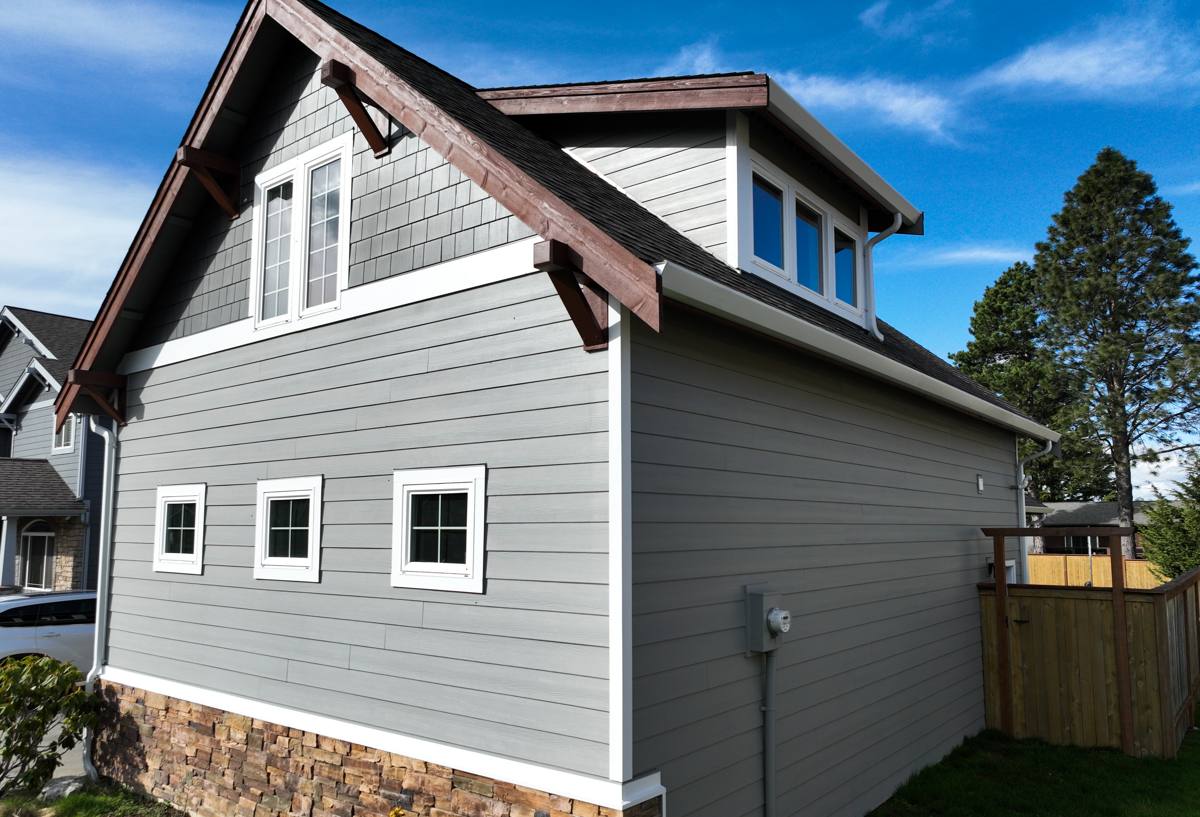
What Custer's Climate Does to a Vertical Siding Profile
Board and batten is more exposed to certain failure modes than horizontal lap siding, simply because of the vertical seams and the way water moves down a wall. In Custer's specific conditions, three things matter more than they would somewhere drier and further inland.
Salt Air and Coastal Exposure
Custer's proximity to the saltwater coastline means airborne salt reaches building exteriors even without a direct ocean view. Salt-laden moisture accelerates corrosion on exposed fasteners and metal trim, and it's harder on paint films and caulk joints than plain rainwater. A board and batten wall has more vertical joints and more exposed fastener lines than lap siding, so the fastening and finish choices matter more here than they would on a horizontal profile.
Driving Rain Against Vertical Seams
Whatcom County's weather comes in off the Strait in wind-driven bands, and wind-driven rain behaves differently on a vertical seam than it does on a shingled, overlapping lap profile. Water can be pushed sideways and upward into a poorly sealed batten joint in a way it simply can't on a lapped horizontal board. That's not a reason to avoid board and batten — it's a reason the water-resistive barrier, flashing, and joint treatment behind it have to be right.
A Long Moss Season
Between the marine humidity and the shaded, tree-lined lots common around Custer, moss and algae growth on siding isn't a cosmetic footnote — it's a maintenance reality that runs most of the year. Moss holds moisture against a wall surface far longer than open air does, and it will grow on any siding material given the right shade and humidity. What differs is how the material handles that sustained damp contact over years, and how easily it cleans without damaging the finish.
Where Board & Batten Installations Actually Fail
Most board and batten problems we get called out to inspect trace back to a handful of installation shortcuts, not the concept of vertical siding itself:
- Battens face-nailed directly through both layers into sheathing, with no room for the boards to move seasonally, which splits the material or blows out fastener holes
- No functioning water-resistive barrier and rainscreen gap behind the panels, so any water that gets past a joint has nowhere to go but into the wall assembly
- Butt joints and corners caulked instead of properly flashed, relying on a bead of sealant as the only defense against driving rain
- Fastener spacing and battens set without accounting for expansion, especially on longer wall runs common on Custer's larger rural lots
- Cut ends and field cuts left unsealed, giving moisture a direct entry point into the substrate at every seam
Every one of those shortcuts is invisible on install day. They show up two, five, or ten winters later, which is exactly why the contractor's process matters as much as the product on the wall.
The Board & Batten System We Install
We install James Hardie fiber cement exclusively — no vinyl board and batten, no cedar, no engineered wood panel systems. For a project like this, that typically means Hardie panel or plank products configured in a board and batten pattern with a factory ColorPlus finish, backed by Hardie's engineered HZ10 formulation built specifically for wetter, cooler climates like ours. That's a deliberate standard, not a default, and it's worth explaining why.
| Factor | Cedar Board & Batten | Vinyl Board & Batten | James Hardie Fiber Cement |
|---|---|---|---|
| Moisture behavior | Absorbs water; needs consistent sealing/refinishing | Doesn't absorb, but seams flex and can loosen over time | Engineered for moisture exposure; doesn't rot or swell |
| Salt air resistance | Finish breaks down faster near salt exposure | Holds up to salt but can chalk and fade | Factory finish formulated to resist fading and moisture damage |
| Fire performance | Combustible | Combustible | Non-combustible core material |
| Moss/algae cleanup | Can stain or degrade wood surface | Cleans easily but surface can look worn afterward | Cleans without damaging the ColorPlus finish |
| Maintenance cycle | Recoat/reseal every few years | Low maintenance, limited repair options if damaged | Long intervals between repainting; factory finish is the durable layer |
Cedar board and batten looks the part, and we understand the appeal, but a wood surface exposed to Custer's rain and moss season needs a maintenance commitment most homeowners underestimate at the time of installation. Vinyl board and batten avoids the rot question but introduces its own trade-offs — thinner material, more visible seams up close, and a look that reads as vertical siding rather than a true board-on-board profile. Fiber cement gives us a material dense enough to hold sharp lines, take a durable factory finish, and shrug off the salt and moisture exposure that's routine out here.
Why We Don't Substitute a Cheaper Fiber Cement Line
James Hardie isn't the only fiber cement manufacturer, but it's the one we've standardized on for the warranty structure, the consistency of the ColorPlus finish, and the climate-specific HZ engineering. We'd rather turn down a job than install a product line we can't stand behind ten years from now.
Our Installation Process for Board & Batten in Custer
The process doesn't change because a house is in Custer versus Lynden versus anywhere else in Whatcom County — but the details we pay closest attention to are shaped by what we've just described.
- Site and wall assessment — checking existing sheathing condition, current moisture intrusion signs, and sun/shade exposure that affects moss growth patterns on each elevation
- Water-resistive barrier and rainscreen installation — a continuous drainage plane behind the panels so any water that reaches the seams has somewhere to go
- Flashing at every penetration and joint — windows, doors, and horizontal joints get metal flashing, not caulk, as the primary water management
- Panel and batten layout — spacing and fastening set to allow for material movement, with fastener placement following Hardie's published specifications, not shortcuts
- Sealed cuts and corners — every field cut treated before installation so no raw edge is left exposed to moisture
- Final finish inspection — checking the ColorPlus finish for consistency and confirming clean, tight lines on the batten pattern
Homeowners evaluating a quote for this kind of project should ask specifically about steps 2 through 5 — that's where the difference between a siding job that lasts and one that doesn't actually gets decided.
What Board & Batten Costs to Do Right in Custer
Costs vary by home size, elevation complexity, and existing wall condition, but the factors below are the ones that actually move the number on a real bid.
| Cost Factor | Why It Matters Here |
|---|---|
| Existing sheathing condition | Moisture-damaged sheathing found during tear-off adds repair cost before new siding goes on |
| Wall height and number of stories | Custer's rural properties often include larger farmhouse-style walls, which affects labor and scaffolding needs |
| Trim and corner detailing | Board and batten's visual appeal depends on clean corner and trim work, which takes more finish labor than plain lap siding |
| Rainscreen/drainage plane | A proper drainage gap adds material and labor but is the single biggest factor in long-term moisture performance |
| ColorPlus finish selection | Factory-applied color eliminates a field-paint step but color and texture options affect base material pricing |
We'll walk through all of this specific to your house during a quote — there's no honest way to give a number without seeing the walls first.
Why a Crew That Already Works Custer Matters
We're based just up the road in Lynden, and Custer is well within the area we regularly work, which means we're not learning Whatcom County's weather patterns on your project. We already spec board and batten installations assuming salt air exposure and a long moss season, because we've seen what happens on local homes when those factors get ignored. A crew based somewhere without that regional exposure may default to a generic install spec that's fine in a drier climate and undersized for ours.
A Quick Checklist Before You Hire
- Ask what water-resistive barrier and drainage plane system they use behind the panels
- Confirm the fiber cement manufacturer and product line by name, not just "fiber cement"
- Ask how fastener spacing accounts for material expansion on your specific wall lengths
- Get the flashing detail explained for windows, doors, and horizontal joints
- Ask how they'd handle a wall section with existing moss or algae staining discovered during tear-off
A contractor who answers those questions specifically, rather than generally, is one who's actually thought through what board and batten needs to do on a Whatcom County wall.
If you're weighing board and batten for a home in Custer, we're happy to take a look and give you a straightforward, no-pressure estimate — just fill out the form below and we'll get back to you.