 Lynden
 Why Deming Homes Need Siding Built for This Specific Climate
Deming sits back from the water compared to Lynden and the rest of the Whatcom County lowlands, but that doesn't mean the siding on a Deming home has it easy. The Nooksack River valley funnels marine-influenced air inland, and homes here still deal with long stretches of driving rain, heavy tree cover, and dampness that lingers on the shaded side of a house for days after a storm passes. Add in the elevation and proximity to the foothills, and you get a microclimate that's arguably tougher on exterior materials than some coastal spots — more shade, more standing moisture, less direct sun to dry things out.
Damp air that doesn't clear out fast
Wind off the water pushes moist air up the valley, and Deming's tree cover and terrain slow it down once it arrives. That means siding here often stays wet longer after a rain event than siding on an open, sun-exposed lot closer to town. Materials that absorb water or swell when saturated are working against the site conditions from day one.
A moss season that runs most of the year
Between the shade, the moisture, and the mild temperatures, moss and algae have a long growing window in this part of Whatcom County. On siding, that shows up as green or black staining in shaded corners, along roof lines, and anywhere water sheets down without much airflow behind it. The siding material itself doesn't stop moss from landing, but how it's installed — clearances, drainage, ventilation — determines whether moss just sits on the surface or actually feeds off a wet substrate underneath.
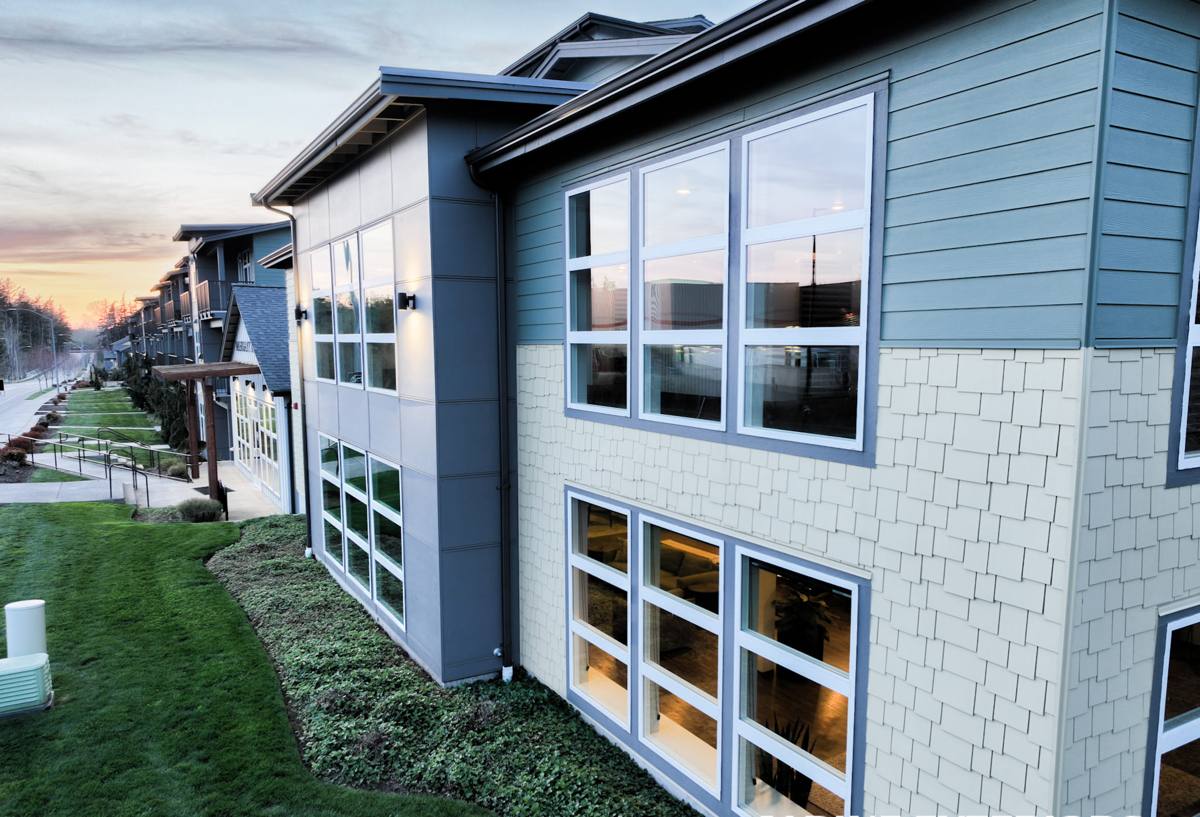
What Correct James Hardie Installation Actually Involves
James Hardie fiber cement is a non-combustible, engineered product, but it only performs the way it's designed to when it's installed to Hardie's actual specifications — not just nailed up in a way that looks similar to the old siding it replaced. In a damp, moss-prone area like Deming, the installation details matter more than the brand name on the box.
The water management layer comes first
Before a single plank goes up, the house needs a correctly lapped weather-resistive barrier, properly integrated flashing at every window, door, and penetration, and a drainage plane that lets any incidental moisture get out instead of sitting against the sheathing. This is the part of the job nobody sees once it's done, and it's also the part that determines whether the wall assembly stays dry for the next 30 years or starts rotting from the inside in year eight.
Fasteners, clearances, and joints
Hardie specifies fastener type, spacing, and embedment depth for a reason — get it wrong and you get popped nails, cracked planks, or panels that can't move with seasonal humidity changes. Just as important in our climate: the minimum clearance between siding and grade, decks, roof lines, and other horizontal surfaces. Skip that clearance and you're guaranteeing the bottom courses stay wet longest and moss the fastest, no matter how good the material is.
Joint treatment and caulking
Butt joints, corners, and trim intersections are where water finds its way in on almost every siding failure we inspect. Correct installation means factory-primed or ColorPlus-finished cut edges get sealed or capped as specified, joints are flashed rather than just caulked, and caulk is used as a backup, not the primary defense. In a wet climate, a installation that relies on caulk alone is a maintenance problem waiting to happen.
HZ5 vs Standard Hardie Products — Which Belongs on a Deming Home
James Hardie makes climate-specific product lines, and the difference isn't marketing — it's engineering for moisture exposure. For the Pacific Northwest, that means the HZ5 line, formulated for wetter, freeze-prone regions.
| Factor | HZ5 (PNW-engineered) | Non-regional formulation |
|---|---|---|
| Moisture resistance | Formulated for high-rainfall, high-humidity regions | Formulated for drier or hotter climates |
| Freeze-thaw performance | Engineered to handle regional freeze-thaw cycling | Not optimized for our winter pattern |
| Warranty fit | Matches Hardie's regional installation standards | May not align with local building practices |
| Our recommendation for Deming | Standard choice | Not what we install here |
We install the product line engineered for this region because that's the version Hardie itself designed and tested for Whatcom County conditions. There's no upside to substituting a product line built for a different climate.
ColorPlus Factory Finish vs Field Painting
Hardie's ColorPlus finish is baked on at the factory under controlled conditions, with a finish that's engineered to resist fading and chipping better than a site-applied paint job. In a climate where the siding stays damp for extended stretches, that matters for two reasons: a factory finish has better adhesion under moisture cycling, and it doesn't rely on field conditions — wind, humidity, temperature — being right on installation day, which in this part of Whatcom County is never guaranteed. Field-painted siding can still look good, but it puts the long-term finish quality in the hands of weather on one specific week, rather than a factory process.
Our Process for a Deming Siding Project
- On-site assessment — we look at the existing siding, sheathing condition, moisture history, and site-specific factors like shade, tree cover, and drainage around the foundation.
- Tear-off and sheathing inspection — old siding comes off and we check what's underneath before covering it back up. This is where hidden rot or past water intrusion gets caught.
- Water management layer — correct weather-resistive barrier, flashing at every opening, and a drainage plane built to Hardie's specification and best practice for our rainfall.
- Hardie installation — HZ5 product line, correct fastener schedule, correct clearances from grade and horizontal surfaces, joints flashed and sealed properly.
- Trim, caulking, and finish details — the small stuff that determines whether the job still looks tight in year ten.
- Final walkthrough — we go over the finished work with the homeowner before calling it done.
Common Problems We See on Homes Around Deming
Some of what we run into during tear-offs and inspections on older siding in this area:
- Siding installed tight to grade or decking with no clearance, holding moisture against the bottom courses year-round
- Missing or poorly lapped flashing above windows and doors, leading to hidden water damage behind the siding
- Caulk used as the only defense at joints and corners, with no flashing behind it
- Heavy moss and algae buildup on the shaded, less-ventilated sides of the house
- Older or non-regional siding material that's swollen, delaminated, or lost its factory finish from years of damp exposure
- Nail pops and cracked panels from incorrect fastening that let moisture behind the siding face
Cost Factors for James Hardie Siding in Deming
Every home is different, but the same handful of factors drive most of the cost variation we see on projects in this area.
| Factor | Why it affects cost |
|---|---|
| Existing siding removal | Tear-off, disposal, and any sheathing repair uncovered underneath |
| Wall complexity | Dormers, multiple gables, and cut-up elevations take more labor per square foot than simple wall planes |
| Product selection | Lap siding, shingle-style panels, and trim board choices carry different material costs |
| Site access | Rural lots, longer driveways, and tree-heavy sites around Deming can affect staging and scaffolding time |
| Moisture damage repair | Rotted sheathing or framing found during tear-off adds cost, but skipping the repair costs far more later |
We give a firm number after we've actually looked at the house — not before. Any estimate that skips the on-site assessment is guessing, and in a climate like this one, guessing on the water management details is exactly where problems start.
Why Hire a Crew That Already Works Deming
Deming isn't a big town, but it has its own site conditions — foothill shade, tree cover, rural lots, and a moisture pattern that's a step wetter and slower to dry than the open lowlands closer to Lynden. A crew that already works this stretch of Whatcom County has seen how siding actually performs here over years, not just on installation day. That experience shows up in the small decisions — where to add extra flashing, which walls need more attention to ventilation and clearance, how to sequence work around our weather windows — that don't show up on a spec sheet but make the difference between siding that holds up and siding that starts showing moss and staining within a few seasons.
If you're considering new siding for a home in or around Deming, we're happy to come take a look and give you a straightforward, no-pressure estimate — no invented urgency, just an honest read on what your house needs.