 Lynden
 Ferndale sits close enough to the water and the tide flats that salt air is part of daily life, and far enough into Whatcom County's rain belt that siding here spends most of the year damp. Add a long moss season stretching from fall through spring, and you have a climate that is quietly hard on exterior walls even when nothing looks obviously wrong. A siding installation done right for Ferndale is not the same job as one done for a dry inland town, and it should not be priced or planned as if it were.
What Ferndale's Climate Actually Does to Siding
Three things work against exterior walls here, and they work together rather than separately.
Salt Air and Marine Moisture
Proximity to Bellingham Bay and the broader Salish Sea means the air carries fine salt particles that settle on exterior surfaces. Over years, that salt film holds moisture against siding longer than plain rain would, and it accelerates corrosion on fasteners, flashing, and any exposed metal trim. Siding that isn't engineered to shrug off moisture absorption starts to show it first at the bottom courses and around corner boards.
Driving Rain
Whatcom County doesn't just get a lot of rain — it gets wind-driven rain that hits walls at an angle rather than falling straight down. That means water gets pushed up under laps, into butt joints, and around windows and doors in ways that a simple "keep water off the wall" approach doesn't handle. The house needs a real drainage plane behind the siding, not just a water-resistant face.
Moss and Organic Growth
Shaded north walls, tree cover, and long stretches of overcast, damp weather give moss, algae, and mildew months at a time to establish themselves. Once organic growth takes hold on a porous or absorbent siding surface, it holds even more moisture against the wall and accelerates whatever decay process was already underway. On homes with mature landscaping — common throughout Ferndale's older residential streets — this is less an occasional nuisance and more a permanent condition to design around.
Why We Only Install James Hardie Fiber Cement
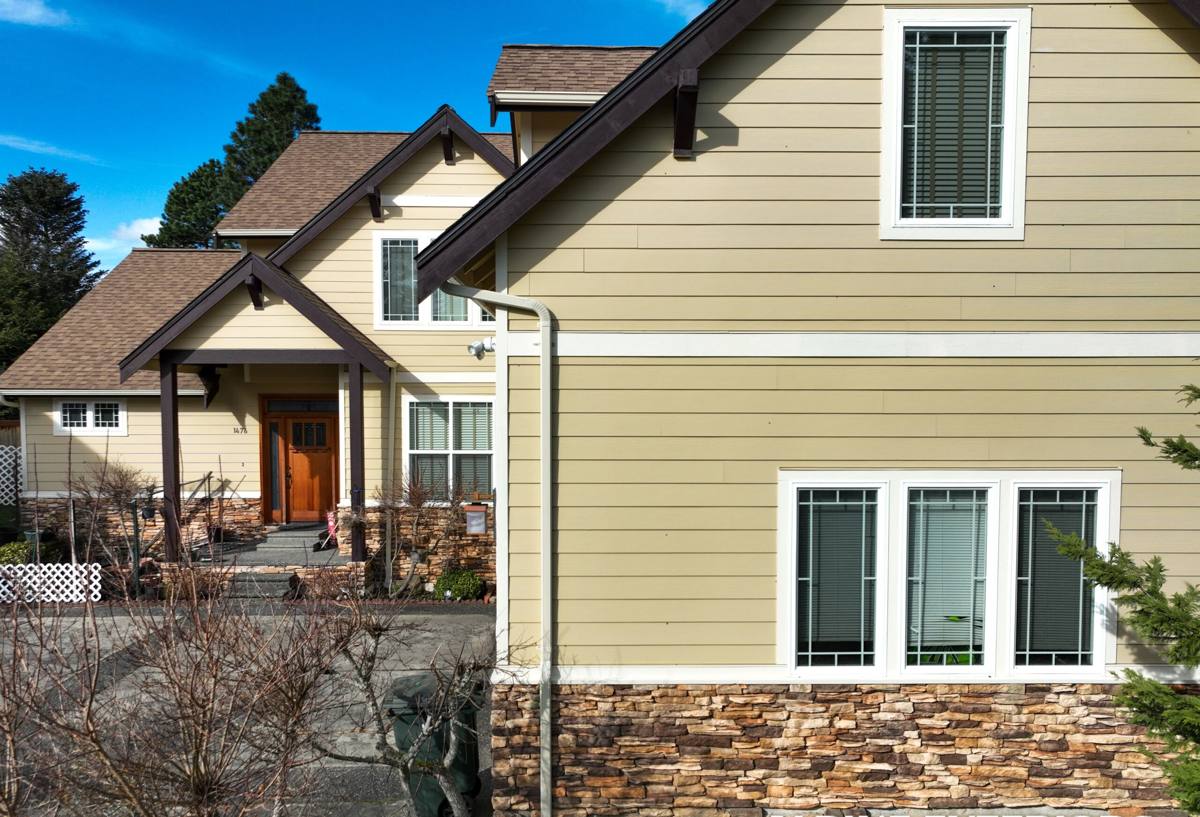
We install one siding system: James Hardie fiber cement, factory-finished with ColorPlus coating. That's not a marketing preference — it's a decision built around exactly the three problems above.
- Non-combustible core. Fiber cement doesn't feed a fire the way wood-based products can, which matters increasingly for insurance and code considerations in the Pacific Northwest.
- Engineered for moisture, not just coated against it. Hardie's HZ5 product line is formulated specifically for climates with heavy rain and humidity cycles, which describes Whatcom County well.
- A factory finish that doesn't rely on field paint. ColorPlus is baked on under controlled conditions, so it resists the fading, chalking, and peeling that field-applied paint suffers when exposed to salt air and constant damp.
- Dimensionally stable. Fiber cement doesn't swell and shrink with moisture the way wood-based sidings can, which keeps joints and laps tighter over time — fewer gaps for wind-driven rain to exploit.
We don't install vinyl, LP SmartSide, cedar, primed spruce, Cemplank, or Allura. Each of those products has legitimate uses somewhere, but none of them hold up to our standard for a marine-influenced, high-moisture climate as well as Hardie does, and we'd rather turn down a job than install something we don't believe will perform on a Ferndale wall for the next thirty years.
What a Correct Ferndale Siding Job Actually Involves
Siding installation is mostly invisible work once it's done — the parts that determine whether a wall performs for ten years or thirty years are all underneath the finished surface.
Tear-Off and Wall Inspection
We remove the old siding down to the sheathing and inspect for rot, soft spots, and prior water intrusion — especially around window sills, door thresholds, and any wall that faces prevailing weather. Anything compromised gets repaired before new material goes up. Covering damaged sheathing with new siding just hides a problem that gets worse behind the wall.
Weather-Resistive Barrier and Drainage Plane
Given how much wind-driven rain this area sees, we pay particular attention to the water-resistive barrier and how it integrates with flashing at every penetration — windows, doors, hose bibs, light fixtures, vents. A drainage plane that lets incidental moisture escape is what keeps a small amount of water intrusion from becoming a rot problem.
Flashing and Trim Details
Corner boards, window and door flashing, and the transitions where siding meets roof lines or foundation are where most siding failures actually start — not on the flat field of the wall. We detail these carefully and use materials that won't corrode in salt-influenced air.
Fastening and Lap Spacing
Hardie specifies fastener type, placement, and lap exposure for a reason — get it wrong and you create gaps or stress points where wind-driven rain gets a foothold. We follow manufacturer installation specs exactly, which is also what keeps the product warranty intact.
Ventilation and Drying Capacity
A wall that can dry out between rain events holds up far better than one that stays perpetually damp. We make sure the assembly has a path for moisture to escape, particularly on shaded or north-facing walls where drying time is naturally slower.
Our Process for Ferndale Homeowners
| Step | What Happens |
|---|---|
| 1. On-site assessment | We walk the exterior, check current siding condition, and note trouble spots specific to sun exposure, shade, and wind direction on your lot. |
| 2. Written estimate | A clear scope and cost breakdown — no surprise change orders for work that should have been scoped up front. |
| 3. Material selection | Hardie plank, panel, or shingle profile and ColorPlus color, matched to the home's style and your preference. |
| 4. Tear-off and inspection | Old siding removed, sheathing inspected and repaired as needed before anything new goes up. |
| 5. Installation to spec | Weather barrier, flashing, fastening, and lap spacing done to Hardie's published requirements. |
| 6. Final walkthrough | We review the finished work with you and confirm everything meets the standard we set for our own crews. |
Why a Crew That Already Works Ferndale Matters
Siding installation isn't a one-size-fits-all trade. A crew that regularly works Ferndale and the surrounding Whatcom County area already understands which walls take the worst of the weather, how far moss and mildew pressure extends up a wall in a given yard, and where prior work in this area has held up versus where it hasn't. That local pattern recognition shows up in small decisions — flashing choices, fastener selection, where extra sealant detail is worth the time — that a crew unfamiliar with the region wouldn't necessarily think to make.
There's also a practical scheduling benefit: a local crew can respond to weather windows more efficiently, which matters on a coast where dry stretches long enough for tear-off and install aren't unlimited.
Signs Your Ferndale Home May Need New Siding
- Visible moss or persistent green/black staining that returns shortly after cleaning
- Soft or spongy spots when you press on siding, especially near the bottom courses
- Paint that's peeling, bubbling, or chalking faster than it used to
- Gaps opening up at butt joints or around trim that weren't there a few years ago
- Visible warping, cupping, or separation of boards, particularly on shaded walls
- Rising energy bills that may point to compromised insulation behind failing siding
Cost Factors to Expect
Every home is different, but the main variables that move a Ferndale siding estimate are consistent from job to job.
| Factor | Why It Matters |
|---|---|
| Home size and wall complexity | More corners, dormers, and trim detail mean more labor and material cuts. |
| Extent of sheathing repair | Hidden rot found during tear-off adds cost but prevents a bigger problem later. |
| Hardie profile selected | Lap siding, shingle-style, and panel systems differ in material and labor cost. |
| Access and site conditions | Mature trees, fencing, and tight lot lines common in older Ferndale neighborhoods can affect staging and timeline. |
| Trim and accessory work | Fascia, soffit, and trim replacement alongside siding affects total scope. |
Maintenance Once It's Installed
Hardie siding with a ColorPlus finish is low-maintenance, not no-maintenance. In a climate like Ferndale's, a periodic soft wash to remove moss and organic buildup — especially on shaded and north-facing walls — keeps the surface performing as designed and keeps the factory finish looking the way it should for years longer. Caulking at trim joints should be checked periodically as well, since sealant is one of the few components that does wear over time regardless of the siding material behind it.
If your Ferndale home's siding is showing its age, or you're planning ahead rather than waiting for a problem, we're happy to walk the exterior with you and give you a straight answer about what it needs. Reach out for a free, no-pressure estimate — there's no obligation, just an honest look at your home.