 Lynden
 Why Wiser Lake Homes Wear Out Siding Faster Than the Brochure Says
Homes around Wiser Lake sit in one of the wetter, greener corners of Whatcom County. The lake itself adds standing humidity that lingers in the yard and against north- and east-facing walls long after a storm has passed. Add in the marine-influenced air that moves across the Lynden lowlands from the Salish Sea, driving rain that comes in sideways off the Nooksack valley weather patterns, and a moss season that can run eight months out of the year, and you get a set of conditions that punishes any siding product installed with shortcuts.
Most of what we see failing on lake-adjacent properties isn't a bad product — it's a product that was never engineered for this kind of sustained moisture exposure, or one that was installed without the details that keep water moving away from the wall instead of into it. That's the starting point for every job we do near Wiser Lake: assume the wall will get wet often, and build the system so it dries out fast every time.
What "Long Moss Season" Actually Does to a Wall
Moss doesn't just look bad. It holds moisture against the siding surface, keeps that surface shaded and cool longer than bare siding would be, and slows evaporation on the north and west elevations that already get the least sun. Over years, that constant damp cycle is what breaks down products that rely on paint film or surface coatings rather than a factory-cured finish, and it's what accelerates rot at anywhere caulk or trim has started to fail.
Why We Only Install James Hardie Fiber Cement
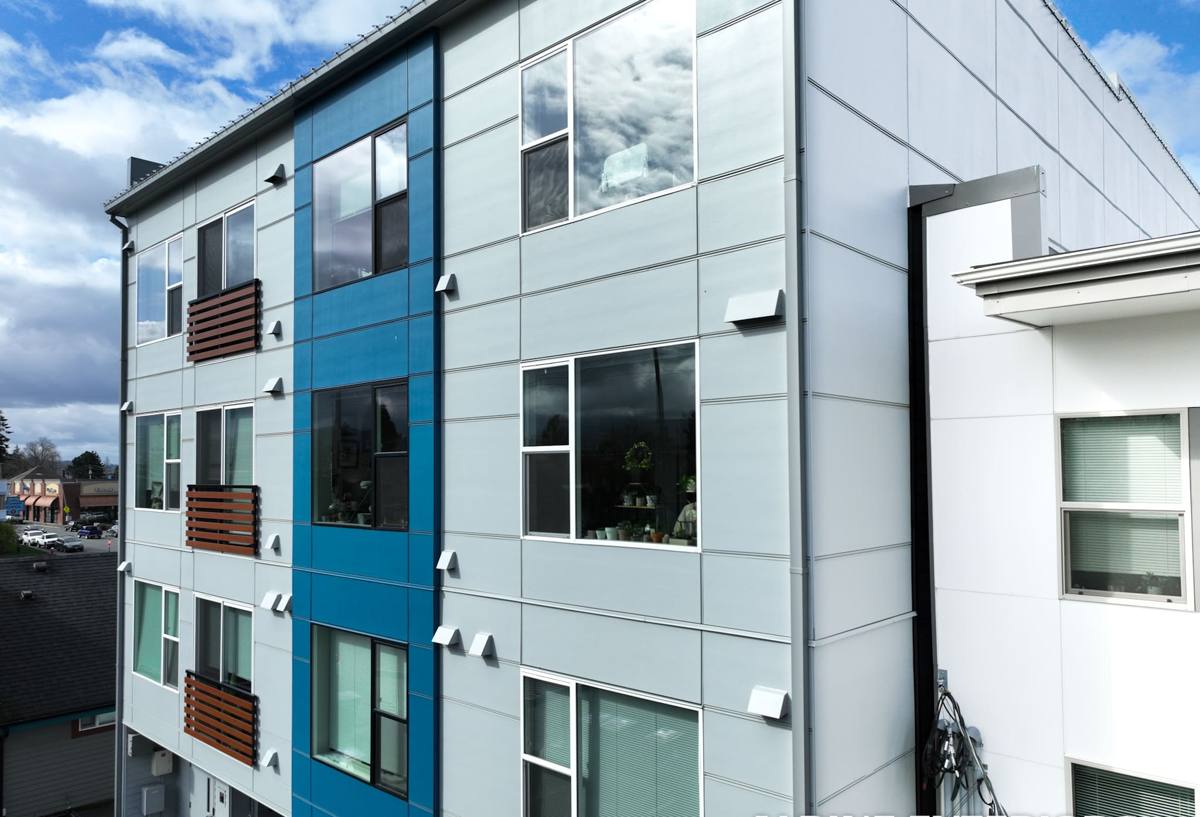
We standardized on James Hardie products for every home we side, including the ones around Wiser Lake, because fiber cement handles sustained moisture exposure differently than the alternatives. It's non-combustible, it doesn't absorb water the way engineered wood products can, and the ColorPlus factory finish is baked on under controlled conditions rather than field-applied — which matters a lot in a climate where you don't get long dry stretches to paint and cure.
We don't install vinyl, LP SmartSide, or cedar on these homes. That's not a knock on any homeowner who has one of those products already — it's a standard we hold for new installs because we've seen how each of those materials behaves specifically in this moisture regime, and Hardie is the one we're willing to put our name behind here.
HZ5 Engineering Matters in This Zone
James Hardie makes climate-specific product lines, and the HZ5 formulation is engineered for the wetter, freeze-capable Pacific Northwest climate zone that includes Whatcom County. It's formulated to resist moisture-related damage better than the versions of Hardie siding sold in dry southern climates. Any Hardie job we quote near Wiser Lake uses HZ5 product — using the wrong climate zone product is one of the most common corner-cutting mistakes in this trade, and it's invisible until years later.
What a Correct Installation Involves
The siding panel itself is only part of the system. Around Wiser Lake specifically, we pay closest attention to the parts of the installation that control water once it inevitably gets behind the surface layer — because with this much ambient moisture, it will, eventually, at some point in the home's life.
- Rainscreen drainage gap: a ventilated air space behind the siding so any moisture that gets past the cladding can drain and dry instead of sitting against the sheathing.
- Weather-resistive barrier, correctly lapped: installed shingle-style so every seam sheds water downward, never trapping it.
- Flashing at every penetration: windows, doors, hose bibs, light fixtures, and deck ledgers all get proper head flashing and kick-out flashing where walls meet rooflines.
- Correct fastener pattern and clearance: Hardie's installation spec calls for minimum clearances from grade, decks, and roof lines — clearances that get ignored more often than you'd think, and that's exactly where rot starts.
- Factory-primed and sealed cut edges: every field cut gets sealed before installation so raw fiber cement edges aren't left exposed to weather.
Skip any one of these and the siding itself can be flawless while the wall behind it still fails. This is the part of the job that doesn't show up in a driveway walkthrough but is the actual difference between siding that lasts and siding that needs attention in year seven.
Which James Hardie Product Lines Fit Wiser Lake Properties
Most homes we work on around Wiser Lake are a mix of traditional lap-sided houses and newer builds with more architectural detail. Hardie's product family covers both without needing a different manufacturer for trim or accents.
| Product | Best Use | Why It Fits This Area |
|---|---|---|
| HardiePlank lap siding | Primary wall cladding on most home styles | Widest color and texture range; the workhorse for full re-sides |
| HardiePanel vertical siding | Accent walls, gables, modern facades | Clean lines that shed water well on steep or exposed elevations |
| HardieShingle | Gable accents, dormers, craftsman-style details | Decorative detail without the moisture retention of real cedar shingle |
| HardieTrim boards | Corners, window and door trim, fascia | Matched system with the siding — no mismatched expansion or moisture behavior between materials |
Our Process for a Wiser Lake Job
- On-site assessment: we look at existing siding condition, moisture staining, moss patterns, drainage around the foundation, and how the home's orientation exposes it to prevailing weather.
- Tear-off and sheathing check: once old siding comes off, we inspect the sheathing itself — this is where hidden rot from years of moisture intrusion actually shows up, and it needs to be dealt with before anything new goes on.
- Weather barrier and rainscreen installation: the drainage system goes in before a single piece of Hardie touches the wall.
- Flashing at every opening and penetration: done before siding installation begins, not patched around it after.
- HZ5 Hardie installation to manufacturer spec: correct fastener spacing, clearances, and joint treatment.
- Final trim, caulking, and walkthrough: we go over clearances, downspout placement, and anything the homeowner should watch for going forward.
What Drives the Cost on a Wiser Lake Home
| Factor | Why It Matters Here |
|---|---|
| Extent of hidden moisture damage | Homes with long-standing moss or past leaks often need sheathing repair before re-siding, which isn't visible until tear-off |
| Home size and wall complexity | Multiple gables, dormers, and cut-ins around a lake-view home add labor time beyond a simple rectangular footprint |
| Product line and texture selection | Smooth versus cedar-textured lap, and lap versus panel/shingle combinations, price differently |
| Trim and accent scope | Full HardieTrim packages on corners and openings add cost but keep the whole system consistent |
| Access and site conditions | Lakeside lots, slopes, and mature landscaping can affect staging and equipment access |
We don't quote off square footage alone — we quote after seeing the actual wall condition, because the difference between a straightforward re-side and one that needs sheathing repair is significant and only shows up on inspection.
Why It Matters That We Already Work This Area
A crew that only occasionally works out toward Wiser Lake is guessing at things a crew based in and around Lynden already knows cold: how far moss actually reaches into shaded lots on the lake's north side, which older subdivisions were built with minimal roof overhangs that put more rain directly on the walls, and how the local building department wants flashing and clearance details documented. None of that is exotic knowledge, but it's the kind of local familiarity that shows up in fewer callbacks, not in anything you'd notice on the surface of a finished job.
It also means faster response if something needs a look after the job is done — we're not scheduling a special trip from across the county to check a question about a corner detail or a downspout.
Maintaining Hardie Siding Around a Lake Environment
Correctly installed Hardie siding is low-maintenance, not no-maintenance. A short annual routine keeps it performing the way it's designed to:
- Rinse siding once or twice a year, especially on shaded north and east walls where moss and mildew build up fastest
- Keep gutters clear so overflow doesn't run directly down the wall face
- Trim back landscaping and tree limbs that keep siding shaded and damp longer than necessary
- Check caulking at trim joints and penetrations every couple of years and re-caulk as needed
- Watch for any soft spots, unusual staining, or paint film failure and address it early rather than waiting
None of this is heavy work, but skipping it is how even a well-installed system loses years off its service life in a moisture-heavy environment like this one.
Getting an Honest Look at Your Home
If you're weighing a re-side or building near Wiser Lake, we're happy to come take a real look at your walls — not a sales pitch, an actual assessment of what's going on with your current siding and what it would take to do the job right for this specific property. Reach out for a free, no-pressure estimate and we'll walk the property with you.