 Lynden
 Siding Replacement for Acme Homes
Acme sits at the foot of Whatcom County's hills, close enough to Lynden to share its weather and far enough into the trees to get its own version of it — more shade, more moisture lingering on the north side of a house, more moss creeping across a roofline and down onto siding before anyone notices. Add the salt-laden air that moves inland off the Sound on a southwest wind, along with the driving, sideways rain that Whatcom County gets several months a year, and you have a climate that is genuinely hard on exterior materials. Siding replacement out here isn't a cosmetic project. It's a decision about what's going to keep water out of your walls for the next few decades.
We work Acme regularly as part of our Lynden-area service territory, which means we already know what this specific stretch of county sees: tree cover that keeps siding damp longer after a storm, older homes with the original wood or early vinyl siding starting to fail, and driveways and access that don't always match what a job in town looks like. That local familiarity changes how we bid and how we install.
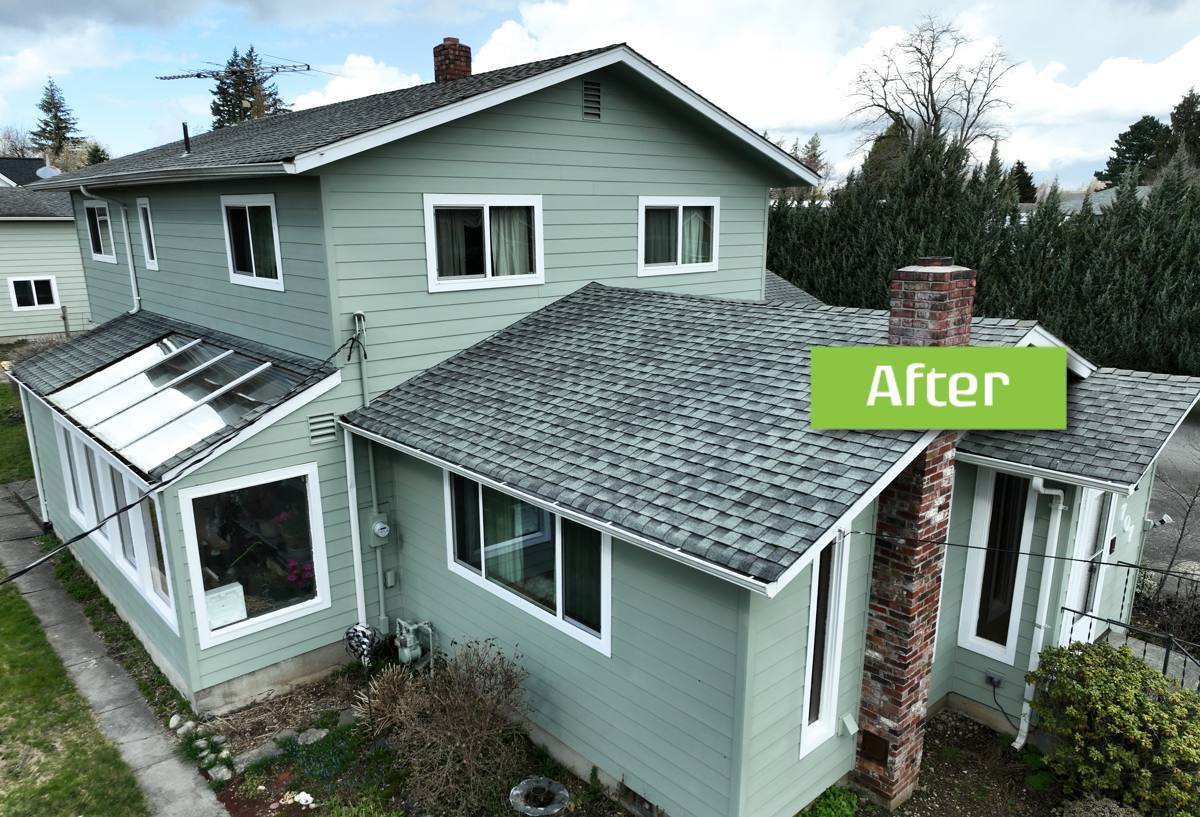
What Acme's Climate Actually Does to Siding
Moss and Sustained Moisture
Moss doesn't just grow on roofs. On homes with heavy tree cover — common around Acme — it establishes on siding too, especially on north- and west-facing walls that don't get much direct sun. Moss holds moisture against the surface far longer than open air would, and that sustained dampness is what breaks materials down: it swells wood fiber, degrades paint film, and on failing caulk joints, it's often the first visible sign that water is starting to track behind the siding rather than off of it.
Driving Rain and Wind-Driven Water
Rain that comes in mostly vertical is manageable for almost any siding. Rain that comes in sideways, pushed by wind off open ground or funneled between trees, tests every horizontal lap, every butt joint, and every penetration around windows and trim. This is where installation quality matters as much as the material itself — a good product installed with poor flashing and gapping will still let water in.
Salt Air and Corrosion
Acme is inland enough that salt exposure is lighter than it is on the water, but Whatcom County's prevailing weather still carries marine air a meaningful distance. Over years, that salt content accelerates corrosion on fasteners, trim flashing, and any siding product that relies on metal components or isn't dimensionally stable in swings of humidity.
What a Correct Siding Replacement Involves
A siding replacement is not just pulling off old panels and nailing up new ones. Done right, it's a system, and skipping steps is how a ten-year siding job turns into a three-year problem.
- Full tear-off and substrate inspection — checking sheathing for rot or soft spots before anything new goes up, especially common on older Acme homes where moisture has had decades to find weak points.
- Water-resistive barrier (WRB) installed correctly — lapped shingle-style so water sheds downward and outward, never trapped behind the new siding.
- Flashing at every penetration — windows, doors, hose bibs, vents, and anywhere else the wall is broken. This is the single most common place we find prior installation shortcuts.
- Proper fastening pattern and gapping — following the manufacturer's specified nailing schedule and expansion gaps, not a generic "close enough" approach.
- Correct caulking and sealant at joints — using the right sealant type for fiber cement, not a general-purpose caulk that fails in a few seasons.
- Trim and transition detailing — the corners, water tables, and roof-to-wall intersections where most leaks actually originate.
Why We Install Only James Hardie Fiber Cement
We don't install vinyl, LP SmartSide, primed spruce, cedar, or other fiber cement brands like Cemplank or Allura. That's a deliberate standard, not a lack of options, and it's worth explaining honestly rather than just asserting it.
Vinyl siding is inexpensive and low-maintenance in mild climates, but it's a thin, flexible material that expands and contracts significantly with temperature swings, and in a climate with sustained wet-dry cycling like Whatcom County's, that movement stresses seams and fastening over time. Engineered wood products like LP SmartSide perform reasonably well when the coating stays intact, but any breach — a scratch, a poorly sealed cut edge, a fastener that backs out — gives moisture a path into wood fiber, and wood fiber that gets wet repeatedly in a moss-prone, high-humidity area is exactly the failure mode we're trying to avoid. Primed spruce and cedar are honest, traditional materials, but they demand a maintenance schedule — repainting, caulk touch-ups, moisture monitoring — that most homeowners underestimate, and Acme's tree cover and moisture load shorten the interval between maintenance cycles.
James Hardie fiber cement is non-combustible, dimensionally stable across temperature and humidity swings, and doesn't absorb water the way wood-based products do. The ColorPlus factory finish is baked on under controlled conditions, which holds up better against UV and moisture than field-applied paint, and it comes with a genuinely strong transferable warranty. Hardie also engineers specific product lines (the HZ5 line, for example) for regions with more moisture exposure — which is directly relevant to a climate like this one. It's not the cheapest material on the market, but it's the one we're willing to stand behind on homes that deal with what Acme's weather deals out.
Material Comparison at a Glance
| Material | Moisture Behavior in Wet Climates | Maintenance Burden | Our Position |
|---|---|---|---|
| Vinyl | Doesn't absorb water, but flexes and can gap at seams over time | Low, but seams need periodic checking | Not installed |
| LP SmartSide / engineered wood | Good if coating stays intact; vulnerable at cuts and fastener breaches | Moderate — coating and caulk upkeep | Not installed |
| Primed spruce / cedar | Absorbs moisture readily; needs consistent sealing | High — repaint and re-caulk cycles | Not installed |
| James Hardie fiber cement | Dimensionally stable, resists moisture-driven swelling | Low — factory finish holds up long-term | What we install |
Our Process for an Acme Siding Replacement
- On-site assessment — we look at your home's exposure, tree cover, existing siding condition, and any signs of moisture already present.
- Written estimate — clear scope, product line and color selection, and a realistic timeline.
- Tear-off and substrate check — old siding removed, sheathing inspected and repaired if needed before anything new is installed.
- WRB and flashing installation — the water management layer goes in before a single piece of Hardie touches the wall.
- Hardie installation to manufacturer spec — correct fastening, gapping, and caulking, following James Hardie's published installation requirements, which is also what keeps the warranty intact.
- Final walkthrough — trim, transitions, and touch-up checked before we call it done.
Why a Crew That Already Works Acme Matters
A contractor who's worked this area knows a few things that don't show up in a generic bid. They know which sides of a house in this microclimate tend to hold moss and moisture longest. They know how tree cover affects drying time between rain events and why that changes how carefully flashing and sealant work needs to be done. They know that "close to Lynden" doesn't mean identical conditions — Acme's mix of tree density, elevation, and pockets of shade can behave differently than an open lot in town. None of that replaces a proper inspection of your specific home, but it means the estimate and the install plan start from an accurate baseline instead of a generic template.
Signs Your Acme Home May Need Siding Replacement
- Visible moss or persistent green/black staining that returns after cleaning
- Soft or spongy spots when you press on wood or engineered wood siding
- Paint that's peeling, bubbling, or failing faster than a normal repaint cycle
- Warping, buckling, or panels that have visibly separated from the wall
- Cracked or missing caulk at joints, corners, and window trim
- Rising energy bills that may point to compromised insulation behind failing siding
Cost Factors Homeowners Should Understand
| Factor | How It Affects the Job |
|---|---|
| Home size and wall complexity | More corners, dormers, and trim detail mean more labor and material |
| Substrate condition | Rot or water damage found during tear-off adds repair scope before new siding can go up |
| Product line and finish | Hardie's various lines and ColorPlus color options price differently |
| Site access | Tree cover, slope, or tight driveways common around Acme can affect staging and labor time |
| Trim and accessory work | Fascia, soffit, and water table replacement alongside siding adds scope but improves the overall water management system |
We don't quote a number without seeing the home — anyone who does is guessing. What we can tell you honestly is that fiber cement costs more upfront than vinyl or engineered wood, and that the difference shows up in how long the job lasts and how little you have to think about it afterward.
If your Acme home is due for new siding, we'd rather walk the property with you and give you a straight answer than guess over the phone. Use the form below to request a free, no-pressure estimate.