 Lynden
 Why Wiser Lake Puts Extra Stress on Siding
Homes around Wiser Lake sit in a spot where several tough conditions stack on top of each other. There's the marine air that moves in off Puget Sound and the Strait of Georgia, carrying salt that slowly attacks fasteners, trim, and any siding material that isn't built to shrug it off. There's the wind-driven rain that Whatcom County gets through fall and winter, which doesn't just fall straight down — it gets pushed sideways into wall assemblies, joints, and butt seams. And there's the shade and standing moisture around the lake itself, which stretches the moss and algae season far longer than it runs in drier parts of the county.
None of these factors are dramatic on their own. The problem is cumulative. A siding product that handles one wet winter fine can still fail after five or ten years of that same cycle repeating — swelling, softening, growing a green film, or letting water track behind a joint that was never properly flashed. If you own a home near Wiser Lake, your siding is working harder than siding on a comparable home twenty miles inland, and it needs to be replaced with that reality in mind, not with whatever's cheapest at the yard.
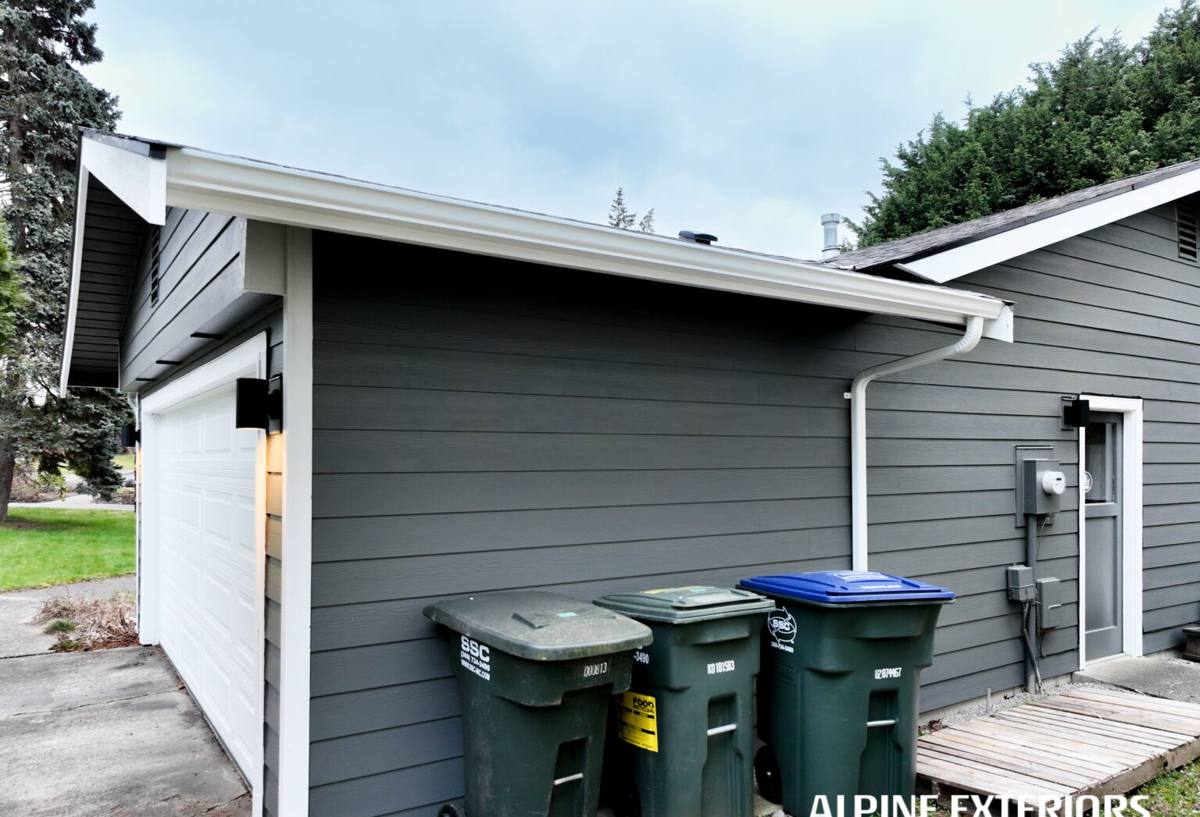
Warning Signs It's Time to Replace, Not Patch
A lot of homeowners try to get a few more years out of siding by re-caulking a seam or repainting a faded section. Sometimes that's the right call. Other times it just delays a replacement that's already overdue and lets hidden damage spread behind the wall. Here's what tells us a patch job won't cut it:
- Soft or spongy spots when you press on the siding, especially near the bottom courses and around window trim
- Persistent moss or dark streaking that comes back within weeks of being cleaned off
- Paint that's bubbling, peeling, or won't hold for more than a couple of years
- Visible warping, cupping, or gaps opening up between boards or panels
- Rising utility bills that point to a wall assembly no longer keeping conditioned air where it belongs
- Interior signs — musty smell, staining on interior drywall, or trim separating near exterior walls
If you're seeing two or more of these, the underlying sheathing is often already wet, and a cosmetic fix will just seal moisture in rather than keep it out.
What a Correct Siding Replacement Actually Involves
Tear-Off and What's Underneath
A proper replacement starts with full removal of the old siding, not an overlay. That's the only way to actually see the sheathing, framing, and any rot or moisture damage that's been building behind the old material — which, near a lake with a long wet season, is common enough that we plan for it rather than treat it as a surprise. Any compromised sheathing gets cut out and replaced before anything new goes up. Skipping this step is the single most common reason a siding job fails early.
The Weather-Resistive Barrier and Flashing
Everything behind the siding matters as much as the siding itself. A correctly lapped weather-resistive barrier, properly integrated window and door flashing, and a drainage gap that lets any water that does get behind the cladding find its way back out — these details are what actually keep a home dry through a Whatcom County winter. Siding is the visible layer, but it's the second line of defense, not the first.
Installation to Manufacturer Spec
Fiber cement siding has specific fastening patterns, clearances from grade and roof lines, caulking requirements at joints, and factory-finish touch-up procedures. Installed loose, over-driven, or with the wrong gaps, even the best material on the market will underperform. We install to the manufacturer's published instructions every time, because that's also what keeps the product warranty valid if you ever need it.
Why We Install Only James Hardie Fiber Cement Here
We standardized on James Hardie fiber cement siding for every home we work on, including the ones around Wiser Lake, and we don't install vinyl, LP SmartSide, or other fiber cement brands. That's a deliberate choice, not a default.
Fiber cement itself is not affected by moisture the way wood-based products can be — it doesn't absorb water and swell the way an engineered wood substrate can if a seam opens up, which matters directly in a spot that sees this much driving rain. It's also non-combustible, which matters everywhere but especially in a region where wildfire smoke seasons have become a normal part of summer. Hardie's ColorPlus factory finish is baked on under controlled conditions and holds color and resists the kind of mildew staining that plain field-painted siding struggles with in a shaded, damp environment like a lakeside lot. And Hardie backs the product with a long, transferable warranty structure that assumes correct installation — which is exactly why we hold ourselves to the installation details above.
We're not going to tell you another product is junk. Vinyl and LP SmartSide both have legitimate uses and plenty of installations that hold up fine in the right conditions. What we will say is that after years of working exteriors in this climate, we made a professional call to install one system and install it correctly, rather than offer several options and let material choice become a race to the lowest price.
Comparing Siding Options for a Wiser Lake Home
| Factor | James Hardie Fiber Cement | Vinyl | Engineered Wood (e.g. LP SmartSide) |
|---|---|---|---|
| Moisture behavior | Cement-based, does not swell or rot from water exposure | Doesn't absorb water, but seams and J-channels can trap it | Wood-based core can swell or delaminate if moisture gets past the coating |
| Combustibility | Non-combustible | Combustible, can deform in heat | Combustible |
| Finish durability in shade/moss conditions | Factory ColorPlus finish resists mildew staining | Color can fade; surface can host algae in shaded, damp spots | Field or factory paint requires more frequent upkeep in shade |
| Typical lifespan when installed to spec | Multiple decades | Multiple decades, shorter in harsh coastal exposure | Long, but sensitive to installation and moisture detailing |
| Warranty structure | Long, transferable manufacturer warranty | Varies widely by manufacturer and grade | Varies by manufacturer; often more installation-sensitive |
The table isn't meant to declare a universal winner — it's meant to show why the trade-offs line up the way they do for a property that sits this close to the lake and this exposed to marine air and driving rain.
Our Process, Start to Finish
- On-site assessment — we walk the exterior, check trim, look for soft spots and existing moisture damage, and take real measurements rather than estimate from a photo.
- Written estimate — scope, product line, and a clear breakdown of what's included, so there are no surprise change orders once tear-off starts.
- Tear-off and sheathing inspection — old siding comes off, damaged sheathing is identified and replaced before anything new goes on.
- Weather barrier and flashing installation — the part that actually keeps water out, done to spec around every window, door, and penetration.
- Hardie siding installation — correct fastening, gapping, and caulking per manufacturer instructions.
- Final walkthrough — we go through the finished job with you before calling it done.
Why a Crew That Already Works Wiser Lake Matters
Siding contractors who mostly work drier inland areas can still do fine work — but the details that matter most near a lake in Whatcom County are the ones you only learn by doing this work in this specific kind of exposure repeatedly. Knowing which elevations of a home take the worst of the wind-driven rain. Knowing that a north-facing wall shaded by trees near the water is going to need a finish that resists moss longer than the south side. Knowing how far to hold siding off the grade on a lot where the water table sits higher than average. These aren't things you look up — they're things a crew learns from doing dozens of jobs in the same conditions.
There's also the practical side: a crew that regularly works the Lynden area already understands local permitting expectations and how to sequence a job around the weather windows this area actually gets, instead of assuming a schedule that works in a drier climate zone.
Maintaining Hardie Siding Around Wiser Lake
Fiber cement cuts down on maintenance significantly compared to wood-based siding, but "low-maintenance" isn't "no-maintenance," especially here. A few habits keep a Hardie installation performing the way it's designed to:
- Rinse off moss and algae buildup once or twice a year, especially on shaded walls, using a garden hose rather than a pressure washer aimed directly at seams
- Keep gutters clear so overflow doesn't run down the face of the siding repeatedly
- Check caulking at trim joints and penetrations annually and have it touched up before it fails, not after
- Trim back vegetation and tree cover that keeps a wall shaded and damp longer than it needs to be
- Address any impact damage or chips in the finish promptly so the substrate underneath stays protected
None of this is heavy work, but skipping it is how even a well-installed product ages faster than it should in this climate.
If your siding is showing wear, or you just want an honest read on whether it's time to replace rather than patch, we'll come take a look. The estimate is free, there's no pressure, and you'll get a straight answer about what your home actually needs — fill out the form below to get started.