 Lynden
 Custer's Climate Is Not Kind to an Outdoor Deck
Custer sits close enough to the water that salt air is a daily fact of life, not an occasional nuisance. Add Whatcom County's long wet season, driving rain off the Strait, and the moss that colonizes anything shaded and damp for more than a few weeks, and you have one of the tougher environments in Western Washington for an outdoor deck to survive in good shape. A deck built with the wrong materials or the wrong details underneath will show it within a year or two — soft spots, green film on the walking surface, fastener corrosion, and boards that cup or gap unevenly.
Composite decking exists specifically to hold up under this kind of exposure better than wood does, but "composite" is not a single product with a single set of rules. Board quality, capping, substructure choice, and drainage detailing all matter more here than they would in a drier inland climate. This page is about what actually needs to happen for a composite deck in Custer to look and perform the way it should for the long haul.
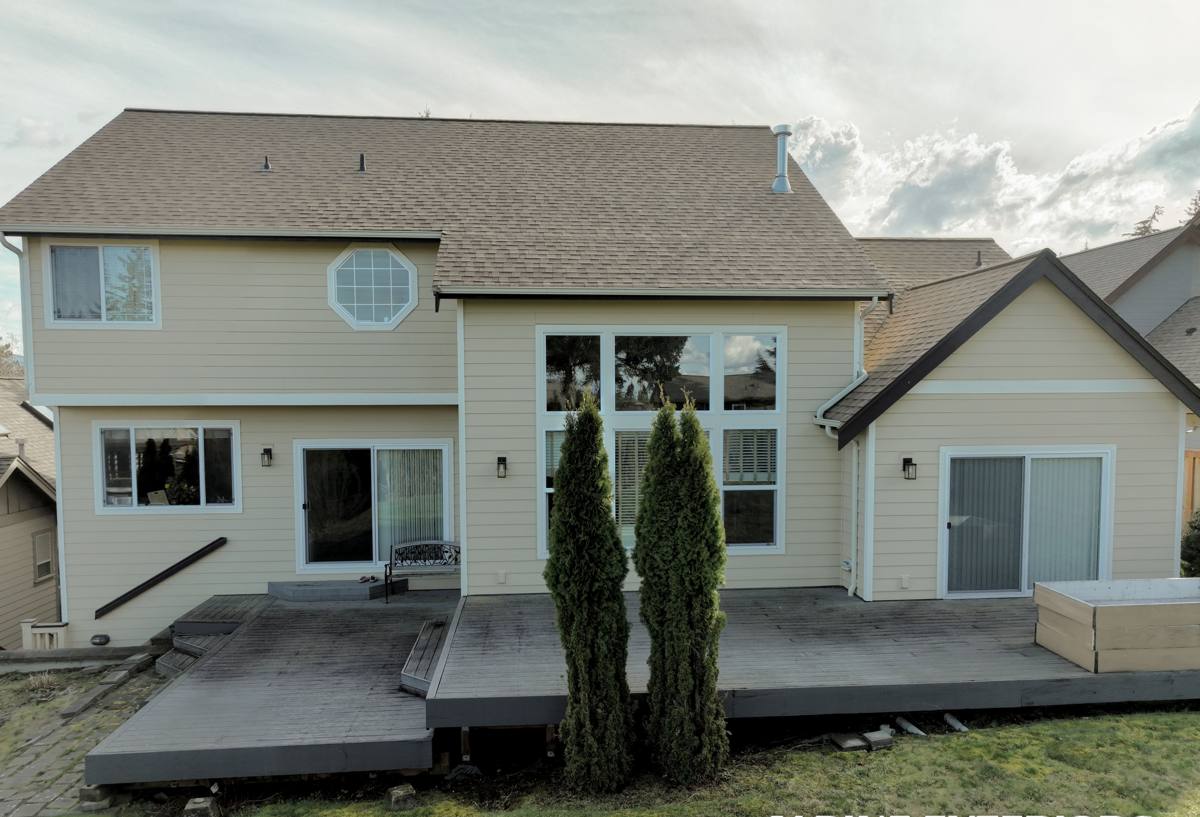
What Salt Air and Moss Season Actually Do to a Deck
It helps to be specific about the failure modes we're designing against, because they're different from generic "weather damage."
Salt-laden air
Airborne salt accelerates corrosion on any exposed metal — screws, joist hangers, post bases, railing brackets. On a wood deck this often shows up first as rust streaking around fastener heads. On a composite deck the boards themselves resist this, but the fasteners, ledger flashing, and structural hardware underneath do not get a pass just because the decking is composite.
Driving, wind-blown rain
Rain that comes in sideways off the water gets under railings, behind fascia, and into end grain more aggressively than a straight-down rain would. Any spot where water can enter but can't easily drain back out becomes the first place a deck fails, regardless of decking material.
Moss and organic growth
Shaded, north-facing, or tree-covered sections of a deck in this area will grow moss and algae film if there's no airflow underneath and no way for the surface to dry between rain events. On composite boards this is mostly cosmetic and cleanable, but a slick, mossy deck surface is also a slip hazard, and moss holding moisture against a board over months does shorten its practical life even when the material itself is moisture-resistant.
What a Correct Composite Deck Build Involves
A composite deck that's actually built for Custer's conditions gets several things right that are easy to skip if a crew is used to easier climates or is moving fast.
- Corrosion-resistant fasteners and hardware rated for coastal or high-moisture exposure, not standard interior-grade hardware
- A drainage plan for the substructure, not just the walking surface — water needs somewhere to go once it gets underneath
- Proper board spacing and hidden fastener systems that allow for expansion and contraction without buckling
- Ledger board flashing that actually sheds water away from the house rim joist, since this is the single most common rot origin point on any attached deck
- Enough clearance and airflow under the deck to let it dry out between rain events instead of staying damp for weeks
- Railing post attachment that's mechanically solid, not just cosmetically fastened — wind load off open water areas is real
None of this is exotic. It's standard good practice applied consistently, which is exactly what tends to get shortcut when a crew is unfamiliar with the area or under pressure to finish fast.
Choosing the Right Composite Board for This Environment
Not all composite decking is built the same way, and the differences matter more here than the marketing usually lets on. The two broad categories are capped composite and uncapped composite, with PVC as a related but distinct all-plastic option.
| Decking Type | How It Handles Salt Air & Moisture | Moss / Mildew Resistance | Trade-offs |
|---|---|---|---|
| Capped composite | Protective outer shell resists moisture absorption at the surface | Good — smooth cap sheds film and cleans easily | Higher upfront cost; cut ends need sealing or capped edge trim |
| Uncapped composite | Wood fiber content can absorb some moisture over time | Fair — more prone to surface staining and mildew in shaded areas | Lower cost; may fade or roughen faster in wet, shaded spots |
| PVC decking | No wood fiber at all; essentially immune to moisture absorption | Very good | Different feel underfoot; higher cost; less "wood-like" look for some homeowners |
| Pressure-treated wood | Absorbs moisture readily; needs consistent maintenance | Poor without regular cleaning and sealing | Lowest upfront cost; highest long-term maintenance in this climate |
For a property in Custer, we generally steer homeowners toward capped composite or PVC for any deck section that's shaded, close to grade, or exposed to prevailing wind off the water. Uncapped composite can still make sense on sunnier, better-ventilated sections where the budget matters more and the exposure is milder. We'll walk the specific site with you and point out which sections fall into which category rather than applying one blanket recommendation to the whole deck.
Why We Don't Just Default to the Cheapest Composite Option
Cheaper, uncapped boards aren't a bad product across the board — they're a reasonable choice in the right spot. Our standard is matching the board to the actual exposure of that section of deck rather than picking one product for the whole job because it's simpler to quote. A shaded section facing the prevailing weather deserves a different spec than a sunny, sheltered section, and we'd rather tell you that up front than have you deal with uneven wear in two or three years.
The Substructure and Drainage: The Part Nobody Sees Until It Fails
Most of what determines whether a deck lasts 10 years or 25 in this climate is invisible once the project is finished. The framing, the ledger connection, and the drainage path underneath do more work than the decking surface itself.
Framing material
In consistently damp, salt-exposed conditions, we look at whether standard pressure-treated framing is adequate or whether a composite or coated structural product makes sense for ledger boards and joists closest to grade, especially on lower decks with limited ground clearance.
Ledger flashing
The ledger board — where the deck attaches to the house — is the most common point of hidden rot on any attached deck we inspect, anywhere in Whatcom County. Correct flashing here, installed so water is directed away from the house rather than behind the flashing, is not optional detail work; it's the difference between a deck that's fine at year 15 and one with a rotted rim joist at year 6.
Drainage below the deck
Low decks with tight ground clearance trap moisture and encourage moss growth on the underside of joists and the bottom of decking boards. Where grading allows, we build in enough slope and clearance for water to actually move away from the structure instead of pooling underneath it.
Our Process, Start to Finish
We keep the process straightforward because a complicated sales process doesn't make for a better deck.
- On-site walkthrough — we look at sun exposure, prevailing wind and rain direction, existing drainage, and the condition of anything we're replacing.
- Board and hardware recommendation — matched to each section's actual exposure, not a one-size answer for the whole deck.
- Written estimate — clear on materials, scope, and timeline, with no vague allowances hiding future upcharges.
- Demo and substructure work — including flashing and framing corrections where the existing structure needs it, not just a deck skin swapped over old problems.
- Composite installation — proper spacing, hidden fastening, and edge/end treatment appropriate to the board type.
- Final walkthrough — we go over the finished deck with you, including basic maintenance specific to your site's exposure.
What Drives the Cost of a Composite Deck Project
Composite decking costs more upfront than pressure-treated wood, and the total project cost depends on more than just board price per square foot. Below is a general breakdown of what moves the number up or down — not a quote, since every site is different.
| Cost Factor | Why It Matters |
|---|---|
| Board tier (uncapped vs. capped vs. PVC) | Material cost differences are significant, and the right tier varies by section exposure |
| Substructure condition | Replacing rotted framing or correcting bad flashing adds labor but prevents a repeat failure |
| Deck height and ground clearance | Low decks near grade often need extra drainage or framing work to manage moisture |
| Railing system | Composite or metal railing systems vary widely in cost and in how well they handle coastal exposure |
| Fastening system | Hidden fastener systems cost more in labor time but give a cleaner surface and fewer exposed metal points |
| Demo and disposal | Removing an old wood deck, especially one with rot, adds scope beyond the new build itself |
We'd rather walk your specific deck and give you real numbers than quote a broad range that doesn't mean much for your project.
Maintaining a Composite Deck in Custer's Conditions
Composite decking is lower-maintenance than wood, but "low-maintenance" doesn't mean "no maintenance" in a climate that produces moss, salt film, and constant moisture. A short seasonal routine keeps a composite deck looking and performing the way it should.
- Sweep debris and organic matter off the surface regularly, especially in fall when leaves and needles accumulate in shaded corners
- Rinse salt film and general grime with a garden hose and mild soap a few times a year — avoid pressure washing directly into board grooves or fastener channels
- Check and clear any drainage gaps or gutters that direct water away from the deck and house
- Inspect railing posts and fasteners annually for corrosion or looseness, especially anything metal near ground level
- Address moss or algae film as soon as it appears rather than letting it establish over a full wet season
- Keep planters and anything that holds standing water off the deck surface for extended periods
Why Hiring a Crew That Already Works Custer Matters
A lot of what separates a composite deck that holds up from one that doesn't isn't the brand of board — it's whether the crew building it understands the specific exposure of that property. A crew that mostly works drier, inland jobs may not think twice about ledger flashing detail or fastener corrosion resistance, because in their usual conditions it doesn't matter as much. In Custer, those details are the whole ballgame.
Working regularly in this part of Whatcom County means we've already seen which board types hold up in which exposures, which framing details fail first, and which shortcuts show up as callbacks two or three years later. That's the value of hiring locally for this kind of work — not a sales pitch, just familiarity with what this specific stretch of coastline and climate does to a deck over time.
Ready to Talk About Your Deck?
If you're planning a new composite deck or replacing an aging wood deck in Custer, we're happy to walk the site, look at your sun and rain exposure, and give you an honest recommendation on board type and structure. There's no pressure and no obligation — just a straightforward look at what your specific property needs. Reach out using the form below to schedule a free estimate.