 Lynden
 Why Custer Homes Wear Out Siding Faster Than the Brochures Suggest
Custer sits close enough to the water that homes here deal with a different set of stresses than siding manufacturers assume when they write their install manuals. You've got salt-laden air moving off the Strait, long stretches of driving rain that hits walls sideways instead of straight down, and a moss season that can run eight or nine months out of the year on north- and west-facing walls. None of that is exotic — it's just Whatcom County weather — but it adds up on siding that wasn't built or installed with those conditions in mind.
We're a Lynden-based crew, and Custer is inside our regular service area, not a special trip. That matters more than it sounds like it should. Siding problems in this area tend to be site-specific — which wall takes the worst weather, where the moss actually establishes, how a particular roofline dumps water onto a particular section of wall — and that kind of knowledge only comes from doing the work here repeatedly, not from a general contractor passing through once.
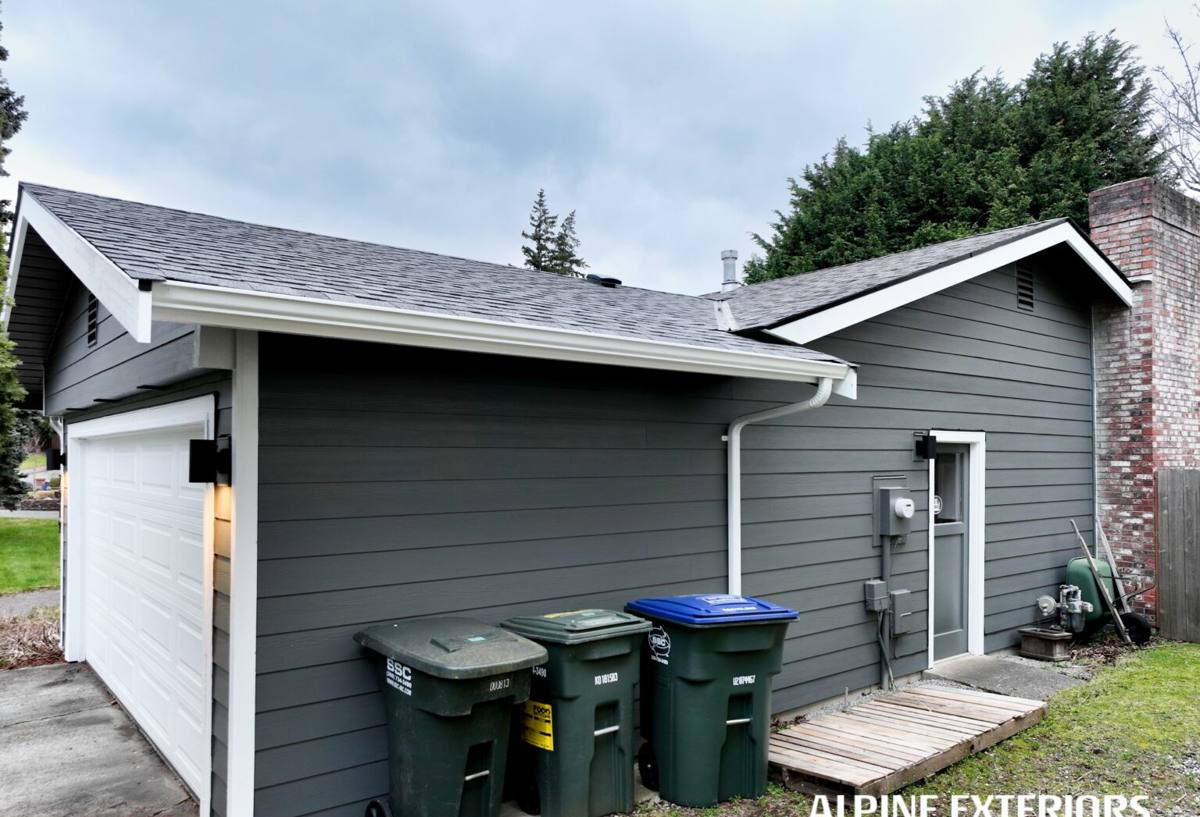
What Custer's Climate Actually Does to Siding
Salt Air and Metal Fasteners
Proximity to salt water accelerates corrosion on anything metal — fasteners, flashing, trim screws. Cheap or improperly rated fasteners can start staining and weakening years before a homeowner expects any trouble. This is one of the first things we check on any Custer job: what's holding the siding on, and is it rated for the environment it's actually in.
Driving Rain and Wind-Driven Moisture
Rain that comes in sideways doesn't behave like rain that falls straight down. It gets pushed up under laps, into gaps around trim, and behind poorly sealed penetrations. Siding systems that rely on caulk alone to keep water out, rather than proper lap geometry and drainage behind the cladding, tend to fail here faster than they would in a drier, calmer climate.
Moss and Prolonged Dampness
Whatcom County's moss season isn't just cosmetic. Moss and algae hold moisture against the siding surface for extended periods, which is hard on any material that isn't dimensionally stable when wet, and it's especially hard on finishes that weren't engineered to resist mildew growth in the first place.
Why We Install Only James Hardie Fiber Cement — Not Alternatives
We don't install vinyl, LP SmartSide, primed wood, or other fiber cement brands. That's a deliberate standard, not a sales pitch, and it's worth explaining honestly rather than just asserting it.
- Vinyl can work fine in mild climates, but it's a poor match for driving rain and wind exposure — it flexes, can crack in cold snaps, and never really stops water at the surface; it manages water behind the panel instead, which raises the stakes on the water-resistive barrier doing its job perfectly for decades.
- LP SmartSide is an engineered wood product. It performs well when detailing is followed exactly, but wood-based products are more sensitive to sustained moisture exposure than cement-based ones — and sustained moisture is exactly what a moss-prone, rain-heavy site produces.
- Primed cedar or spruce requires an ongoing maintenance commitment — repainting, caulking, moisture monitoring — that most homeowners underestimate until the third or fourth year.
James Hardie fiber cement is non-combustible, dimensionally stable when wet or dry, and comes with a factory-applied ColorPlus finish engineered to resist fading and hold up in high-moisture, high-UV-swing environments — which is a fair description of a coastal Pacific Northwest wall. It doesn't eliminate maintenance entirely, but it removes the categories of failure — swelling, rot, cracking from freeze-thaw cycling — that we see most often on the alternatives.
What a Correct Fiber Cement Job Looks Like in This Climate
Fiber cement siding is only as good as its installation. The product itself is engineered well; most of the failures we get called out to fix elsewhere in Whatcom County trace back to installation shortcuts, not the material. In a rain- and moss-prone area like Custer, a few details matter more than usual:
Drainage Plane and Rainscreen Gap
A proper water-resistive barrier behind the siding, with a drainage gap that lets any moisture that gets past the cladding actually drain and dry out, rather than sit against the sheathing. This is the single biggest factor in long-term wall health in a wet climate.
Fastener Selection and Placement
Corrosion-resistant fasteners, driven at the manufacturer-specified depth and location — not just close enough. Overdriven or underdriven fasteners are a common source of premature siding failure, and salt air exposure raises the cost of getting this wrong.
Flashing and Trim Details
Window heads, deck ledgers, roof-to-wall transitions, and any horizontal trim need flashing that actually sheds water outward, not just caulk hoping to hold. Caulk is a backup, not a strategy.
Clearances
Proper gaps at grade, roofs, decks, and other siding-to-hardscape transitions so the bottom edge of the siding isn't sitting in standing water or trapped moisture — a common problem on homes where landscaping or grade has crept up over the years.
Fiber Cement vs. Common Alternatives for a Custer Property
| Factor | James Hardie Fiber Cement | Vinyl | LP SmartSide / Wood-Based |
|---|---|---|---|
| Moisture stability | Dimensionally stable wet or dry | Doesn't absorb, but relies on barrier behind it | More sensitive to sustained dampness |
| Salt air / coastal exposure | Factory finish engineered for UV and moisture cycling | Can become brittle over time | Requires diligent sealing and repainting |
| Fire resistance | Non-combustible | Combustible | Combustible |
| Moss/algae resistance | Finish resists mildew growth | Moderate; surface can stain | More prone to surface degradation under prolonged moisture |
| Maintenance | Periodic cleaning; caulk checks | Low, but limited repair options if cracked | Ongoing paint/caulk maintenance |
| Warranty | Strong transferable warranty on product and finish | Varies widely by manufacturer | Varies; often shorter on finish |
Our Process on a Custer Job
- Walk-through and wall-by-wall assessment. We look at which elevations take the worst weather, where moss has already established, and what the existing sheathing and water barrier look like once siding comes off.
- Scope and product selection. We spec the Hardie product line, profile, and ColorPlus finish that fits the home and the exposure — a west-facing wall catching driving rain may get different detailing attention than a sheltered side yard.
- Tear-off and substrate check. Old siding comes off, and we inspect sheathing for hidden rot or moisture damage before anything new goes up — a step that's easy to skip and expensive to skip wrong.
- Water-resistive barrier and rainscreen installation. This is the part homeowners never see again once siding is up, and it's the part that determines how the wall performs for the next 30 years.
- Hardie installation to manufacturer spec. Correct fastener schedule, clearances, flashing, and joint treatment throughout.
- Final walkthrough. We go over the finished work with the homeowner and flag any maintenance items — caulk lines to watch, grade issues to keep an eye on — so there are no surprises later.
Signs a Custer Home May Need Siding Attention
- Persistent moss or dark staining on north- or west-facing walls that keeps coming back after cleaning
- Soft spots, bubbling paint, or visible warping, especially near ground level or under windows
- Caulk that's cracked, shrunk, or pulled away at trim and window edges
- Rust streaks below fasteners or trim screws
- Higher-than-expected heating bills, which can point to a compromised wall assembly letting moisture and air through
- Visible gaps or warping at butt joints and corners
Why a Local Crew Matters More Than It Seems
Siding manufacturers write installation guidelines for a national market. A crew that only works this specific pocket of Whatcom County — Lynden, Custer, and the surrounding areas — develops a working knowledge of which details actually matter here: which walls take the brunt of the weather, where moss and algae tend to establish first, how local grading and drainage patterns affect siding at the base of a wall. That's not something you get from a manual. It's something you get from doing the work in this exact climate, on this exact terrain, over and over.
It also means accountability doesn't end when the truck leaves. A local crew has a reason to get callbacks right and to stand behind the warranty in practice, not just on paper.
If you're weighing a siding project on a Custer home — whether it's a full replacement or you're trying to figure out how much life is left in what's already up — we're happy to take a look and give you a straightforward, no-pressure estimate. There's a form below to get that conversation started.