 Lynden
 Building Decks for the Kendall Area
Kendall sits in the wooded, semi-rural stretch of Whatcom County that our Lynden crew already drives through on a regular basis. It's a different building environment than a flat, open lot in town — more tree cover, more shade, and often heavier, slower-draining soil. Those conditions don't stop a deck from being built well, but they do change which details matter most.
Whatcom County's climate is defined by moisture-laden air moving in off the water, driving rain for a good chunk of the year, and a moss season that can run from fall through spring on anything that doesn't get direct sun. Add wind-driven storms that carry a trace of salt air even well inland, and you've got an environment that's genuinely harder on exterior wood and hardware than most manufacturers' warranty language assumes. A deck built to a generic national spec often shows problems in year three or four here — not because the materials failed outright, but because the assembly wasn't detailed for constant dampness.
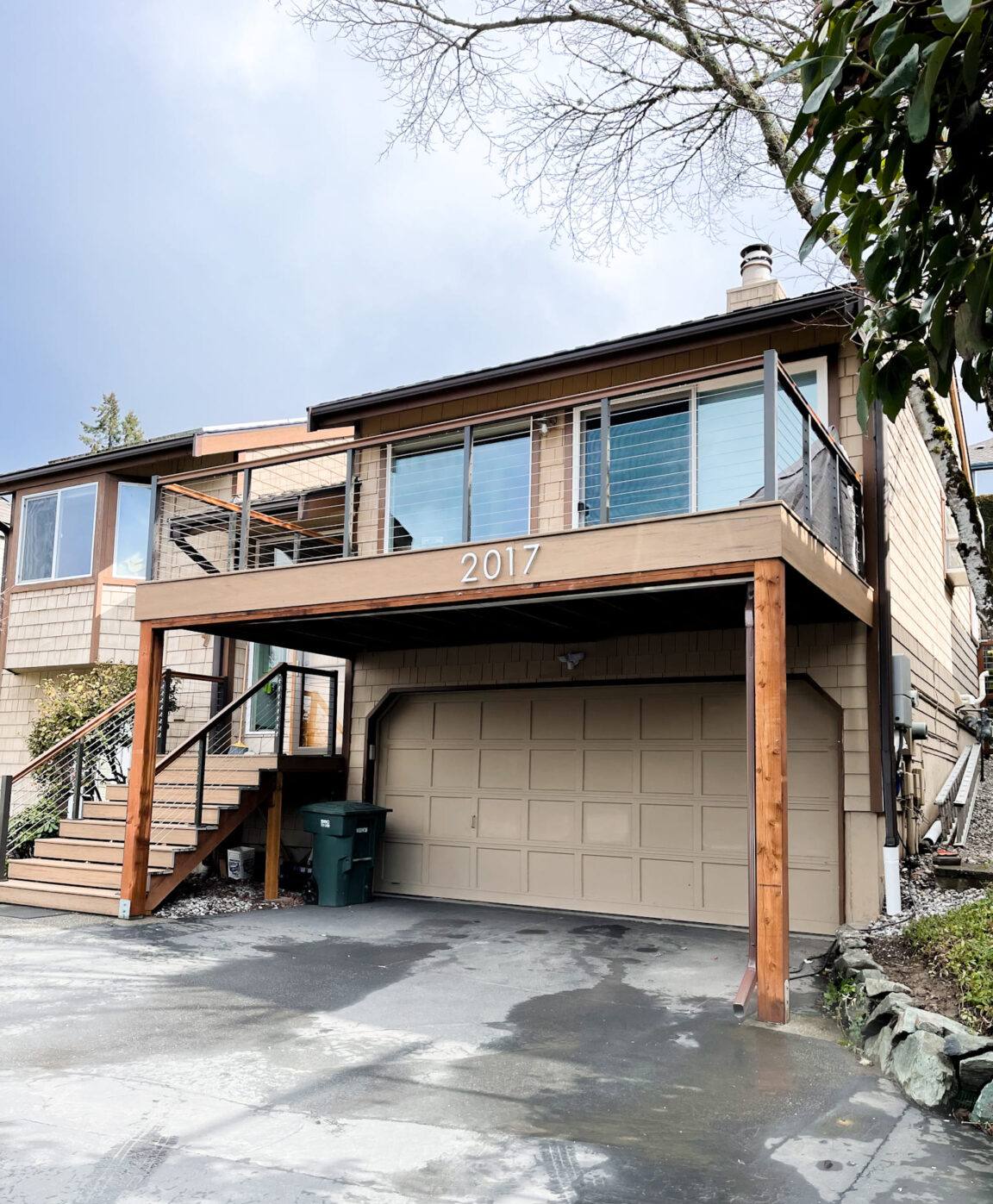
What a Properly Built Deck Requires Here
A deck is a structure first and a surface second. Most of the failures we get called out to fix started below the decking boards, not on top of them.
Footings Below Frost Depth, Sized for the Soil
Whatcom County soils vary a lot from lot to lot — some are well-draining, some hold water like a bathtub after glacial till or clay layers close to the surface. Footings need to go below frost depth and be sized for the load and the soil, not just poured to whatever depth is fastest. On wooded or low-lying parcels, we'll also look at how water moves across the site before we dig, because a footing that sits in standing water every winter is a problem years before anyone notices.
Ledger Attachment and Flashing
The ledger board — where the deck bolts to the house — is the single most common point of failure we see on decks that were built cheaply or in a hurry. It has to be through-bolted or lag-screwed into solid framing, not just nailed, and it needs flashing that integrates with the house's existing water-resistive barrier so rain runs over the flashing and off the wall, not behind it. Get this wrong and you don't find out until there's rot in the rim joist behind the siding, which turns a deck repair into a siding repair too.
Choosing a Decking Material for Wet, Shaded Ground
There's no single "best" decking material — there's a best fit for the site, the budget, and how much upkeep you actually want to do. On shaded, moss-prone lots like much of what we see around Kendall, the maintenance conversation matters more than it would on an open, sunny lot.
| Material | Moisture behavior here | Maintenance | Typical lifespan |
|---|---|---|---|
| Pressure-treated lumber | Handles wetting/drying cycles well if detailed correctly; end grain and fasteners are the weak points | Annual cleaning, periodic sealing/staining | 15–25 years with upkeep |
| Cedar | Naturally resists rot and insects; still needs airflow underneath to avoid staying damp under moss and leaf litter | Regular cleaning, refinishing every few years to hold color | 20–25 years with upkeep |
| Capped composite/PVC | Doesn't absorb water or rot; still needs cleaning where moss and algae can grow on the surface film | Occasional washing, no staining or sealing | 25–30+ years, manufacturer-warrantied |
Composite generally costs more up front than wood but less over the life of the deck once you account for the sealing and staining wood needs to keep looking good in this climate. Wood costs less to install but asks more of the homeowner every year it's outside.
Substructure and Hidden Moisture Management
The parts of a deck nobody sees are the parts that determine how long it lasts.
Joist Protection
Uncapped joist tops are one of the fastest ways a deck starts rotting from the inside. Water sits in every screw hole and end cut, and with the amount of rain Whatcom County gets, that adds up fast. We run joist tape over the top of framing before decking goes down — a small step that keeps water out of the wood where it's hardest to inspect later.
Fasteners and Hardware
Standard fasteners corrode faster than people expect in this region's damp, salt-tinged air, especially on decks near the coast but even further inland where humidity stays high for months. We use stainless or heavy-coated fasteners and hardware rated for treated lumber, because a rusted-out connector is a hidden structural problem, not a cosmetic one.
Airflow Underneath
A deck built low to the ground or fully skirted in without vents traps moisture underneath, which is exactly what moss and mildew want. We build in enough clearance and ventilation for the underside to actually dry out between storms, especially on shaded lots where the sun never gets a chance to do that job for us.
Railings, Stairs, and Permit Requirements
Anything more than a low platform deck needs a code-compliant guardrail, and Washington's residential code sets clear minimums: guardrail height, baluster spacing narrow enough that a small child can't pass through, and consistent stair rise and run so steps don't become a tripping hazard. These aren't optional details we can skip to save money — they're the difference between a deck that passes inspection and one that has to be torn apart and redone.
Most deck projects in Whatcom County require a permit, and the review looks at footing size, ledger attachment, and guardrail design specifically. We handle the permit drawings and inspection scheduling as part of the build, so it's not something the homeowner has to chase down separately.
Our Process, Start to Finish
- Site visit: we look at the lot, the drainage, sun exposure, and how the deck will attach to the house before talking materials.
- Design and material selection: we go over the material comparison above in the context of your budget and how much maintenance you actually want to take on.
- Permit drawings: we prepare and submit what the jurisdiction requires, sized for your specific footing and framing plan.
- Footings and framing: the structural work that determines everything else, done to depth and spec for the actual soil on your lot.
- Decking, railings, and stairs: installed to the manufacturer's fastening pattern and local code, not just "close enough."
- Final walkthrough: we go over the finished deck with you, including what maintenance it actually needs going forward.
Living With Moss Season: Maintenance That Actually Matters
No deck in this climate is maintenance-free, even composite. The good news is that the maintenance that actually extends a deck's life is simple and doesn't take long if it's done on a schedule.
- Sweep debris out of the gaps between boards so water and organic matter don't sit and hold moisture against the wood.
- Clean the surface at least once a year to remove the moss and algae film that builds up in shaded, damp conditions.
- Check the ledger flashing where the deck meets the house for any gaps, cracks, or signs of water tracking behind it.
- Look at fasteners and connector hardware for rust or loosening, especially after a hard winter.
- Make sure gutters and downspouts near the deck are directing water away from it, not onto it.
- Trim back overhanging branches where you can — more sun and airflow on the deck surface means less moss.
Why a Crew That Already Works Kendall Matters
A lot of what makes a deck last in this area isn't in a manufacturer's spec sheet — it's knowing how the soil in a given part of Whatcom County drains, which lots hold water longer into spring, and which details actually fail here versus what's just marketing language on a fastener box. A crew that's already building and repairing decks around Kendall and the rest of the Lynden area has seen what five or ten years of this climate does to different materials and assemblies, and builds accordingly from the start instead of learning it the hard way on your project.
Being local also means faster response if something needs a look after the fact — no waiting on a crew that has to drive in from out of the area for a warranty check or a quick adjustment.
If you're planning a new deck or replacing one that's showing its age, we're happy to come take a look and talk through what makes sense for your lot. The estimate is free, there's no pressure, and you'll get a straight answer about what your site actually needs — just fill out the form below to get started.