 Lynden
 Why Nooksack Homes Take a Different Kind of Weather Beating
Nooksack sits in the part of Whatcom County where three weather patterns stack on top of each other for most of the year: long stretches of wind-driven rain rolling in off the Pacific, salt-tinged air pushed inland from the Strait of Georgia and Bellingham Bay during winter storms, and a shaded, damp growing season that keeps moss and algae active on north- and east-facing walls far longer than most siding products are built to handle. None of these on their own is unusual for western Washington. Together, over years, they're what separates a siding job that still looks tight after a decade from one that's already showing swollen seams, chalky paint, and green streaking by year five.
The Long Moss Season
Whatcom County's growing season for moss and algae runs longer than it does even one county south, thanks to consistent cloud cover, cool temperatures, and the tree cover common on rural and semi-rural Nooksack lots. Moss doesn't just look bad — it holds moisture directly against the siding surface, which is a problem for any material that isn't dimensionally stable or that relies on a field-applied paint film to keep water out.
Wind-Driven Rain and Salt Air
Storms coming off the water don't just drop rain straight down — they drive it sideways into lap joints, butt seams, and trim intersections. Add in the low-level salt content that rides inland on those same storm winds, and you've got a combination that accelerates corrosion on fasteners and hardware and speeds up the breakdown of lower-grade paint and caulk. A siding system for this area has to be engineered for that combination, not just rated for "the Pacific Northwest" in general.
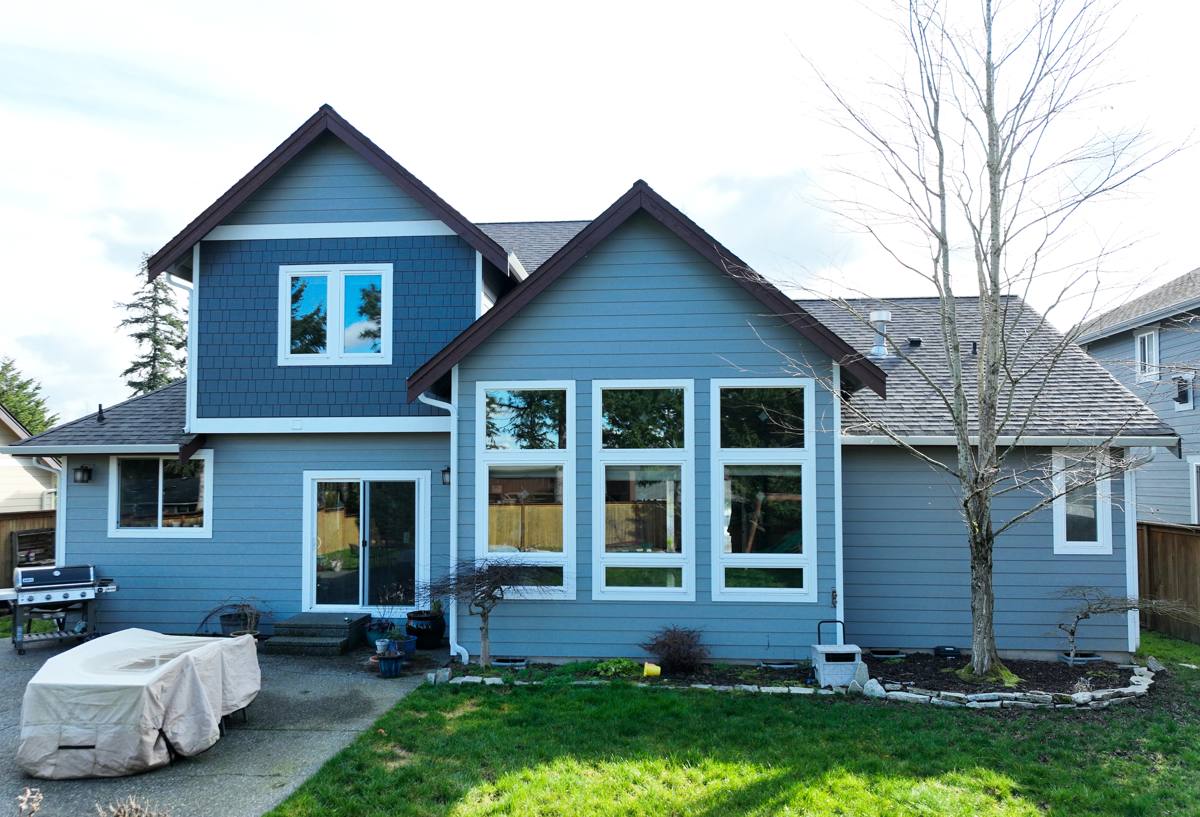
Why We Only Install James Hardie Fiber Cement
This company made a decision a long time ago to install one siding system — James Hardie fiber cement — and to stop offering the alternatives. That's not a marketing position, it's a maintenance-and-longevity one. We've seen what this climate does to the products we don't install, and we'd rather stand behind one system we know performs here than offer a menu of options and hope the homeowner picks the right one.
What Fiber Cement Actually Is
James Hardie siding is made from cement, sand, and cellulose fiber, cured into a dense, dimensionally stable board. It doesn't expand and contract with moisture the way wood-based products do, and it's non-combustible, which matters increasingly for insurance underwriting in Washington regardless of wildfire zone. For a climate defined by constant moisture cycling, that dimensional stability is the whole ballgame — it's what keeps seams tight and paint film intact year after year.
Where the Alternatives Fall Short in This Climate
Vinyl siding is inexpensive and low-maintenance, but it's a thin, flexible material that can warp under sustained heat and impact, and its seams and J-channels give moss and windblown debris plenty of places to collect. LP SmartSide and other engineered wood products use a resin-treated wood strand core — a real improvement over old wood siding, but the core is still wood, which means any breach in the factory coating or field-cut edge that isn't properly sealed becomes a moisture entry point. Primed spruce and cedar are honest, attractive materials, but they demand a repaint cycle and ongoing caulk maintenance that most homeowners underestimate until they're facing peeling paint on a north wall a few years in. We're not saying these products are junk — we're saying we've chosen not to install them here, because fiber cement's stability and factory-cured finish are a better match for Nooksack's specific mix of rain, shade, and salt air.
What a Correct Fiber Cement Install Involves
Fiber cement siding is only as good as the water-management system behind it. The board itself is durable, but a siding job fails at the details around it — the flashing, the housewrap, the gaps, the fasteners — long before the board itself gives out.
Water Management Behind the Cladding
Every correct install starts with a weather-resistive barrier installed shingle-style so water sheds down and out, not into the wall cavity. Behind that, we pay close attention to flashing at every horizontal transition — window heads, roof-to-wall intersections, deck ledgers — because those are the spots where a rushed job lets water behind the siding instead of over it. In a climate with as much sustained rain as this one, a rainscreen gap (a small air space between the WRB and the back of the siding) is worth the extra step: it lets any moisture that does get past the cladding drain and dry instead of sitting against the wall sheathing.
Fastening, Clearances, and Caulking Done Right
James Hardie publishes specific fastening patterns, nail types, and minimum clearances — from grade, from roof lines, from decks and patios — and those specs exist for a reason particular to wet climates: gaps that are too tight trap moisture and debris, and fasteners that are the wrong type or spaced wrong let boards work loose over freeze-thaw cycles. Butt joints and trim intersections get a high-quality, paintable, flexible sealant rated for exterior use, not whatever caulk happens to be in the truck. Skipping any one of these steps doesn't show up on day one — it shows up in year three or four as staining, cupping, or a soft spot in the sheathing behind the wall.
Our Process for a Nooksack Siding Project
- On-site assessment. We look at existing siding condition, sheathing access points, moss and moisture patterns on the specific walls that take the worst weather, and any trim or window details that need special attention.
- Tear-off and sheathing check. Old siding comes off and we inspect the sheathing underneath for rot or soft spots before anything new goes up — this is the point where hidden moisture damage from a prior install gets caught and fixed, not covered over.
- Weather barrier and flashing. Housewrap, flashing, and rainscreen furring (where called for) go on before a single piece of siding is hung.
- Fiber cement installation. Boards are cut, fastened, and sealed to James Hardie's published specifications, with attention to the clearances and joint treatment this climate demands.
- Trim, caulk, and touch-up. Trim boards, corner details, and factory-finish touch-up paint (matched to the ColorPlus color) are completed last.
- Final walkthrough. We walk the job with the homeowner before calling it done, checking sightlines, seams, and paint match in daylight.
Comparing Siding Materials for This Climate
| Material | Moisture Behavior | Moss/Algae Resistance | Maintenance | Typical Lifespan |
|---|---|---|---|---|
| James Hardie Fiber Cement | Dimensionally stable, resists swelling | Factory finish resists staining; cleans well | Occasional rinse; no repainting for years | Multiple decades with correct install |
| Vinyl | Can warp with heat/impact; seams allow water tracking | Seams and channels trap debris and moss | Low, but panels aren't repairable individually in most cases | Moderate, shorter in harsh sun/impact areas |
| Engineered Wood (e.g. LP SmartSide) | Wood-strand core; vulnerable at cut edges/breaches | Moderate; depends on coating integrity | Coating inspection and edge sealing over time | Moderate, coating-dependent |
| Primed Spruce / Cedar | Natural wood movement; absorbs moisture if coating fails | Needs active upkeep to resist staining | Repaint cycle plus ongoing caulk maintenance | Shorter without disciplined upkeep |
What Affects the Cost of a Fiber Cement Project
Every Nooksack property is a little different, so instead of a flat number, here's what actually drives the estimate up or down.
| Cost Factor | Why It Matters |
|---|---|
| Home size and number of stories | More square footage and taller walls mean more material and more labor, plus added scaffolding or lift needs on multi-story homes. |
| Existing siding removal | Tear-off of old vinyl, wood, or damaged siding — and any sheathing repair found underneath — adds time before new siding can go up. |
| Trim and architectural detail | Homes with more corners, dormers, or window trim take longer to flash and finish correctly than a simple rectangular footprint. |
| Siding profile and color choice | Lap width, shingle-style panels, and custom ColorPlus color selections can shift material cost compared to standard options. |
| Site access | Steep lots, tight setbacks, or limited driveway access affect staging, scaffolding, and how efficiently the crew can work. |
Keeping Nooksack Siding Looking Good Through Moss Season
Even the best siding system benefits from a little seasonal attention in this climate. None of this is heavy maintenance — it's mostly about not letting moisture and organic growth sit against the wall for months at a time.
- Rinse siding (garden hose, low pressure) once a year, focusing on shaded north- and east-facing walls where moss builds up fastest.
- Keep gutters and downspouts clear so overflow doesn't run down the face of the siding during heavy storms.
- Trim back shrubs, trees, and vines that block airflow or keep a wall section in permanent shade — airflow is the simplest moss deterrent there is.
- Check caulk lines at trim joints and penetrations once a year; recaulk before a small gap becomes a water entry point.
- Have any impact damage (ladders, debris, equipment) inspected and touched up promptly rather than left through a wet winter.
Why Hiring a Crew That Already Works This Area Matters
A siding crew that's worked Nooksack and the surrounding Lynden area already knows which walls on a given lot orientation take the worst of the driving rain, where moss tends to establish first, and how local building department expectations for flashing and clearances get enforced. That's not something a crew coming in from outside the region picks up on the first job. It also means we're not guessing at how James Hardie's HZ5 product line — engineered specifically for cold, wet climates like this one — performs here over time; we've watched it hold up on homes in this exact weather pattern.
Warranty and Long-Term Value
Part of why this company standardized on James Hardie is the warranty structure behind it. James Hardie backs its fiber cement products with a strong, transferable limited warranty, and the ColorPlus factory finish carries its own finish warranty separate from the substrate — meaning the color coat is engineered and tested as part of the product, not applied on-site where weather and technique introduce variables. Combined with correct installation to Hardie's published specs, that's the combination that gives Nooksack homeowners a siding system built to actually last through what this climate throws at it, not just look good on installation day.
If you're weighing a siding project on a Nooksack home, we're happy to take a look and walk you through what your specific walls, exposure, and existing siding condition call for. Request a free, no-pressure estimate below and we'll give you an honest read on the job.