 Lynden
 Why Roofs in Sumas Wear Differently Than Roofs Inland
Sumas sits at the far north end of Whatcom County, close enough to the water and to the marine weather systems that move through this corner of Washington that its roofs take a different kind of beating than a roof fifty miles inland. Salt-laden air pushes in off the Strait of Georgia and Puget Sound and settles over the county for months at a time. Combine that with driving rain that comes in sideways during fall and winter storms, and a moss season that can run eight months out of the year in shaded, north-facing sections of a roof, and you get a roofing system that has to do more work than a roof in a drier climate ever would.
None of this means a Sumas roof is doomed to fail early. It means the materials, the underlayment, the ventilation, and the flashing details all have to be chosen and installed with this specific climate in mind. A roof replacement done to a generic national standard, without accounting for the local moisture load, is a roof that will need attention again in half the time it should.
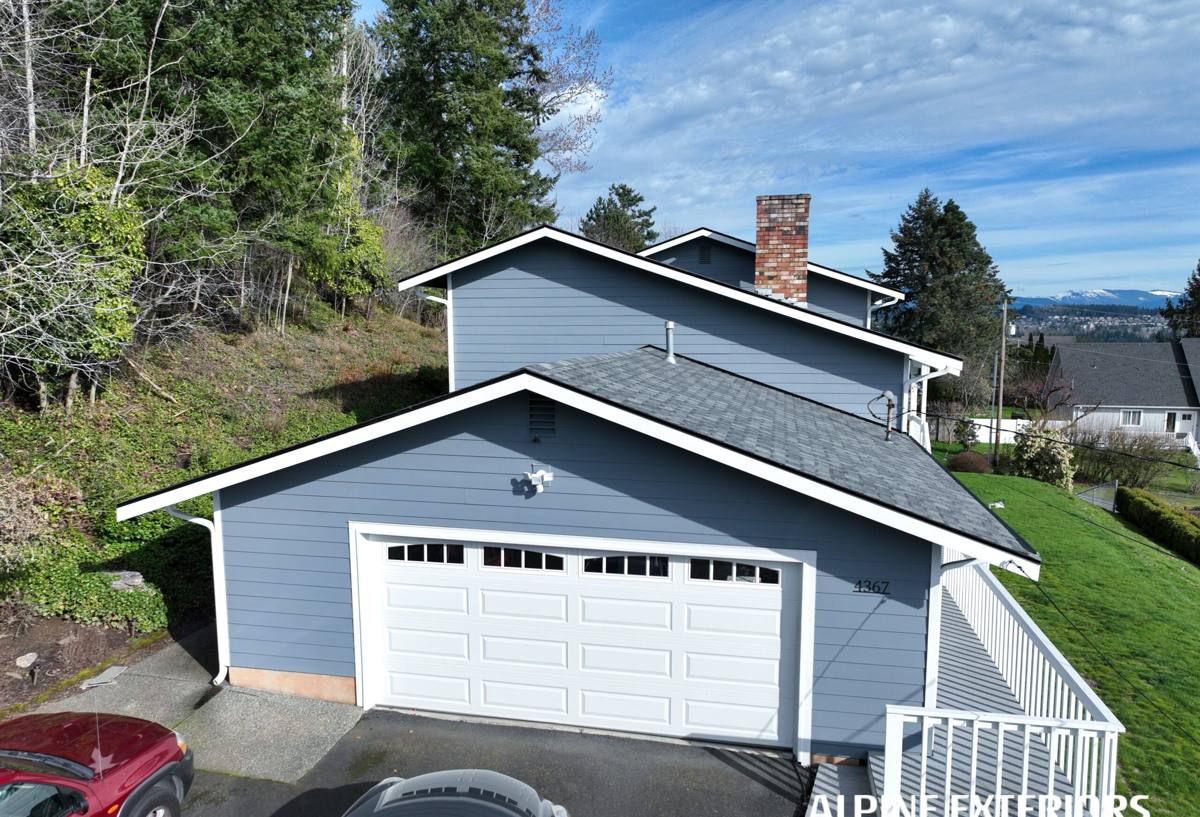
Signs a Sumas Roof Needs Full Replacement, Not Another Repair
Homeowners often ask us to patch a leak and end up learning the roof has passed the point where patching makes financial sense. A few signs point toward replacement rather than repair:
- Granule loss heavy enough that you can see bare asphalt on multiple slopes, not just one weathered section
- Shingles that are cupping, curling, or cracking across a wide area rather than in one isolated spot
- Moss or algae growth that has lifted shingle edges, allowing water to work underneath rather than run off
- Soft spots in the decking when walked, or daylight visible through the roof deck from the attic
- Repeated leaks in different locations each winter, which usually means the underlayment has failed, not just the shingles
- A roof that is already past 20-25 years old for asphalt composition shingle, given how much faster moss and moisture shorten lifespan here compared to a drier region
If only one of these applies and the roof is otherwise sound, a targeted repair is often the honest answer. We'll tell you that plainly rather than sell a full tear-off you don't need yet.
What a Correct Roof Replacement Actually Involves
A roof replacement is not just stripping old shingles and nailing down new ones. In a climate like Whatcom County's, several layers under the surface matter as much as the shingle itself.
Tear-Off and Deck Inspection
Every job starts with a full tear-off down to the decking, not an overlay on top of old shingles. Overlaying traps moisture and hides deck rot, which in a wet climate is a bad trade for saving a day of labor. Once the old roofing is off, we inspect every sheet of decking for soft spots, delamination, or water staining and replace what's compromised before anything new goes down.
Underlayment and Moisture Barrier
This is where a lot of the real weatherproofing happens, and it's the layer homeowners never see once the job is done. In a region with this much driving rain, we use synthetic underlayment rather than old-style felt paper — it holds up better to the extended exposure a roof gets during a multi-day tear-off and doesn't wick moisture the way felt can. Along eaves, valleys, and any low-slope transitions, an ice-and-water shield membrane goes down first as a second line of defense against wind-driven rain working its way up under the shingle tabs.
Ventilation
A roof that can't breathe traps moisture in the attic, and trapped moisture is what accelerates decking rot and encourages mold, regardless of how good the shingles are. We check intake at the soffits and exhaust at the ridge or through roof vents and correct the balance if the existing system was undersized — which is common on older Sumas homes that were built before current ventilation standards.
Flashing Details
Flashing around chimneys, skylights, sidewalls, and valleys is where most roof leaks actually originate, not in the open field of shingles. We replace flashing rather than reuse old pieces, and we pay particular attention to any point where the roof meets a wall or vertical surface, since that's where wind-driven rain finds its way in during a coastal storm.
Material Options for Sumas Homes
There isn't one right material for every house — it depends on your budget, your roof's slope and exposure, and how much long-term maintenance you're willing to take on. Here's how the common options compare for a home dealing with this region's rain, salt air, and moss pressure.
| Material | Typical Lifespan Here | Moss/Moisture Resistance | Relative Cost | Best For |
|---|---|---|---|---|
| Asphalt composition shingle (standard 3-tab) | 15-20 years | Fair — needs regular cleaning | Lowest | Budget-conscious replacements, rental properties |
| Asphalt architectural/laminate shingle | 20-30 years | Good, especially with algae-resistant granules | Moderate | Most Sumas homes — best balance of cost and durability |
| Metal roofing (standing seam or panel) | 40-50+ years | Excellent — sheds moss and water fast | Highest upfront | Homeowners planning to stay long-term or wanting minimal maintenance |
| Synthetic/composite shingle | 30-40 years | Very good | High | Homeowners wanting a shingle look with better moisture performance |
For most homes in and around Sumas, we point people toward an architectural shingle with algae-resistant (copper- or zinc-infused) granules. It costs more than a basic 3-tab shingle up front but resists the moss and algae staining that plagues shaded, north-facing roofs in this county, and it holds up noticeably better to the driving rain we get in fall and winter storms.
Our Roof Replacement Process
We keep the process straightforward and try not to surprise anyone once the crew is on the roof.
- On-site assessment. We walk the roof, check the attic for ventilation and moisture issues, and measure the actual scope — square footage, slope, number of valleys and penetrations.
- Written estimate. You get a clear breakdown of material, labor, and what's included — tear-off, disposal, underlayment upgrade, flashing replacement — so there's no vague "roof replacement" line item hiding decisions you didn't agree to.
- Scheduling around the weather. Given how much rain this area gets, we plan tear-off days around forecast windows and can dry-in a roof partway through if weather turns, rather than leaving decking exposed overnight.
- Tear-off and deck repair. Old roofing comes off, decking gets inspected and repaired as needed, and debris is hauled off site.
- Underlayment, flashing, and shingle installation. Each layer goes down to manufacturer specification, which matters for warranty coverage as much as for performance.
- Final walkthrough. We walk the finished roof and the attic with you, cover ventilation, and explain any basic maintenance specific to your material and roof layout.
Moss: The Maintenance Factor That's Different Here
Moss is not a cosmetic issue in this climate — it's a structural one if left alone. Moss holds moisture directly against the shingle surface and works its rhizoids under shingle edges over time, and on a shaded, north-facing slope in Sumas it can take hold within a couple of seasons of a roof going untreated. Once moss lifts a shingle edge, water gets underneath the shingle instead of running over it, which is a very different, faster path to a leak than simple granule wear.
A correctly installed roof reduces this risk but doesn't eliminate it — no material is fully moss-proof in a climate this wet for this much of the year. Zinc or copper ridge strips can help by releasing metal ions that wash down the roof in the rain and discourage regrowth. Beyond that, the simplest defense is a roof kept clear of overhanging branches and debris, and an annual or biannual soft-wash rather than pressure-washing, which can strip granules and shorten shingle life on its own.
Permits, Timeline, and What to Expect During the Job
Most residential roof replacements in this area require a building permit, and we handle that as part of the job rather than leaving it on the homeowner's plate. A typical single-family home tear-off and replacement runs one to three days depending on roof size and complexity — steep pitches, multiple valleys, and dormers all add time. Weather is the biggest variable in Whatcom County; we build a buffer into scheduling because a roof that's partway torn off is not a place to gamble on a dry forecast that doesn't hold.
During the job you should expect noise, debris in the yard staging area (we protect landscaping and clean up daily, not just at the end), and vibration through the house during tear-off. We'll walk you through what to expect for your specific roof before the crew shows up so there are no surprises on day one.
Questions to Ask Before Hiring a Roofing Crew in Sumas
Roofing draws its share of storm-chasing crews that show up after a bad windstorm and are gone by the time a warranty issue turns up. A few questions separate a crew that's actually set up to stand behind the work from one that isn't:
- Are you licensed and insured to work in Washington, and can you provide proof, not just tell me you are?
- Do you carry workers' compensation coverage for your crew?
- Is the estimate itemized — tear-off, disposal, underlayment, flashing, shingles — or is it one lump number?
- What's the workmanship warranty, separate from the manufacturer's material warranty, and how long is it?
- Do you have a permanent local presence, or are you traveling in for storm work?
- Who do I call if there's a problem two years from now, and will that person still be reachable?
A local crew that answers these plainly, without hedging, is usually the safer bet — not because a traveling crew can't do quality work, but because accountability gets a lot harder once they've left the area.
Why Working With a Crew That Already Knows Sumas Matters
A roofer who works this specific corner of Whatcom County regularly already knows which slopes in the area hold moss the longest, how far inland the driving rain problem actually reaches, and which underlayment and flashing choices have held up over time versus which ones haven't. That's not something you get from a national franchise pricing sheet — it comes from doing the work here, season after season, and seeing which roofs come back for repairs and which ones don't. We'd rather build that roof correctly the first time, with materials matched to this climate, than have you calling us back in five years about the same moss and leak problems a properly specified roof would have avoided.
If your roof in Sumas is showing its age or you're just trying to plan ahead before the wet season sets in, we're happy to take a look and give you a straightforward assessment — no pressure, no inflated urgency. Request a free estimate through the form below and we'll get you a clear picture of what your roof actually needs.